Why India Has Multiple Border Disputes
Context
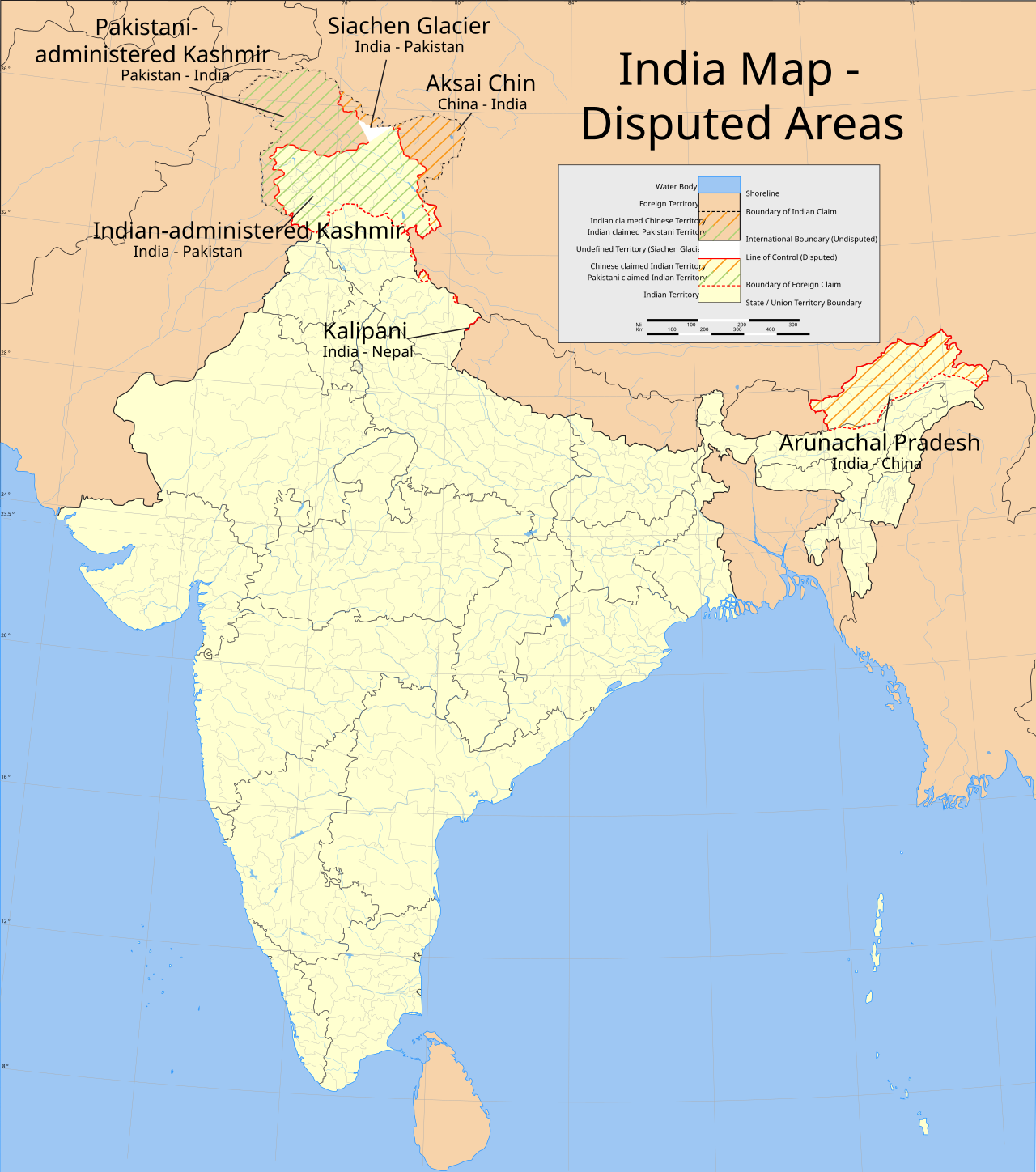
India shares around 15,106.7 km of international land boundaries with seven countries, including several historically disputed or unsettled sectors. These disputes reflect the interaction of inherited colonial boundaries, difficult geography, competing legal interpretations, strategic interests and domestic political constraints.
Colonial Legacy and Unclear Boundary-Making
- Frontier-to-boundary transition: Pre-modern borders often functioned as broad frontier zones rather than precise lines; colonial efforts to convert them into fixed boundaries remained incomplete in some regions.
- Competing colonial alignments: Different British-era proposals placed territories such as Aksai Chin differently; India and China later inherited conflicting territorial interpretations.
- Ambiguous historical records: Treaties, surveys and administrative documents were sometimes incomplete or inconsistent, allowing neighbouring states to rely on different historical evidence for their claims.
Geography and Technical Demarcation
- Himalayan terrain: High mountains, glaciers and sparsely inhabited regions historically limited accurate surveying; therefore, differing perceptions of the boundary could persist.
- River boundaries: Rivers may have several headwaters or change course; the Kalapani–Limpiyadhura dispute reflects disagreement over the source of the Kali River mentioned in the Treaty of Sugauli, 1816.
- Tidal boundaries: In Sir Creek, differing interpretations of the boundary through a shifting tidal channel affect not only land claims but also adjoining maritime entitlements.
Strategic, Legal and Political Constraints
- Strategic value: Disputed territories may control military routes, heights or connectivity; consequently, compromise involves security considerations beyond territorial area alone.
- Domestic political cost: Territorial concessions can be portrayed as surrender of national land, making compromise politically difficult for governments.
- Constitutional requirement: In the Berubari Union case (1960), the Supreme Court held that cession of Indian territory requires a constitutional amendment, adding a legal hurdle to territorial settlement.
- National claims: Once territorial positions become embedded in official maps and political narratives, governments face greater difficulty modifying them without domestic opposition.
Internal Boundary Disputes: A Parallel
- Assam–Mizoram: Competing colonial-era notifications continue to influence rival boundary claims, showing how historical administrative lines can generate modern disputes.
- Maharashtra–Karnataka: The dispute over Belagavi and adjoining areas emerged from linguistic reorganisation and competing territorial claims after 1956.
- These internal cases show that unclear historical records and political identity—not merely hostile neighbours—can sustain territorial disputes.
Lessons for Resolution
- Joint clarification: Shared surveys, maps and agreed coordinates can reduce differing territorial perceptions and prevent accidental confrontation.
- Institutional dialogue: Diplomatic negotiations, military-level talks and confidence-building measures can manage disputes even before a final boundary settlement.
- India–Bangladesh precedent: The 2015 Land Boundary Agreement exchanged 111 Indian enclaves in Bangladesh and 51 Bangladeshi enclaves in India, resolving a long-standing anomaly through bilateral negotiation and constitutional amendment.
- Political consensus: Durable settlements require broad domestic acceptance so that territorial compromise is viewed as dispute resolution rather than unilateral concession.
FAQs
Q1. What is the difference between a frontier and a boundary?
A frontier is a broad transitional zone, while a boundary is a legally defined territorial line.
Q2. What is the Line of Actual Control?
It separates areas under Indian and Chinese control but is not a mutually agreed international boundary.
Q3. Which treaty is central to the India–Nepal Kalapani dispute?
The Treaty of Sugauli, 1816.
Q4. Why is the Berubari case important?
It established that cession of Indian territory requires a constitutional amendment.
Q5. Which agreement resolved the India–Bangladesh enclave issue?
The 2015 implementation of the Land Boundary Agreement.