Delhi Police Protest, Article 33 and Restrictions on Fundamental Rights
Context
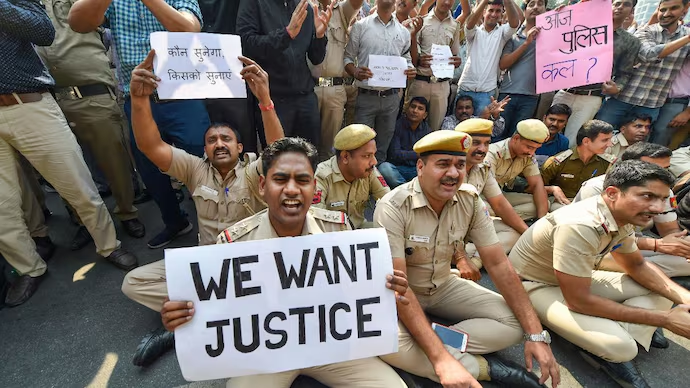
In November 2026, Delhi Police personnel protested outside Police Headquarters after the transfer of two officers following a dispute involving lawyers at Shahdara Police Station. Soon after, ACP Manasvi Vashistha was suspended under Rule 10 of the CCS (CCA) Rules, 1965, reviving debate over the constitutional rights and grievance mechanisms available to police personnel.
Article 33: Constitutional Basis
- Special power of Parliament: Article 33 empowers Parliament to restrict or abrogate specified Fundamental Rights of the Armed Forces, forces maintaining public order and certain intelligence personnel; this allows stricter service discipline.
- Limited objective: Such restrictions must relate to the proper discharge of duties and maintenance of discipline, preventing Article 33 from becoming a general denial of constitutional rights.
- Law required: Article 33 provides the constitutional authority, but Parliament must enact a specific law to operationalise such restrictions.
Police Forces (Restriction of Rights) Act, 1966
- Association restrictions: Section 3 restricts police personnel from joining trade unions, labour unions or political associations without prescribed sanction; this supports institutional and political neutrality.
- Demonstrations and communication: The Act restricts participation in meetings or demonstrations organised for political or other prescribed purposes and limits unauthorised communication with the press; this narrows ordinary protest and expression rights in the interest of discipline.
- Penalty: Contravention can attract imprisonment of up to two years, a fine of up to ₹2,000, or both under Section 4.
Why Are Such Restrictions Considered Necessary?
- Chain of command: Police operate through a strict hierarchy; unrestricted collective agitation can disrupt operational discipline.
- Political neutrality: Restrictions on political association reduce the risk of partisan policing and support impartial enforcement of law.
- Public-order responsibility: Since police regulate assemblies and protests themselves, service-related agitation can create conflict between personal grievance and official duty.
- Public confidence: A disciplined and politically neutral force is essential for maintaining trust in law-enforcement institutions.
Police Grievances and Reform Mechanisms
- Need for internal redressal: Restrictions on protest do not eliminate legitimate concerns over transfers, workload, working conditions or disciplinary treatment; effective grievance mechanisms are therefore necessary.
- Police Establishment Board: In Prakash Singh v. Union of India (2006), the Supreme Court directed creation of such Boards for transfers, postings and promotions of specified ranks, reducing arbitrary interference.
- Police Complaints Authority: The same judgment called for independent authorities to examine serious complaints against police personnel, strengthening accountability.
- Institutional balance: Police reform must combine discipline, autonomy and grievance redressal, rather than treating restrictions on protest as a substitute for reform.
Lawyers and the Right to Strike
- In Ex-Capt. Harish Uppal v. Union of India (2002), the Supreme Court held that lawyers have no general right to strike or boycott courts, because such action disrupts administration of justice.
- Thus, both police personnel and lawyers face professional restrictions, but the legal basis differs—Article 33 and statutory discipline for police, and professional duties towards courts and litigants for lawyers.
Significance
- Rights–discipline balance: Article 33 shows that Fundamental Rights may be specially restricted where disciplined public services require uninterrupted functioning.
- Police reform imperative: Since street protest is legally constrained, credible internal grievance and oversight mechanisms become more important.
- Institutional neutrality: Restrictions seek to preserve non-partisan policing, while police reforms aim to protect the force from undue external interference.
- Rule of law: Effective policing requires both professional autonomy and accountability, not one at the cost of the other.
FAQs
Q1. Which Article allows restriction of Fundamental Rights of police personnel?
Article 33.
Q2. Which law specifically restricts certain rights of police personnel?
The Police Forces (Restriction of Rights) Act, 1966.
Q3. Under which rule was the Delhi ACP suspended?
Rule 10 of the CCS (CCA) Rules, 1965.
Q4. Which case laid down major police-reform directives?
Prakash Singh v. Union of India (2006).
Q5. Do lawyers have a right to strike?
No. In Ex-Capt. Harish Uppal v. Union of India (2002), the Supreme Court held that lawyers have no general right to strike or boycott courts.