MLC Elections: How Legislative Council Elections Work
Context
Recent Legislative Council elections in Uttar Pradesh, Bihar, Maharashtra and Karnataka have brought renewed attention to how Members of Legislative Councils (MLCs) are elected. Unlike Assembly elections, MLC polls involve different electorates and preferential voting, making their electoral mechanism distinctive.
Legislative Council: Constitutional Framework
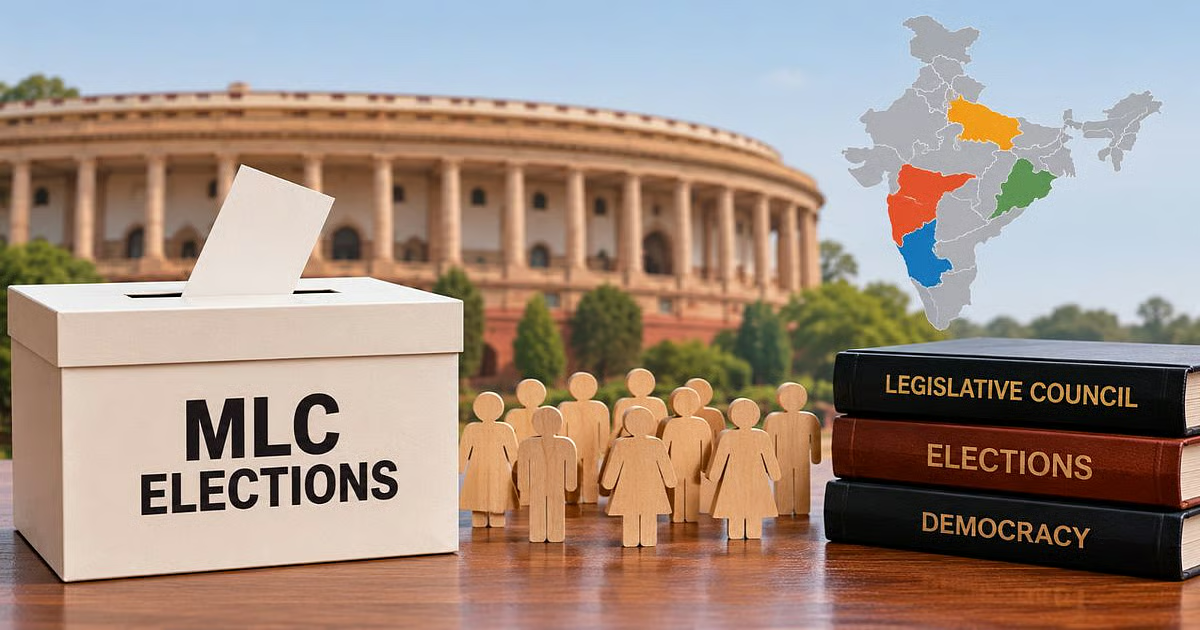
- State Upper House: A Legislative Council is the second chamber of a bicameral State Legislature under Article 168; currently, six States have one—Andhra Pradesh, Bihar, Karnataka, Maharashtra, Telangana and Uttar Pradesh.
- Creation or abolition: Under Article 169, Parliament may create or abolish a Council after the concerned Assembly passes a resolution by a majority of its total membership and at least two-thirds of members present and voting.
- Strength: Under Article 171, membership cannot exceed one-third of the Assembly’s strength and ordinarily cannot be below 40 members.
- Continuing chamber: MLCs serve six-year terms, with roughly one-third retiring every two years; hence the Council is not dissolved as a whole.
Who Elects the MLCs?
Article 171 creates multiple electorates rather than one common electorate:
- One-third: Elected by members of specified local authorities.
- One-third: Elected by members of the State Legislative Assembly.
- One-twelfth: Elected by registered graduates meeting prescribed conditions.
- One-twelfth: Elected by eligible teachers of specified educational institutions.
- Remaining members: Nominated by the Governor from persons with special knowledge or practical experience in literature, science, art, cooperative movement and social service.
This mixed composition gives local institutions, professionals and the Assembly representation in the State’s second chamber.
How Does the Election Work?
- Preferential voting: Elected MLCs are chosen through proportional representation by Single Transferable Vote (STV); voters rank candidates in order of preference.
- Quota system: Candidates must secure a prescribed quota; surplus and transferable preferences are redistributed until the required seats are filled.
- Ballot paper: MLC elections use ballot papers, as voters must indicate multiple preferences.
- Secret ballot: Unlike Rajya Sabha elections by MLAs, MLC elections use a secret ballot, preserving voter confidentiality.
Issues in Legislative Councils
- Weak legislative power: A Council can delay ordinary legislation but cannot permanently block it; therefore, its ability to independently shape State legislation remains limited.
- Indirect democratic mandate: Most members are elected by restricted electorates such as MLAs, local bodies, teachers and graduates rather than by universal adult franchise, raising questions about representativeness.
- Political rehabilitation: Critics argue that Councils can sometimes be used to accommodate politicians who could not enter the Assembly, weakening their intended role as deliberative chambers.
- Additional cost: Maintaining a second chamber requires separate members, staff and institutional expenditure; its value therefore depends on whether it substantially improves legislative scrutiny.
- Variable relevance: Since only six States retain Councils and Article 169 allows their creation or abolition, their usefulness remains dependent on each State’s political and institutional context.
Legislative Council vs Rajya Sabha
- Both are continuing upper chambers, with six-year terms and periodic retirement of members.
- However, a Legislative Council may be created or abolished under Article 169, while the Rajya Sabha is a permanent constitutional institution.
- Rajya Sabha has significantly greater legislative and federal importance, whereas a Legislative Council primarily performs a revising and deliberative role.
FAQs
Q1. Which Article deals with the composition of Legislative Councils?
Article 171.
Q2. How many States currently have Legislative Councils?
Six States.
Q3. What voting system is used in MLC elections?
Proportional representation by Single Transferable Vote.
Q4. Are all MLCs directly elected by the public?
No. Different categories are elected by MLAs, local authorities, graduates and teachers, while some are nominated.
Q5. Is an MLC election an open ballot like a Rajya Sabha election?
No. MLC elections use secret ballots.