Context
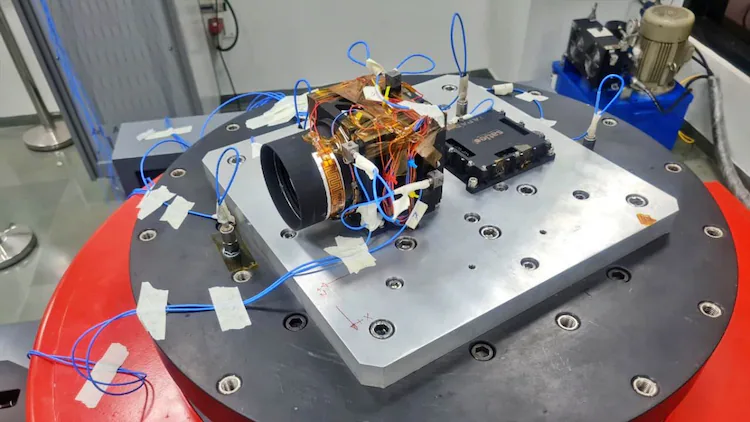
India’s private space sector has developed TAPAS-1, a specialised commercial payload designed for thermal observation of the Earth’s surface.
About TAPAS-1
- TAPAS stands for Thermal Access Platform for Analytics & Solutions.
- It was developed by Satleo Labs, an Ahmedabad-based space-technology startup.
- The payload was deployed aboard SpaceX’s Falcon 9 rocket.
- It has been placed in an orbit approximately 500 km above Earth and weighs 1.5 kg.
- It belongs to the CubeSat category, with such platforms typically based on 10 cm × 10 cm × 10 cm units.
Thermal-Imaging Capability
- TAPAS-1 uses Long-Wave Infrared (LWIR) sensing to capture thermal information from the Earth’s surface.
- The technology detects temperature variations that may not be visible in conventional optical imagery.
- It is designed to generate high-resolution thermal images.
Applications
- Agriculture: Monitoring agricultural stress and water stress.
- Disaster Management: Detection and monitoring of forest fires.
- Urban Planning: Tracking temperature variations across urban areas to support measures addressing urban heat stress.
FAQs
- What does TAPAS stand for?
TAPAS stands for Thermal Access Platform for Analytics & Solutions. - What is a thermal-imaging payload?
It is an instrument designed to capture information related to thermal radiation and temperature conditions of an observed surface. - What does LWIR mean?
LWIR stands for Long-Wave Infrared, the infrared sensing range used by TAPAS-1 to obtain thermal information. - How does thermal imagery differ from conventional optical imagery?
Thermal imagery provides information associated with surface temperature, while conventional optical imagery primarily records reflected radiation. - What is a CubeSat?
A CubeSat is a category of compact nanosatellite platform based on standardised small satellite units. - Why are compact payloads useful for specialised space missions?
Their relatively small size and mass can facilitate the development and deployment of mission-specific instruments for focused applications. - What does private-sector participation add to Earth observation?
It broadens the range of commercially developed space-based observation capabilities and supports specialised applications of satellite technology.