Context
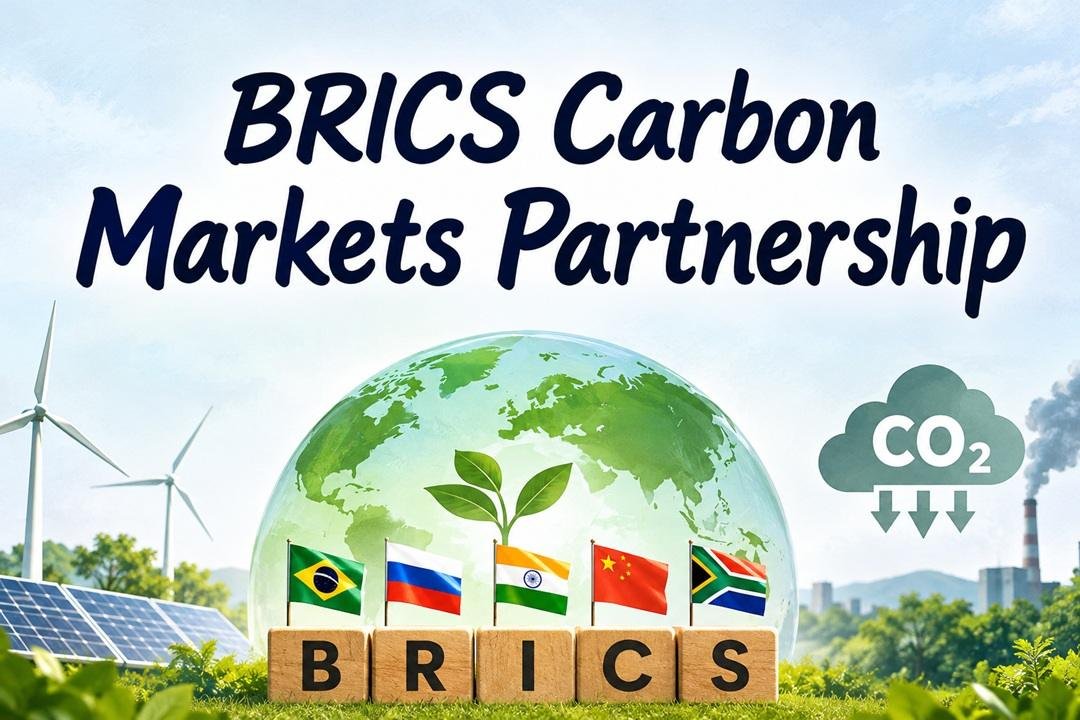
The BRICS Carbon Markets Partnership has gained renewed attention following the 18th BRICS Summit 2026, with emphasis on developing a common carbon market rulebook, capacity building and knowledge sharing, while opposing unilateral carbon border measures like the EU’s CBAM.
About BRICS Carbon Markets Partnership
- Establishment: An MoU signed in 2024 under Russia’s BRICS chairship.
- Objective: Promote cooperation, capacity building and exchange of experiences in carbon markets.
- Carbon Market: A system for trading emission allowances or carbon credits to encourage greenhouse gas reductions.
- Carbon Credit: Generally represents one tonne of carbon dioxide equivalent (CO₂e) reduced, removed or avoided under an approved methodology.
- Current Status: A cooperation framework, not a unified BRICS carbon trading platform.
Why BRICS Carbon Markets Matter
- Global Share: About 8 BRICS members run voluntary carbon markets; Brazil, China, India, and Indonesia together hold over one-third of global carbon-credit projects.
- China: Its ETS (Emissions Trading System) covers steel, cement, and aluminium.
- India: The CCTS (Carbon Credit Trading Scheme) sets binding emission-intensity targets (emissions per unit of output) for ~490 entities across seven sectors, plus a voluntary offset mechanism.
- Brazil: Created the SBCE (Brazilian Greenhouse Gas Emissions Trading System) in 2024, based on a fixed absolute emissions cap.
- Core Problem: BRICS carbon markets operate separately, blocking cross-border carbon-credit trade.
Differences in National Carbon Markets
| Feature | China | India | Brazil |
| Emission Limit Type | Emission-intensity target | Emission-intensity target | Absolute emissions cap (fixed total limit) |
| Offset Rules | Accepts domestic certified credits | Allows projects started after 1 Jan 2025 | Needs approved methods |
| Regulator | Environmental & market regulators | Traded on power exchanges under CERC (Central Electricity Regulatory Commission) | Regulated by securities regulators |
Key Issue: Different rules and laws make it hard for BRICS countries to recognise each other’s carbon credits.
External Pressure: Carbon Border Taxes
- EU’s CBAM (European Union’s Carbon Border Adjustment Mechanism): Entered its full tax-paying phase on 1 January 2026, covering steel, aluminium, cement, fertilisers, hydrogen, and electricity.
- UK’s CBAM (United Kingdom’s Carbon Border Adjustment Mechanism): Starts on 1 January 2027.
- Carbon Price Relief: Exporters get discounts for carbon prices already paid at home only with verified emissions data; otherwise, higher default taxes apply.
- India–UK Deal: In September 2026, the UK recognised India’s CCTS, allowing Indian exporters carbon-tax relief from 2027.
- BRICS Advantage: Common carbon rules cut compliance costs for exporters and boost joint bargaining power against foreign green taxes.
Challenges to BRICS Carbon Market Integration
- Market Dominance: China’s massive carbon market could sway carbon-credit prices, putting smaller member countries at a disadvantage.
- Geopolitical Barriers: International sanctions on some members (like Russia and Iran) complicate cross-border payments and money transfers.
- Trade Competition: Rivalry in export-heavy industries like steel and aluminium can hold back close cooperation.
- Regulatory Differences: Varying domestic rules—such as emission-intensity targets (used by India and China) versus fixed emission caps (used by Brazil)—make linking markets difficult.
Way Forward
- Common Rulebook: Set uniform MRV (Measurement, Reporting, and Verification) standards, mutually recognise approved verifiers, and link digital registries to stop double counting (counting the same emission cut twice).
- Existing Framework: Build on the 2025 BRICS Principles for Fair, Inclusive and Transparent Carbon Accounting, supported by standards such as ISO 14064, while preserving national regulatory autonomy.
- Pilot Carbon Trading: Test limited carbon-credit trades among select BRICS nations under Article 6.2 of the Paris Agreement (which allows cross-border climate cooperation).
- ITMOs (Internationally Transferred Mitigation Outcomes): Trade credits as ITMOs with corresponding adjustments (subtracting sold credits from the seller’s national climate goal) to maintain climate credibility.
- Role of NDB (New Development Bank): Use the NDB to run a shared carbon-credit registry, buy pilot credits, and fund climate adaptation projects.
- Step-by-Step Rollout: Start with 2–3 member countries using capped (limited) trades to fix legal and financial hurdles before expanding across all BRICS members.
FAQs
Q1. What is the BRICS Carbon Markets Partnership?
Ans. A 2024 MoU promoting carbon market cooperation, capacity building and knowledge sharing among BRICS members.
Q2. Why are BRICS carbon markets not linked?
Ans. Differences in emission targets, offset eligibility, accounting standards and legal frameworks.
Q3. What is MRV?
Ans. Measurement, Reporting and Verification, a system for measuring, reporting and independently verifying emission reductions.
Q4. What is CBAM?
Ans. The EU’s Carbon Border Adjustment Mechanism, which applies carbon pricing to certain imports based on their embedded emissions.
Q5. What is Article 6.2 of the Paris Agreement?
Ans. Allows international transfers of mitigation outcomes (ITMOs) with corresponding adjustments to prevent double counting.