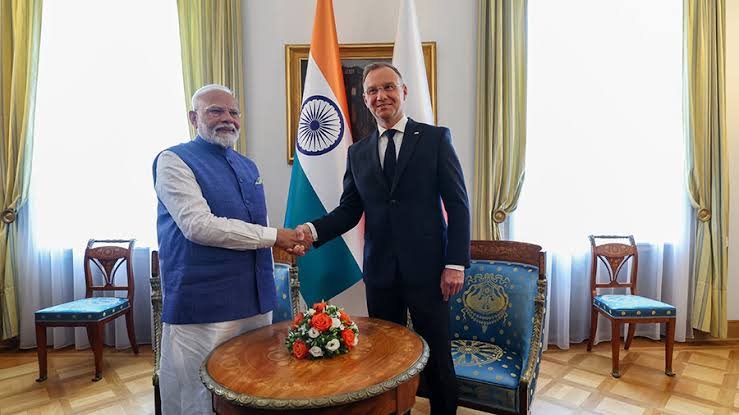
Context
Polish Prime Minister Donald Tusk’s visit to India from 21 to 23 October 2026 offers an opportunity to strengthen bilateral ties. Both countries are working to implement the Strategic Partnership established in August 2024 and aim to increase bilateral trade from around USD 6 billion to USD 10 billion. The proposed India–European Union free trade agreement could further support this growth.
Background of Relations
- Diplomatic relations: India and Poland established diplomatic relations in 1954. Jawaharlal Nehru visited Poland in 1955.
- Poland and the EU: Poland’s entry into the European Union in 2004 increased its importance as a partner for India in Central Europe.
- Strategic Partnership: The Indian Prime Minister visited Poland in 2024, the first such visit in 45 years. The visit elevated bilateral relations to a Strategic Partnership.
- Action Plan 2024–2028: The five-year plan covers defence, trade, agricultural technology, energy, green technology, mining and pharmaceuticals.
- Existing agreements: The two countries have agreements covering taxation, defence, extradition, counter-terrorism and agriculture.
- Social security: A 2024 agreement supports the movement of skilled workers between the two countries.
Significance of Poland for India
- Gateway to Central Europe: Poland is one of the larger EU economies and can help Indian businesses expand into Central and Eastern Europe.
- Regional groupings: Close relations with Poland can strengthen India’s engagement with the Visegrad Group and the Three Seas Initiative.
- Trade and investment: Bilateral trade grew from USD 1.95 billion in 2013 to USD 5.72 billion in 2023. Poland is India’s largest trade partner in Central Europe, and Indian companies use it as a base for serving the EU market.
- Manufacturing and technology: Indian companies have invested in Poland, particularly in IT, engineering and manufacturing.
- Defence cooperation: Existing defence arrangements and a Joint Working Group provide opportunities for equipment modernisation, maintenance and possible co-production.
- Support during crises: Poland helped evacuate Indian citizens from Ukraine in 2022.
- Historical goodwill: Indian princely states sheltered Polish refugees during the Second World War, creating a lasting people-to-people connection.
Key Areas of Cooperation
- Trade and investment: Both countries aim to raise bilateral trade to USD 10 billion. The India–EU free trade agreement may improve market access if signed and implemented.
- Defence: Cooperation could include maintenance and modernisation of equipment, training and co-production.
- Technology and innovation: IT, engineering, startups and financial technology offer scope for partnerships.
- Agriculture and food processing: Poland’s experience in cold storage and food value chains could help reduce food losses in India.
- Energy and green technology: The countries can explore cooperation in green hydrogen, electric mobility and clean technologies.
- Skills and mobility: The social security agreement can support skilled workers and improve coordination on social security matters.
- Connectivity: More direct air links can support tourism, business travel and investment.
- Regional and global issues: Both sides can discuss disaster resilience, infrastructure and possible cooperation in Ukraine’s future reconstruction.
Challenges in Bilateral Relations
- Different views on Ukraine: India has pursued a balanced approach, while Poland strongly supports Ukraine and is critical of Russia.
- Trade imbalance: India exports more to Poland than it imports, and Poland has sought a more balanced trade relationship.
- EU regulatory barriers: Food safety and plant and animal health standards can make it difficult for some Indian products to enter European markets.
- Complex approvals: Regulatory requirements can slow pharmaceutical exports and the entry of traditional medicine products.
- Slow implementation: Bureaucratic delays and limited business awareness can prevent agreements from becoming actual projects.
- Limited connectivity: Insufficient direct air connections can constrain business, tourism and people-to-people exchanges.
- Uncertain trade benefits: The benefits of the India–EU trade agreement depend on its signing, implementation and effective use by businesses.
Existing Initiatives
- Strategic Partnership (2024): Provides a framework for regular dialogue and broader cooperation.
- Joint Action Plan 2024–2028: Sets priorities across economic, technological and strategic sectors.
- Joint Working Group on Defence: Provides a platform to discuss defence industry cooperation and equipment modernisation.
- Joint Commission on Economic Cooperation: Reviews trade and investment issues and explores ways to address barriers.
- International cooperation: India has invited Poland to join the International Solar Alliance and the Coalition for Disaster Resilient Infrastructure.
- Business engagement and air links: Business forums and improved direct air connectivity can help convert political commitments into practical cooperation.
Way Forward
- Turn agreements into outcomes: Set clear timelines, measurable targets and regular reviews for projects under the Action Plan.
- Expand trade: Help companies understand standards and market-entry requirements, and ensure any India–EU trade agreement is implemented effectively.
- Promote defence cooperation: Explore feasible projects in maintenance, modernisation and co-production, while safeguarding India’s strategic interests.
- Strengthen connectivity: Improve direct air links and business-to-business exchanges.
- Deepen green and technology partnerships: Support joint research in clean energy, electric mobility, digital technology and fintech.
- Improve agricultural value chains: Share expertise in cold storage, food processing and reducing post-harvest losses.
- Maintain regular dialogue: Continue consultations on Ukraine and other international issues while respecting differences in national positions.
- Resolve investment barriers: A dedicated mechanism to address regulatory and administrative issues can help turn announcements into actual investment.
Conclusion
India–Poland relations have the potential to move from historical goodwill to a stronger partnership in trade, defence, technology and green development. Better connectivity, timely implementation of agreements and regular dialogue can help both countries expand cooperation while managing differences in their international outlook.
FAQs
Q1. When were bilateral relations upgraded to a Strategic Partnership?
Ans: During the Indian Prime Minister’s visit to Poland in August 2024.
Q2. What is the Visegrad Group?
Ans: A regional grouping comprising Poland, Hungary, Czechia and Slovakia.
Q3. What is the Three Seas Initiative?
Ans: A regional initiative focused on improving energy, transport and digital links between countries in Central and Eastern Europe.
Q4. What is the India–EU free trade agreement intended to do?
Ans: It aims to reduce trade barriers and improve market access. Its timing and benefits depend on formal completion and implementation.