Context
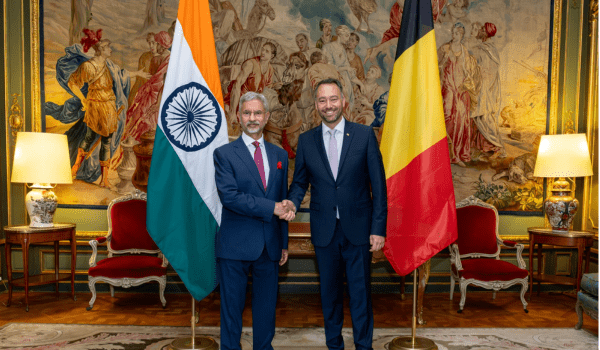
- Belgian Prime Minister Bart De Wever visited India, marking the first visit by a Belgian Prime Minister to India in two decades.
- India and Belgium agreed to deepen cooperation in defence, intelligence-sharing, trade, semiconductors, fintech, renewable energy and maritime security.
Economic Relations
- The India–Belgium–Luxembourg Economic Union Joint Commission, established in 1997, provides an institutional framework for economic cooperation.
- Bilateral trade stood at around US$13.01 billion in 2025–26.
- Antwerp is a major global diamond-trading centre and has strong commercial links with India’s diamond-processing centres, particularly Mumbai and Surat.
- Belgian investment in India was around US$4.2 billion between April 2000 and December 2025.
- Economic engagement is expanding beyond diamonds into pharmaceuticals, chemicals, defence manufacturing, semiconductors, fintech and renewable energy.
- The two countries aim to double bilateral trade within five years and facilitate investment through an Investment Fast Track mechanism and regular business engagement.
Defence and Security Cooperation
- India and Belgium finalised a Letter of Intent to strengthen defence cooperation.
- Key areas include:
- Military training and exchanges
- Research and development
- Joint exercises and seminars
- Maritime security
- Defence-industrial cooperation
- Around 15 Belgian defence companies are engaged in discussions with Indian partners.
- Potential cooperation covers drones, rockets, ammunition, mine-countermeasure systems, radar, electro-optical systems, counter-drone technologies and armoured platforms.
- The partnership also includes intelligence-sharing and cooperation between security agencies.
Maritime Security Cooperation
- India and Belgium are exploring cooperation in mine-countermeasure systems, autonomous maritime systems, underwater robotics and advanced sensors.
- These technologies have applications in protecting ports, pipelines, subsea cables and other critical maritime infrastructure.
- Such cooperation can contribute to the security and resilience of international maritime trade and supply chains.
Technology and Emerging Sectors
- Semiconductors have emerged as an important area of bilateral technological cooperation.
- Cooperation in fintech and regulatory coordination can strengthen financial-sector linkages and support innovation.
- Partnership in renewable energy can contribute to clean-energy development and the broader energy transition.
Strategic Significance for India
- Diversification of bilateral ties: The relationship is moving beyond its traditional focus on diamonds and trade towards technology, defence and strategic sectors.
- Defence industrialisation: Belgian technological capabilities can complement India’s manufacturing base and support joint production and technology cooperation.
- Maritime resilience: Cooperation in advanced maritime systems can strengthen the protection of critical infrastructure and sea-based trade.
- Technology and investment: Engagement in semiconductors, fintech and renewable energy creates opportunities for technology exchange, investment and industrial development.
- Broader European engagement: Stronger ties with Belgium can support India’s wider economic and strategic engagement with Europe.
Global and Regional Cooperation
- India and Belgium have discussed major international developments, including the situations in Ukraine and West Asia.
- Both sides emphasise dialogue, diplomacy, international law and the UN Charter in addressing international conflicts.
- Cooperation also focuses on maintaining safe and uninterrupted maritime shipping.
Way Forward
- Diversify trade by expanding cooperation beyond traditional sectors.
- Promote defence co-development and co-production with greater emphasis on technology and industrial capabilities.
- Deepen emerging-technology partnerships in semiconductors, fintech and renewable energy.
- Strengthen investment facilitation through effective use of the Investment Fast Track mechanism.
- Expand maritime technology cooperation for protection of critical infrastructure and maritime trade.
- Enhance intelligence and security cooperation to address evolving security challenges.
Conclusion
India–Belgium relations are evolving from a traditional trade and diamond-based partnership into a broader economic, technological and strategic relationship. Greater cooperation in defence manufacturing, maritime security, semiconductors, fintech and renewable energy can strengthen India’s industrial capabilities while creating new avenues for trade, investment and strategic cooperation.
FAQs
- What is the traditional foundation of India–Belgium economic relations?
Diamond trade has been a major traditional component, with Antwerp playing an important role in the global diamond industry and maintaining strong links with Mumbai and Surat. - What is the current bilateral trade value between India and Belgium?
Bilateral trade was around US$13.01 billion in 2025–26. The two countries aim to double trade within five years. - What are the major areas of India–Belgium defence cooperation?
They include military training and exchanges, R&D, joint exercises, maritime security and defence-industrial cooperation, along with intelligence-sharing. - Why is Belgium important for India’s defence-industrial cooperation?
Belgian expertise in specialised defence technologies can complement India’s manufacturing capabilities and create opportunities for joint production and technology cooperation. - Why is maritime cooperation important in India–Belgium relations?
Cooperation in autonomous maritime systems, underwater robotics, mine-countermeasure systems and advanced sensors can improve the protection of critical maritime infrastructure and trade routes. - Which emerging sectors are gaining importance in bilateral relations?
Key areas include semiconductors, fintech, renewable energy, advanced defence technologies and maritime systems. - What is the significance of the India–Belgium–Luxembourg Economic Union Joint Commission?
Established in 1997, it provides an institutional mechanism for promoting and facilitating economic cooperation.