Context
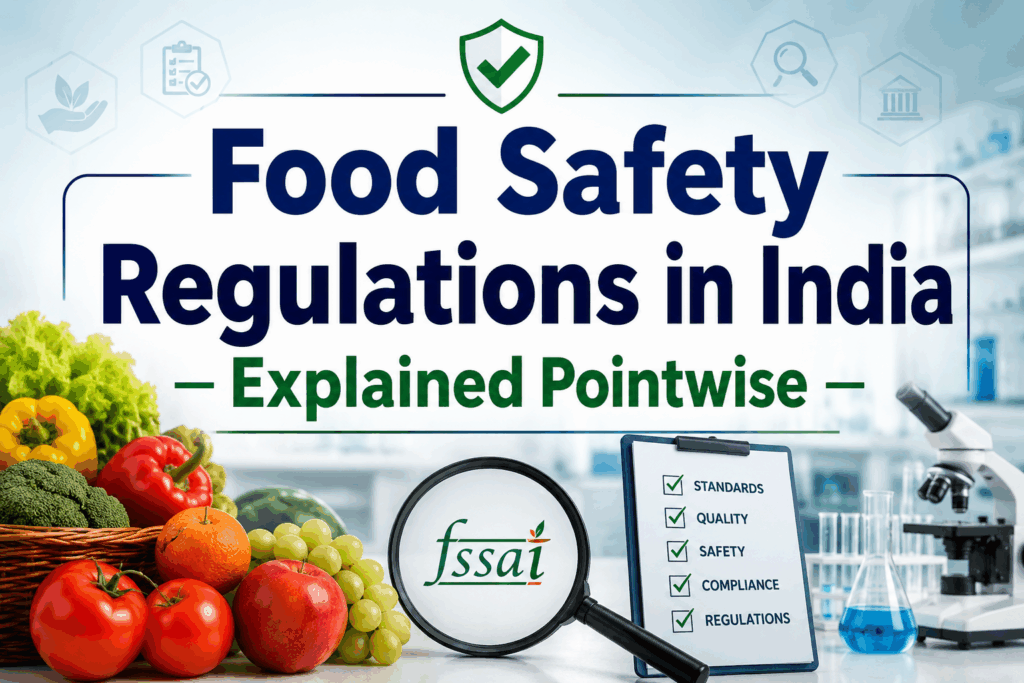
The Food Safety and Standards Authority of India (FSSAI) recently sanctioned prosecution against Bisleri International over suspected chemical contamination in packaged drinking water. Separately, the Maharashtra Government withdrew its Bombay High Court petition challenging FSSAI’s enforcement powers, highlighting concerns over food safety regulation and Centre–State coordination.
About FSSAI (Food Safety and Standards Authority of India)
- Establishment: An autonomous statutory body set up under the FSSA (Food Safety and Standards Act), 2006.
- Nodal Ministry: Functions under the MoHFW (Ministry of Health and Family Welfare).
- Core Objective: Ensure safe and wholesome food by regulating manufacture, processing, storage, distribution, sale, and import.
- Composition: Consists of a Chairperson and 22 members (with one-third women representation) under Section 5 of the FSSA, 2006.
- Regulatory Mandate: Sets uniform, science-based food safety standards across India.
Key Functions of FSSAI
- Food Standards & Licensing: Regulates FBOs (Food Business Operators) through registration and licensing, issuing a 14-digit FSSAI number.
- Quality & Safety Monitoring: Conducts regular inspections to detect food contamination, adulteration, and safety hazards.
- Scientific Risk Assessment: Carries out risk assessment, accredits food testing laboratories, and sets testing protocols.
- Policy Advisory: Advises Central and State Governments on framing food safety rules and nutrition policies.
- Consumer Awareness: Promotes food hygiene, healthy diets, and safe food handling among citizens and businesses.
Revised FSSAI Licensing Framework (Effective 1 April 2026)
| Licence Category | Annual Turnover Limit |
| FSSAI Registration | Up to ₹1.5 crore |
| State Licence | Above ₹1.5 crore to ₹50 crore |
| Central Licence | Above ₹50 crore |
(Note: Certain high-risk or specialised food businesses remain subject to specific eligibility conditions irrespective of turnover.)
Key Accompanying Reforms:
- Perpetual Validity: Registrations and licences remain valid permanently, subject to ongoing compliance and annual returns.
- Street Vendors: Grants deemed registration to eligible street vendors already registered with municipal bodies or TVCs (Town Vending Committees).
- Risk-Based Inspections: Focuses regulatory checks primarily on high-risk food businesses rather than routine burden on low-risk operators.
Major Initiatives of FSSAI
- Eat Right India Movement (2018): Flagship campaign promoting safe, healthy, and sustainable food across India.
- Save Food, Share Food, Share Joy: Connects food businesses with surplus food distribution agencies to cut food wastage.
- Clean Street Food Hub: Certifies street food clusters that meet hygiene, water quality, and sanitation benchmarks.
- RUCO (Repurpose Used Cooking Oil): Collects and converts used cooking oil into biodiesel and non-food industrial products to prevent harmful reuse.
- Jaivik Bharat: Unified certification logo helping consumers identify authentic organic food products.
- Diet4Life: Spreads awareness and provides dietary guidance for children with IEM (Inborn Errors of Metabolism).
- Aaj Se Thoda Kam: Mass awareness drive urging people to gradually cut down on salt, sugar, and trans/unhealthy fats.
Bisleri Packaged Drinking Water Controversy
- Initial Lab Finding: FSSAI approved prosecution after a sample from Bisleri’s Goa facility (Batch GO 270) showed bromate at 0.012 mg/L (milligrams per litre), crossing the safe limit.
- Referral Lab Finding: A second referral test found bromate within limits, but detected PAHs (Polynuclear Aromatic Hydrocarbons) at 0.000144 mg/L.
- Regulatory Action & Response: FSSAI restricted the sale of the affected batch and ordered a probe; Bisleri disputed the findings, noting the issue was isolated to one sample from Batch GO 270.
Major Chemical Contaminants
- Bromate ():
- Formation: Forms when ozone (used to disinfect water) reacts with naturally occurring bromide ions in water.
- Health Risks: Linked to potential cancer risk over long-term exposure and kidney damage at high doses.
- Permissible Limit & Control: Capped at 01 mg/L (10 µg/L) in packaged drinking water; prevented through controlled ozone dosing and bromide monitoring.
- PAHs (Polynuclear Aromatic Hydrocarbons):
- Nature & Sources: Organic compounds with multiple fused carbon rings formed mainly by incomplete burning of coal, oil, wood, or waste, entering water via industrial pollution or packaging/processing.
- Health Risks & Standard: Several PAHs are carcinogenic (cancer-causing) and mutagenic (DNA-damaging); must be not detectable in packaged drinking water under prescribed tests.
FSSAI vs Maharashtra FDA: Centre–State Jurisdiction Dispute
- Background: In 2026, Maharashtra’s FDA (Food and Drug Administration) petitioned the Bombay High Court, alleging FSSAI created a parallel enforcement system that curtailed State powers over centrally licensed food businesses; Maharashtra withdrew the petition on 21 November 2026 without a court ruling.
- Key Issues Raised by Maharashtra (Allegations, Not Judicial Findings):
- State Enforcement Role: Argued that the FSSA, 2006 gives primary field enforcement duties to State food safety authorities.
- Over-Centralisation: Questioned central control over Central Licensing Authorities, Food Safety Officers, and Food Analysts, challenging the 2011 Licensing Regulations, 2018 Recruitment Regulations, and 2026 amendments.
- Procedural Compliance: Alleged gaps in prior approval and public consultation rules under Section 23 of the General Clauses Act, 1897.
- FoSCoS (Food Safety Compliance System) Portal (2020): Contended that centralised digital licensing reduced State-level administrative oversight.
Significance of FSSAI
- Uniform National Standards: Replaced fragmented laws (like the Prevention of Food Adulteration Act, 1954) with a single science-based regulatory framework across States.
- Public Health & Nutrition: Curbs foodborne diseases, chemical adulteration, and non-communicable diseases through trans-fat limits and fortification norms.
- Ease of Doing Business: Digital licensing via FoSCoS, perpetual validity, and higher turnover thresholds reduce compliance burdens for MSMEs (Micro, Small and Medium Enterprises) and street vendors.
- Global Trade & Export Credibility: Aligning Indian standards with Codex Alimentarius boosts trust in Indian agricultural and processed food exports.
Key Challenges
- Manpower & Lab Deficit: Shortage of Food Safety Officers (FSOs) and NABL (National Accreditation Board for Testing and Calibration Laboratories)-accredited testing labs, particularly in smaller towns and rural districts.
- Vast Informal Food Sector: Regulating millions of unorganised street vendors, local dairies, and small eateries remains difficult.
- Centre–State Friction: Overlapping jurisdiction between Central and State licensing authorities creates enforcement delays.
- Inconsistent Lab Results: Conflicting test outcomes between primary and referral laboratories (as seen in the packaged water dispute) weaken prosecution and public trust.
Way Forward
- Strengthen Testing Infrastructure: Expand accredited food testing laboratories, rapid testing kits, and Food Safety on Wheels (mobile labs) across all districts with uniform testing protocols.
- Cooperative Federalism: Clarify Centre–State enforcement roles through joint consultative mechanisms to avoid jurisdictional disputes.
- Risk-Based Surveillance: Use data analytics to target high-risk categories (packaged water, milk, spices, edible oils) with surprise inspections and strict recalls.
- Transparent Rule-Making: Ensure mandatory stakeholder consultation and statutory compliance during regulatory amendments.
- Citizen Vigilance: Promote the Food Safety Connect app and public disclosure of lab findings so consumers can easily report adulteration.
FAQs
Q1. Which ministry administers FSSAI, and what is its composition?
Ans: Ministry of Health and Family Welfare; comprises a Chairperson and 22 members, with one-third women.
Q2. What is bromate, and why is it harmful?
Ans: Bromate (BrO₃⁻) forms during ozonation of bromide-containing water, poses potential cancer risks, and has a permissible limit of 0.01 mg/L.
Q3. What was the central issue in the FSSAI–Maharashtra FDA dispute?
Ans: The dispute concerned the alleged overlap of Central and State licensing and enforcement powers under the Food Safety and Standards Act, 2006.
Q4. Which Act established FSSAI, and what is its primary objective?
Ans: The Food Safety and Standards Act, 2006, to ensure safe and wholesome food through science-based food safety standards and regulation.