Context
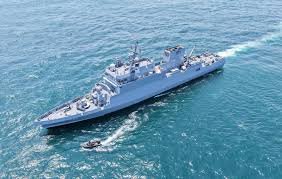
The Indian Navy recently received Ashank, an indigenously designed Anti-Submarine Warfare Shallow Water Craft (ASW-SWC), at Visakhapatnam to strengthen coastal defence and underwater surveillance capabilities.
About Ashank
- Nature: An indigenous ASW-SWC (Anti-Submarine Warfare Shallow Water Craft) built to detect, track, and neutralise submarines in shallow coastal waters (replacing older Abhay-class corvettes).
- Manufacturer: Built by GRSE (Garden Reach Shipbuilders and Engineers) in Kolkata, West Bengal.
- Classification Rules: Constructed in compliance with IRS (Indian Register of Shipping) classification norms.
- Indigenous Content: Features over 80% indigenous content, advancing Aatmanirbhar Bharat (self-reliant India) in defence shipbuilding.
Key Features of Ashank
- Weapons: Fitted with lightweight torpedoes and indigenous anti-submarine rocket launchers to engage underwater targets.
- Sensors & Surveillance: Equipped with advanced sonar systems for underwater threat detection and tracking in noisy shallow waters.
- Propulsion: Uses waterjet propulsion for high agility and easy manoeuvrability in shallow coastal zones.
- Multi-Role Capability: Supports anti-submarine warfare, coastal surveillance, search-and-rescue, and mine-laying operations.
About IRS (Indian Register of Shipping)
- Establishment: Set up in 1975 as an independent, non-profit ship classification society.
- Core Functions: Sets and verifies technical rules for ship design, construction, structural integrity, maintenance, and maritime safety.
- Global Standing: Full member of IACS (International Association of Classification Societies), giving its certification global acceptance across international shipping and naval standards.
Significance
- Coastal Security: Strengthens India’s ability to spot and counter submarines operating close to the coastline.
- Protection of Vital Assets: Safeguards naval bases, major ports/harbours, and offshore maritime infrastructure.
- Defence Indigenisation: Boosts domestic shipbuilding capacity, supply-chain resilience, and lower reliance on foreign defence imports.
FAQs
Q1. Which organisation manufactured Ashank?
Ans: Garden Reach Shipbuilders and Engineers (GRSE), Kolkata.
Q2. What type of propulsion system does Ashank use?
Ans: Waterjet propulsion, which provides improved manoeuvrability in shallow waters.
Q3. What is the indigenous content of Ashank?
Ans: Over 80% indigenous components.