Context
- A rare two-headed Diamondback Terrapin hatchling was discovered at a protected nesting site in Wellfleet, Cape Cod, Massachusetts, USA, in September 2026.
- The hatchling was taken to the Cape Wildlife Center for observation. Its condition, known as bicephaly, is a rare developmental abnormality in which an animal develops two heads on a single body.
About Diamondback Terrapin
- Scientific Name: Malaclemys terrapin
- Type: Semi-aquatic turtle adapted to brackish water.
- Habitat: Salt marshes, tidal creeks, estuaries, lagoons and coastal wetlands.
- Distribution: Native to the eastern and Gulf coasts of the United States and Bermuda, ranging from Cape Cod in Massachusetts to the southern United States.
Physical Features
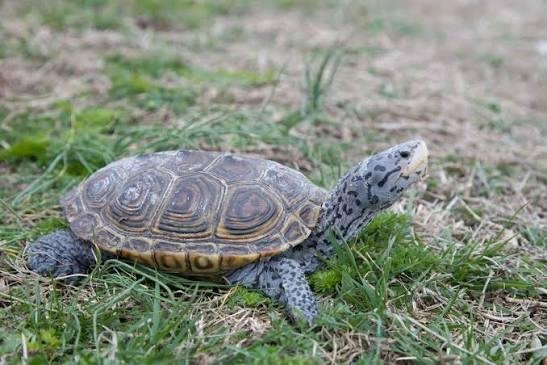
- Distinctive Shell: Its name comes from the diamond-shaped patterns on the upper shell.
- Body Markings: The head and body have characteristic dark spots and markings.
- Webbed Feet: Its large, webbed feet help it swim efficiently.
- Aquatic Life: It spends most of its time in water but comes onto land to bask and lay eggs.
Behaviour and Food Habits
- Basking and Nesting: Females come ashore to lay eggs in sandy or loosely packed soil.
- Winter Dormancy: In colder parts of its range, adults remain dormant in muddy creeks and marshes during winter.
- Diet: Feeds mainly on crabs, snails, clams, mussels, other aquatic invertebrates and occasionally fish.
Conservation Status
- IUCN Red List: Vulnerable (VU).
- Major Threats: Coastal habitat destruction, pollution, accidental capture in fishing gear, road mortality and rising sea levels.
- Conservation Need: Protecting coastal marshes, nesting sites and estuarine habitats is essential for its survival.
Frequently Asked Questions (FAQs)
Q1. What is the Diamondback Terrapin?
The Diamondback Terrapin (Malaclemys terrapin) is a semi-aquatic turtle adapted to brackish water.
Q2. Why is it called the Diamondback Terrapin?
It gets its name from the distinctive diamond-shaped patterns on its upper shell. Its head and body also have characteristic dark spots and markings.
Q3. What does the Diamondback Terrapin eat?
It feeds mainly on crabs, snails, clams, mussels and other aquatic invertebrates, occasionally consuming fish. Females come ashore to lay eggs in sandy or loosely packed soil.
Q4. What is the conservation status of the Diamondback Terrapin?
The Diamondback Terrapin is classified as Vulnerable (VU) on the IUCN Red List.