Context
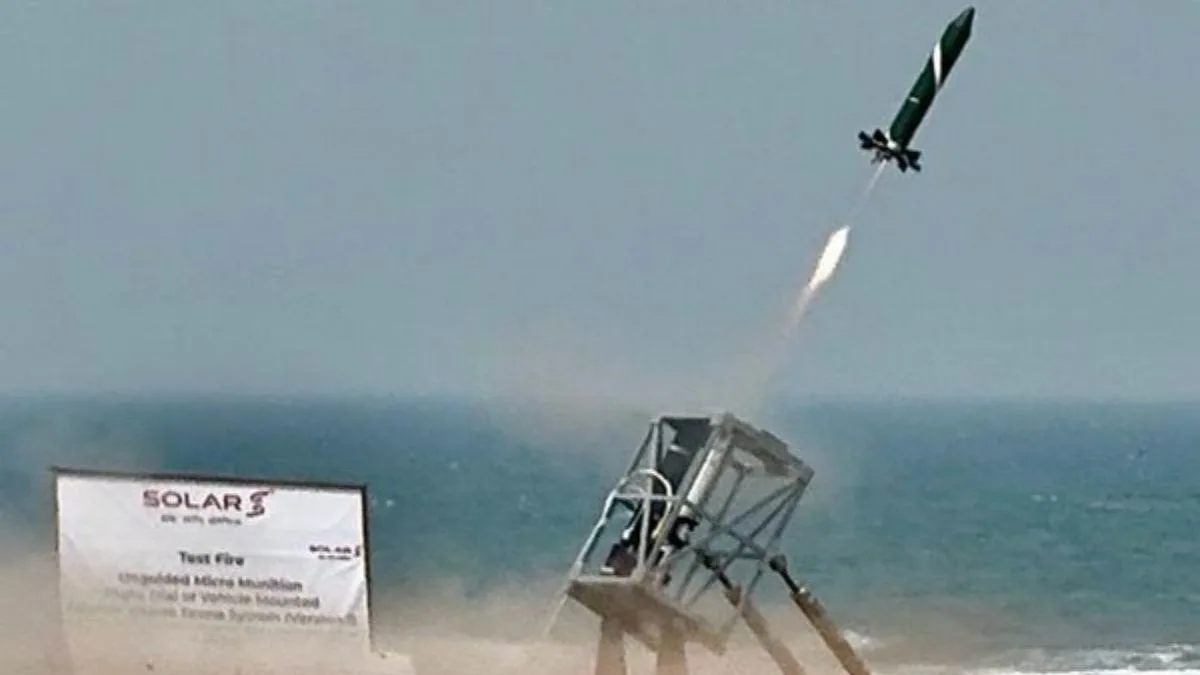
On 3 October 2026, the Odisha-based start-up IG Defence test-fired two solid rocket motors for JWALA-MK1, a short-range missile meant to destroy hostile drones, and described it as India’s first private-sector micro-missile for this role. The test comes as the West Asia conflict shows how a cheap drone can force a defender to fire a far costlier interceptor. JWALA is still under development, and no independent performance data has been released.
About the Jwala Missile
- Developer: Jwala-MK1 is a low-cost, short-range surface-to-air missile being built by IG Defence, a defence technology start-up based in Odisha.
- Purpose: It is meant mainly to shoot down hostile drones, whereas traditional air-defence missiles are built to stop aircraft or other high-value targets.
- First public display: The missile was first shown at the North Tech Symposium in Prayagraj in May 2026.
- Technical features:
- Motor: It runs on a solid-fuel, dual-pulse rocket motor that gives quick acceleration at launch and an extra burst of speed in the final approach.
- Range: It can engage targets at a distance of 2 to 5 km.
- Altitude: It can operate from 50 metres up to 5,000 metres above the ground.
- Latest milestone: The company has successfully test-fired two solid rocket motors, which is an important step towards building the complete propulsion system.
- Next steps: The missile still needs full-system flight trials, checks on its guidance and control, tests against realistic targets, reliability assessment, and integration with command-and-control networks.
- Wider system: IG Defence plans to connect Jwala to its GRID battle-management system, which links sensors, threat analysis and defensive weapons into one solution rather than a stand-alone interceptor.
- Cost caution: It is too early to judge the cost of each interception, because its hit rate, purchase cost and performance against real threats have not yet been independently verified.
Significance of Counter-Drone Missiles for India
- Cost balance: Reports say a drone worth about USD 10,000 can force the launch of an interceptor worth hundreds of thousands of dollars, so cheap interceptors matter.
- Protection of bases: Military bases, troops and critical sites like airfields and power plants need protection from small, low-flying drones.
- Lessons from recent conflicts: India faced waves of drones during the May 2025 conflict with Pakistan, and West Asia shows how common this threat has become.
- Indigenous capability: Home-grown interceptors reduce dependence on costly imports and improve supply during a conflict.
- Private sector role: Start-ups and private firms can bring faster design cycles to defence technology.
- Export potential: A proven low-cost interceptor could find buyers abroad, adding to India’s growing defence exports.
Challenges in Building Counter-Drone Missiles
- Unproven performance: JWALA has only completed motor tests, so its accuracy, reliability and kill rate are not yet shown.
- Unknown cost per kill: The true cost per successful interception cannot be judged until trials and production costs are known.
- Hard targets: Small, slow and low-flying drones are difficult to detect and hit, and swarms can overwhelm a few interceptors.
- Scaling production: Making large numbers of reliable missiles at low cost needs strong supply chains and quality control.
- Imported components: Sensors, seekers and electronics often depend on foreign suppliers, which can raise costs and delay supply.
- Integration: An interceptor works only if radars and command systems connect smoothly with it.
- Long approval cycles: User trials and procurement approvals take time, which can discourage small firms.
- Other technologies: Guns, lasers and electronic warfare may offer cheaper options in some cases, so missiles are not a complete answer.
Implications of Indigenous Counter-Drone Missiles
- Better economics of defence: If JWALA proves cost-effective, India could defend its sites without draining its stocks of costly missiles.
- Layered air defence: Small interceptors can leave larger systems such as Akash and the S-400 free to deal with aircraft and missiles.
- Boost to start-ups: A successful test programme encourages more private investment in defence technology.
- Strategic confidence: Credible home-grown defences strengthen deterrence against drone-heavy attacks.
- Risk of overpromising: Claims made before trials can raise unrealistic expectations, so independent testing is important.
- Wider market: Success could open export markets for low-cost counter-drone systems.
Initiatives Supporting Counter-Drone Capability
- Defence production push: Production rose to Rs 1.78 lakh crore and exports to a record Rs 38,424 crore in 2025–26, giving firms a strong base.
- iDEX scheme: Innovations for Defence Excellence has engaged 676 start-ups and innovators and led to 551 design contracts as of March 2026.
- DRDO anti-drone systems: DRDO has developed the D4 anti-drone system that uses both jamming and kinetic options.
- Acquisition approvals: The Defence Acquisition Council approved projects worth over Rs 8.75 lakh crore in a year to modernise the forces.
- Mission Sudarshan Chakra: Announced in 2025, it aims to build a national air-defence shield by 2035, with counter-drone layers as one part.
Way Forward for Counter-Drone Capability
- Independent trials: The armed forces and DRDO should run transparent trials against realistic drone types and publish tested results.
- Cost-per-kill benchmark: Procurement should compare systems by the cost for each successful interception, not just by price.
- Layered approach: India should combine missiles, guns, lasers and jammers so that the cheapest effective tool is used on each threat.
- Local components: Policy support for domestic sensors, seekers and electronics can cut import dependence.
- Faster procurement: Shorter approval timelines and guaranteed small orders would help start-ups scale up.
- Integrated command: Counter-drone weapons should connect to common radar and command networks used by all three services.
- Train and exercise: Regular drills against drone swarms will test both equipment and soldiers.
FAQs
Q1. What is a counter-drone missile?
Ans: It is a small, low-cost missile designed to destroy hostile drones instead of aircraft or large targets. It is meant to be cheap enough to use repeatedly to protect bases and infrastructure.
Q2. What is JWALA-MK1?
Ans: JWALA-MK1 is a short-range surface-to-air missile being developed by IG Defence, an Odisha-based start-up. It has a stated range of 2–5 km and an altitude of 50 to 5,000 metres.
Q3. What is cost asymmetry in modern warfare?
Ans: It is a situation where an attacker uses a cheap weapon, such as a drone, and the defender uses an expensive weapon to stop it. Over time, this can drain the defender’s budget and stocks.
Q4. What is the difference between hard-kill and soft-kill?
Ans: Hard-kill destroys a threat physically, for example with a missile or gun. Soft-kill disrupts it without destroying it, for example by jamming its signals or taking over control.
Q5. What is a dual-pulse rocket motor?
Ans: It is a solid rocket motor that burns in two stages, which gives strong thrust at launch and additional speed during the final approach to the target. This helps a small missile reach and catch fast-moving targets.