Context
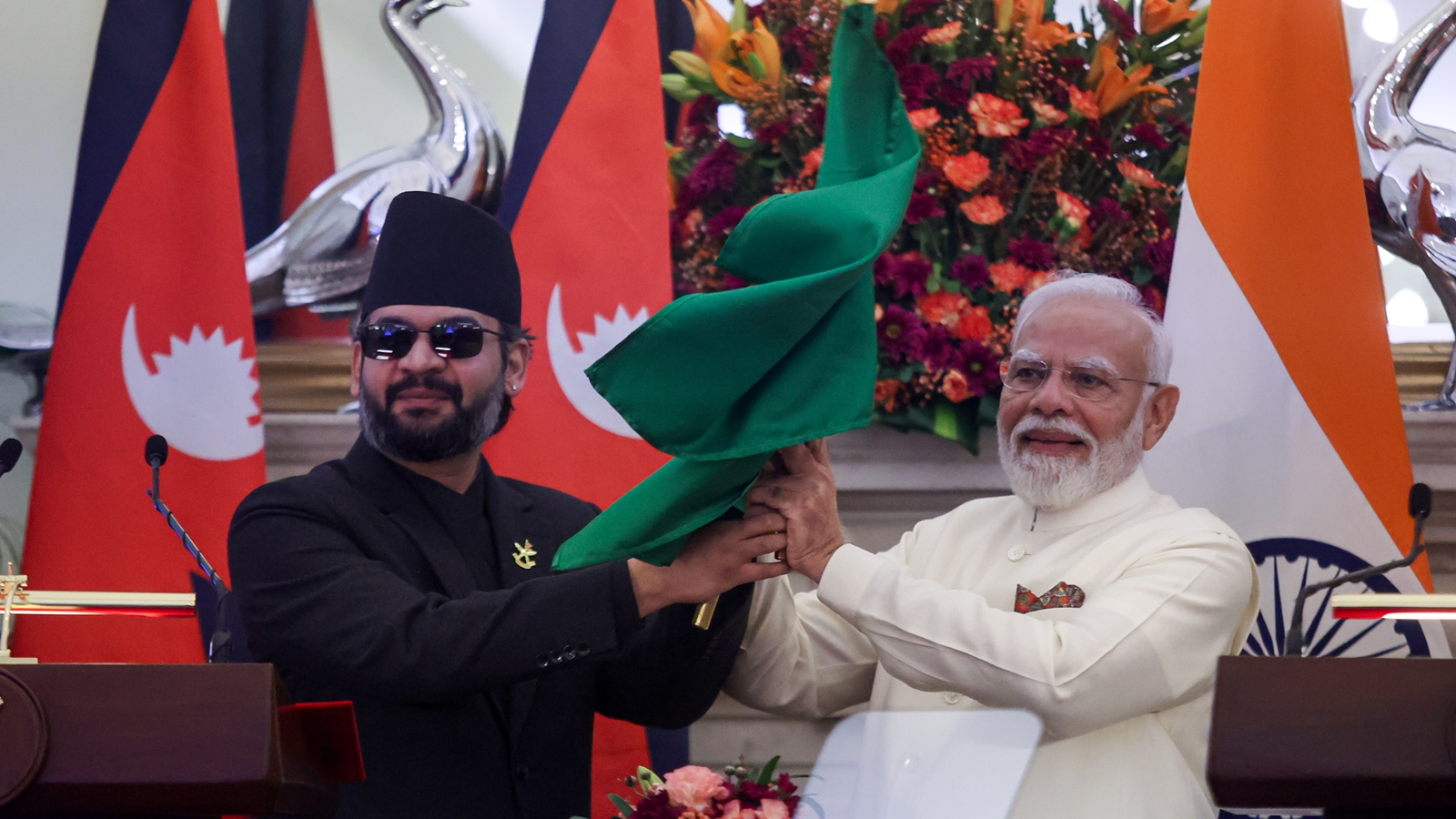
During Nepalese Prime Minister Balendra Shah’s recent visit to India, both countries signed eight Memoranda of Understanding (MoUs) and adopted a 10-pillar Joint Vision Document, titled ‘Viksit Bharat and Samunnat Nepal: Re-imagining the Partnership’, to strengthen bilateral cooperation and development partnerships.
Background & Historical Evolution
- 1950 Treaty & Open Border: Signed on 31 July 1950, the India–Nepal Treaty of Peace and Friendship anchored modern ties through mutual recognition of sovereignty, open borders, and reciprocal rights for citizens to live, work, and own property.
- Political Transitions (1950–2006): India played a key role in Nepal’s 1950–51 transition from Rana rule toward constitutional monarchy and later supported the 2005–06 peace process that ended monarchy and established a federal democratic republic.
- River & Hydropower Pacts (1954–1996): Early cooperation on transboundary rivers took shape through the Kosi Agreement (1954), Gandak Agreement (1959), and Mahakali Treaty (1996).
- Friction & Rebalancing (2015–2020): Nepal’s 2015 Constitution and border disruptions strained ties and pushed Kathmandu to diversify transit and trade links, prompting renewed focus on connectivity, power trade, and mutual trust.
- Joint Vision 2026 Shift: Moves ties beyond traditional aid toward equal economic partnership, regional energy trade, digital integration, and emerging technologies.
Major Outcomes of the India–Nepal Joint Vision Document
A. Economic and Development Cooperation
- Development Assistance Package: India announced ₹15,000 crore (NPR 24,000 crore)— comprising ₹3,500 crore in grants (for post-disaster reconstruction and infrastructure) and ₹11,500 crore in rupee-denominated LoCs (Lines of Credit) for energy projects.
- Industrial & IT Parks: Promote cross-border SEZs (Special Economic Zones), export-oriented manufacturing, and IT (Information Technology) parks.
- Port & Transit Access: Expand Nepal’s access to Kandla (Gujarat) and Paradip (Odisha) ports (alongside Kolkata/Haldia and Visakhapatnam) for international trade.
- Air Connectivity: Operationalise the Kathmandu–Bhairahawa–Lucknow air corridor for smoother two-way air travel.
B. Physical and Digital Connectivity
| Initiative | Key Focus |
| Saryu–Kamala Express | Rail service linking Ayodhya and Janakpur to boost religious tourism. |
| Dharchula–Darchula Bridge | Motorable bridge across the Mahakali River strengthening cross-border road links. |
| ICPs (Integrated Check Posts) | Modern border trade and customs hubs at Banbasa, Bhairahawa, Sunauli, and Dodhara Chandani. |
| Cross-Border Railways | Progress on Jayanagar–Bardibas and Jogbani–Biratnagar broad-gauge rail links. |
| UPI (Unified Payments Interface) Linkage | Enables seamless cross-border digital payments and financial integration. |
C. Energy Cooperation
- Lower Arun Hydropower Project: Foundation stone laid for the 669 MW (Megawatt) project in Nepal (being developed by SJVN — Satluj Jal Vidyut Nigam).
- Arun-III Hydropower Project: Reaffirmed commitment to timely completion of the 900 MW flagship project.
- Petroleum Pipelines: Inaugurated Phase II of the Motihari–Amlekhgunj pipeline; agreed to build the Siliguri–Jhapa pipeline and a new storage terminal at Jhapa.
- Essential Supply Assurance: India guaranteed uninterrupted supply of petroleum products, fertilisers, and essential commodities to Nepal.
D. Cooperation in Emerging Sectors
| Sector | Areas of Cooperation |
| Technology & AI | Start-ups, digital parks, data centres, and AI (Artificial Intelligence). |
| Space | Satellite development, remote sensing, and disaster management. |
| Education | Proposed IIT (Indian Institute of Technology) campus in Nepal, scholarships, and academic exchanges. |
| Healthcare | Jan Aushadhi Kendras (affordable generic medicines), hospital tie-ups, and lab modernisation. |
| Agriculture | Agro-Industrial Park in Chitwan and an ICAR (Indian Council of Agricultural Research) Centre of Excellence. |
| Sports | Cricket academy and modern sports infrastructure. |
| Governance | Civil servant training and administrative capacity-building exchanges. |
E. Cultural and Civilisational Cooperation
1. Three Pilgrimage Circuits: Joint promotion of religious tourism through:
- Ramayana Circuit: Ayodhya–Janakpur.
- Buddhist Circuit: Lumbini–Bodh Gaya–Sarnath–Kushinagar.
- Shiv-Shakti Circuit: Pashupatinath Temple (Kathmandu)–Varanasi.
2. Academic Heritage Link: Proposed Nalanda Centre at Lumbini, linking Nalanda University (Bihar) and Lumbini Buddhist University.
F. Institutional Monitoring Mechanism
- High-Level Monitoring Group: Co-chaired by Nepal’s Foreign Secretary and India’s Ambassador to Nepal.
- Mandate: Reviews all bilateral agreements and development projects at least once every six months to prevent delays.
Strategic Significance of India–Nepal Relations
- Neighbourhood First Policy: Central pillar of India’s Neighbourhood First Policy, promoting stability, connectivity, and integration in South Asia.
- Geographical & Border Link: Nepal shares an open 1,751 km border with five Indian states—Uttarakhand, Uttar Pradesh, Bihar, West Bengal, and Sikkim—acting as a vital Himalayan buffer.
- Economic & Transit Integration: Deep links in bilateral trade, investment, and third-country maritime transit through Indian ports.
- Clean Energy Security: Nepal’s vast hydropower potential supports India’s renewable energy transition and regional grid stability under BBIN (Bangladesh, Bhutan, India, Nepal).
- Internal & Border Security: Joint border management helps curb smuggling, counterfeit currency, human trafficking, and cross-border crime.
- Civilisational & Cultural Ties: Deep historical, religious, and family bonds underpin the unique “Roti-Beti” relationship.
Major Challenges in India–Nepal Relations
- Boundary Disputes: Unresolved territorial claims over Kalapani, Lipulekh, and Limpiyadhura (in the west) and Susta (in Bihar).
- 1950 Peace & Friendship Treaty: Nepal seeks review and updating of the 1950 India–Nepal Treaty of Peace and Friendship to reflect modern realities.
- Water-Sharing & Floods: Differences over river basin management, embankment construction, monsoon flooding in Bihar/UP, and benefit-sharing from hydropower projects.
- Trust Deficit: Periodic political friction over sovereignty concerns, economic dependence, and perceived interference.
- Trade Deficit & Asymmetry: Nepal faces a large trade deficit with India and relies heavily on Indian transit routes.
- China Factor: Growing Chinese infrastructure investments under BRI (Belt and Road Initiative) and strategic outreach add geopolitical complexity.
- Project Implementation Delays: Land acquisition, regulatory clearances, and funding bottlenecks slow down bilateral projects.
Way Forward
- Gujral Doctrine & Mutual Trust: Engage on the basis of sovereign equality, mutual respect, and non-interference, while respecting Nepal’s sensitivities.
- Constructive Dialogue: Use existing diplomatic mechanisms (like the Foreign Secretary-level boundary mechanism and EPG — Eminent Persons’ Group inputs) to resolve boundary and 1950 Treaty issues peacefully.
- Time-Bound Delivery: Leverage the High-Level Monitoring Group to ensure strict timelines for roads, railways, ICPs, and hydropower projects.
- Balanced Economic Ties: Promote Indian private investment in Nepali manufacturing, tourism, and IT, alongside smooth hydropower exports to India and Bangladesh to narrow Nepal’s trade deficit.
- Climate & Disaster Resilience: Strengthen joint flood forecasting, hydrometeorological data-sharing, and GLOF (Glacial Lake Outburst Flood) monitoring in the fragile Himalayas.
- People-to-People & Youth Connect: Expand educational scholarships, digital/UPI integration, sports exchanges, and pilgrimage tourism to keep public goodwill strong.
FAQs
Q1. Which Indian states share an international border with Nepal?
Ans: Uttarakhand, Uttar Pradesh, Bihar, West Bengal and Sikkim.
Q2. Which areas are associated with the India–Nepal boundary dispute?
Ans: Kalapani, Lipulekh, Limpiyadhura and Susta.
Q3. Who leads the India–Nepal High-Level Monitoring Group?
Ans: Nepal’s Foreign Secretary and India’s Ambassador to Nepal, with meetings at least once every six months.
Q4. Which religious tourism circuits are being promoted by India and Nepal?
Ans: The Ramayana Circuit, Buddhist Circuit and Shiv-Shakti Circuit.