Context
Following the August 26, 2026 glacial collapse and flash flood, Nepal has sought climate-related compensation of around $4–5 billion, from major greenhouse-gas emitters, including India, China and the United States.
About the Disaster
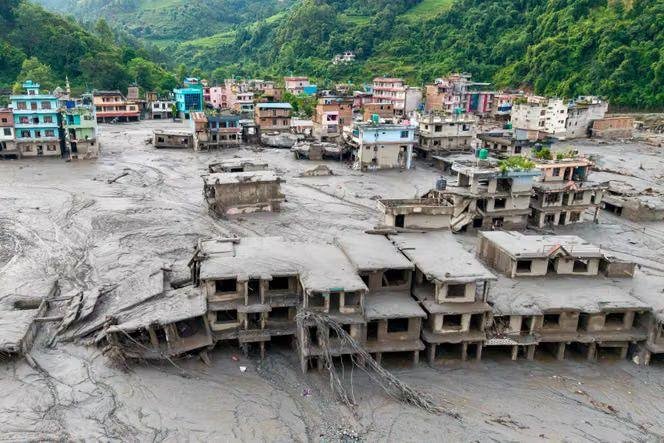
- The disaster occurred in the Rasuwa region near the Nepal–China border and was associated with a major ice-rock/glacier collapse.
- A sudden release of ice, rock, water and debris produced destructive flash floods along downstream river valleys, affecting settlements, roads, bridges and hydropower infrastructure.
- The event severely affected hydropower projects, with workers trapped in tunnels and infrastructure buried under mud and debris.
Why is Nepal Disproportionately Vulnerable?
- Active Tectonic Zone: Nepal lies at the collision zone of the Indian and Eurasian plates. Frequent seismic activity can destabilise mountain slopes and trigger landslides.
- Young and Fragile Himalayas: Nepal lies in the young, tectonically active Himalayan system, where steep slopes and weak rocks make the terrain highly vulnerable to landslides, avalanches and erosion.
- Extensive Glaciers and Glacial Lakes: The Hindu Kush Himalayas (HKH) are often called the Third Pole because they contain one of the world’s largest concentrations of snow and ice outside the Arctic and Antarctic.
- Intense Monsoonal Rainfall: The South Asian monsoon brings heavy rainfall to Nepal. When intense rain interacts with steep slopes and fragile geology, it can trigger floods, landslides and debris flows.
- Transboundary River Systems: Major rivers such as the Koshi, Gandaki and Karnali originate in the Himalayas and carry large volumes of water downstream, increasing flood risks during extreme events.
- Rapidly Changing Cryosphere: Rising temperatures are causing changes in glaciers, snow cover and permafrost. This can destabilise high-altitude slopes and alter the timing and volume of water flowing into Himalayan rivers.
- High Economic Exposure: Nepal’s economy depends significantly on hydropower, agriculture and tourism, all of which are sensitive to climate and environmental changes.
Why is Nepal Seeking Climate Compensation?
- Nepal contributes only around 0.1% of global greenhouse-gas emissions, yet is highly vulnerable to climate change because of its mountainous terrain and fragile ecosystems.
- Its latest climate plans identify glacier retreat, floods, landslides and GLOFs as major climate-related risks.
- Nepal argues that countries with much higher emissions should provide greater financial support to vulnerable developing countries facing Loss and Damage.
- However, demanding compensation is different from establishing legal liability. Proving that a particular country’s emissions directly caused a specific disaster involves complex questions of scientific attribution and international law.
Loss and Damage Fund
- The Fund for Responding to Loss and Damage (FRLD) was established through the climate negotiations to support developing countries facing climate-related economic and non-economic losses.
- It was agreed upon at COP27 (2022) and operationalised at COP28 (2023).
- Initial pledges to the fund crossed $700 million, but this remains very small compared with the scale of climate-related losses faced by vulnerable countries.
Climate Justice and CBDR-RC
- All countries share responsibility for addressing climate change.
- However, their responsibilities differ because of differences in historical emissions, capabilities and development levels.
- Nepal’s demand reflects the broader argument of the Global South that climate finance should reflect the unequal contribution to the climate crisis and unequal vulnerability.
Implications for India
- Pressure on Major Emitters: Nepal’s demand may increase pressure on India and other major emitters to provide greater climate finance to vulnerable Himalayan countries under the principle of CBDR-RC.
- Climate Diplomacy Challenge: India will need to balance its position as a developing country with significant development needs with its role as a major regional power and climate negotiator.
- Greater Himalayan Vulnerability: The demand highlights that India faces similar risks in Sikkim, Himachal Pradesh, Uttarakhand, Arunachal Pradesh and Ladakh, strengthening the case for greater investment in climate adaptation.
- Financial Implications: If international climate finance increasingly moves towards compensation or Loss and Damage, India may face greater expectations to contribute while also seeking finance for its own climate vulnerabilities.
- Infrastructure Planning: The disaster strengthens the case for climate-risk assessment of Himalayan hydropower, roads, tunnels and other infrastructure in India.
- Strategic Opportunity: India can use its leadership in the region to promote Himalayan climate cooperation, while maintaining that climate finance should follow equity, CBDR-RC and differentiated capabilities rather than automatic legal liability.
Way Forward
- Strengthen Regional Climate Cooperation: India and Nepal should establish stronger mechanisms for glacial monitoring, flood forecasting, early warnings and disaster response, particularly for transboundary river basins.
- Promote Accessible Climate Finance: India should support greater access to the Loss and Damage Fund for vulnerable developing countries while advocating that international climate finance remains based on equity and CBDR-RC.
- Joint Himalayan Risk Assessment: Both countries can collaborate on mapping GLOF, landslide and flash-flood hotspots and share scientific data for better disaster preparedness.
- Build Climate-Resilient Infrastructure: Future hydropower, roads, bridges and settlements in the Himalayas should undergo cumulative environmental and climate-risk assessments, rather than project-level assessment alone.
- Strengthen India’s Himalayan Preparedness: India should use lessons from Nepal to improve monitoring of glacial lakes, unstable slopes and high-risk valleys in Sikkim, Uttarakhand, Himachal Pradesh and Arunachal Pradesh.
- Balance Climate Justice with Development Needs: India should recognise the concerns of vulnerable neighbours while maintaining that climate responsibility cannot automatically be equated with legal liability.
- Use Regional Platforms: Platforms such as SAARC, BIMSTEC and bilateral India–Nepal mechanisms can be used for coordinated disaster-risk reduction and Himalayan climate resilience.
- Shift from Relief to Prevention: The focus should move from post-disaster compensation and relief towards anticipatory action, early warning, risk reduction and resilient development across the Himalayan region.
FAQs
Q1. Why is Nepal seeking climate compensation?
Ans. Nepal argues that it contributes only about 0.1% of global GHG emissions but faces severe climate-related risks. It is seeking greater international support for the losses caused by climate-related disasters.
Q2. What caused the August 2026 Nepal disaster?
Ans. A major ice-rock/glacier collapse triggered a sudden flash flood carrying water, ice, rocks and debris through downstream valleys.
Q3. What is the Third Pole?
Ans. The Hindu Kush Himalayas are called the Third Pole because they contain one of the largest concentrations of snow and ice outside the polar regions.
Q4. What is the Loss and Damage Fund?
Ans. The Fund for Responding to Loss and Damage is an international climate-finance mechanism designed to support vulnerable developing countries dealing with climate-related losses. It was operationalised at COP28.
Q5. What is CBDR-RC?
Ans. Common but Differentiated Responsibilities and Respective Capabilities means all countries must address climate change, but their responsibilities differ according to their historical contribution and capacity to act.
Q6. Why is Nepal highly vulnerable to climate change?
Ans. Its mountainous terrain, glaciers, fragile ecosystems and dependence on climate-sensitive sectors such as agriculture and hydropower increase its vulnerability.
Q7. Does climate compensation automatically mean legal liability?
Ans. No. Climate finance or compensation does not automatically establish legal liability. Proving that a particular country’s emissions caused a specific disaster requires strong scientific attribution and a viable legal basis.
Q8. Why is the issue important for India?
Ans. India faces similar Himalayan risks while also being a major regional emitter. The issue therefore highlights the need for India–Nepal cooperation on glaciers, floods, early warnings and climate-resilient infrastructure.