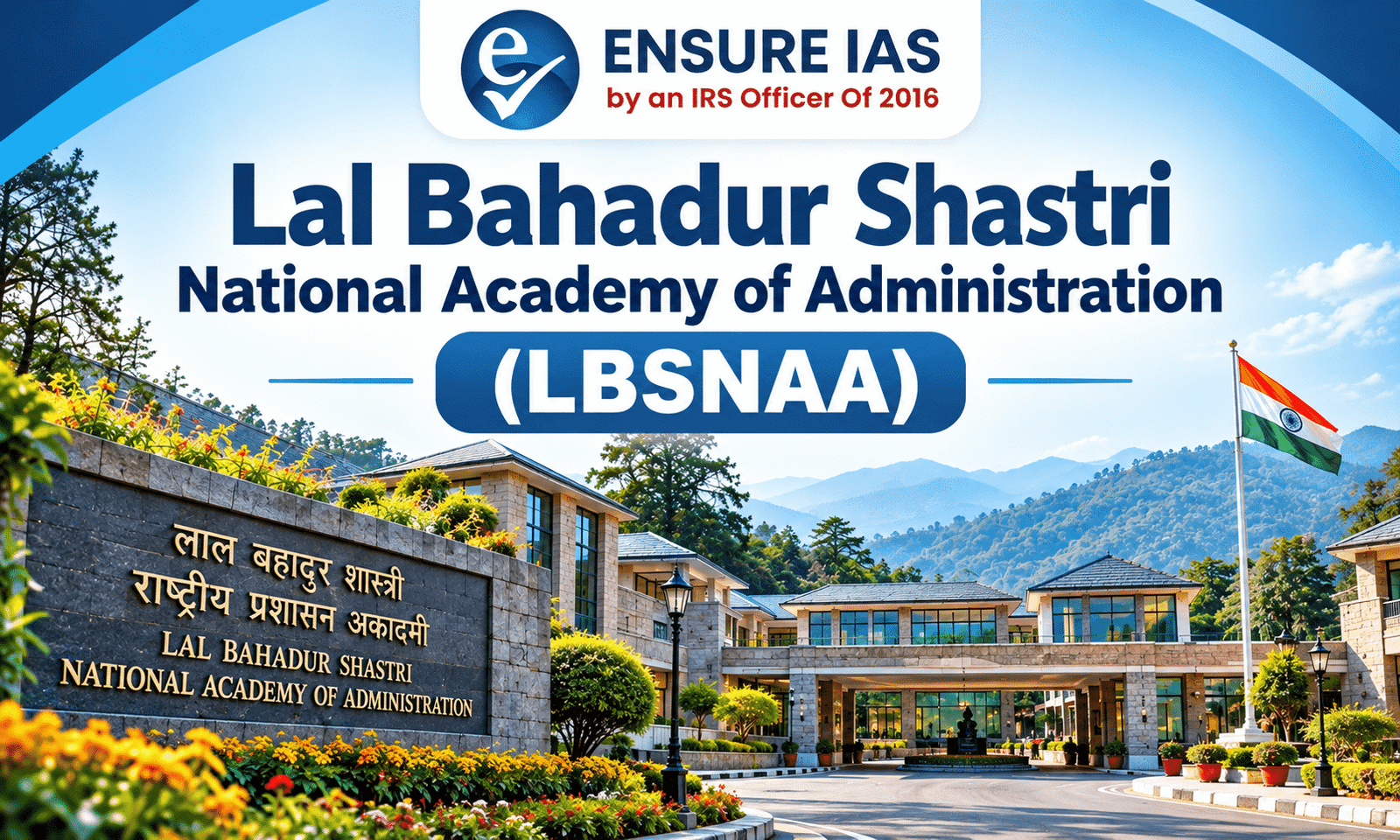
The Lal Bahadur Shastri National Academy of Administration (LBSNAA) is India’s premier training institution for civil servants. Located in Mussoorie, Uttarakhand, the academy plays a significant role in preparing officers for administrative responsibilities, public service delivery and effective governance.
LBSNAA conducts a Common Foundation Course for entrants to the All India Services, Indian Foreign Service, Group ‘A’ Central Services and Royal Bhutan Service. It also provides professional training to regular IAS recruits and members of the Royal Bhutan Service. The academy organises in-service training, Mid-Career Training Programmes (MCTPs) for IAS officers, and induction training for State Civil Service officers promoted to the IAS. In addition, it conducts workshops and seminars on public policy, administration and governance
LBSNAA Full Form
LBSNAA stands for Lal Bahadur Shastri National Academy of Administration. It is a central government training institution that prepares civil servants for the responsibilities of public administration.
The academy functions under the Department of Personnel and Training (DoPT), Ministry of Personnel, Public Grievances and Pensions, Government of India. It provides professional training to newly recruited IAS officers and offers training programmes for officers at different stages of their careers.
LBSNAA Motto
The motto of LBSNAA is “शीलम् परं भूषणम्” “Sheelam Param Bhushanam,” which means “Character is the highest virtue.” It highlights the importance of honesty, integrity, discipline and ethical behaviour in public service. The motto encourages civil servants to perform their duties responsibly and work for the welfare of citizens.
History of LBSNAA
The history of LBSNAA dates back to the early years after India’s independence, when the country needed a professional administrative system to implement government policies and deliver public services.
- 1958: The proposal to establish a National Academy of Administration was announced in the Lok Sabha.
- 1959: The National Academy of Administration was established in Mussoorie by bringing together the IAS Training School in Delhi and the IAS Staff College in Shimla.
- 1960: A common Foundation Course was introduced for officers belonging to different civil services.
- 1969: A training pattern combining academy-based education with district-level training was introduced.
- 1972–1973: The academy was renamed in honour of former Prime Minister Lal Bahadur Shastri, and the word “National” was subsequently incorporated into its name.
Over time, the academy has developed into an important institution for civil service training and capacity building.
Phases of IAS Training at LBSNAA
IAS training at LBSNAA consists of different phases that combine classroom learning, practical experience and field training to prepare officers for administrative responsibilities.
IAS training at LBSNAA is divided into different phases that combine academic learning, field experience and practical activities to prepare officers for their administrative responsibilities.
1 Common Foundation Course
- Introduces officer trainees to the Indian Constitution, governance and public administration.
- Covers ethics, integrity, leadership and public service values.
- Includes group discussions, sports, cultural activities and teamwork exercises.
- Builds coordination and professional relationships among trainees from different civil services.
2. IAS Professional Course – Phase I.
- Provides knowledge of economics, public finance and development programmes.
- Includes land administration, revenue management and disaster management.
- Develops decision-making, problem-solving and leadership skills through practical exercises.
3. Bharat Darshan
- Exposes trainees to India’s geographical, cultural and economic diversity.
- Includes visits to government institutions and development projects.
- Provides opportunities to understand the challenges faced by rural, tribal and remote communities.
- Helps trainees understand national security, infrastructure and public service delivery through field exposure.
4. District Training
- Provides practical experience in district and local administration.
- Introduces trainees to revenue administration, land records and related responsibilities.
- Offers exposure to rural development, welfare schemes and public grievance redressal.
- Helps trainees understand disaster response, departmental coordination and law-and-order-related administrative duties.
5. Assistant Secretaryship
- Introduces trainees to the functioning of Central Government ministries and departments.
- Provides exposure to policy formulation, file processing and official decision-making.
- Helps trainees understand coordination between the Union and state governments.
- Connects field-level administrative experience with national policymaking and programme implementation.
6. IAS Professional Course – Phase II
- Helps trainees review their experiences during district training.
- Includes discussions, presentations and case studies on administrative challenges.
- Strengthens knowledge of governance, public policy and administrative procedures.
- Prepares trainees for their future responsibilities through experience-sharing and professional assessments.
Facilities Available at LBSNAA
LBSNAA provides various academic, residential and recreational facilities to support the learning, physical fitness and overall development of civil servants during their training.
- Residential Facilities: Accommodation for officer trainees during their training period.
- Classrooms and Lecture Halls: Spaces for lectures, seminars, presentations and group discussions.
- Library: Learning resources related to public administration, law, governance, economics and other subjects.
- Sports and Fitness Facilities: Facilities for sports, physical training, exercise and outdoor activities.
- Dining Facilities: Mess and dining arrangements for officer trainees.
- Auditorium and Conference Halls: Venues for official functions, workshops, seminars and cultural programmes.
- Recreational Facilities: Clubs, cultural activities and social events that encourage teamwork and interaction among trainees.
- Outdoor Training Facilities: Spaces and activities for trekking, physical exercises and other practical training programmes.
Salary of IAS Officers During LBSNAA Training
IAS officer trainees receive salary during their probationary training, subject to applicable service and pay rules.
The entry-level basic pay under the IAS Pay Rules, 2016, is ₹56,100 per month at Level 10. The actual amount payable during training depends on the applicable rules, allowances, deductions and individual circumstances.
Training Location for Other Civil Servants
Different civil services have designated training academies across India, where officers receive professional training according to their roles and responsibilities.
Training Academies for Other Civil Services
Different civil services have designated institutions for professional training.
| Civil Service | Training Institution | University/Academic Association | Location |
| Indian Administrative Service (IAS) | Lal Bahadur Shastri National Academy of Administration (LBSNAA) | Jawaharlal Nehru University (JNU) | Mussoorie, Uttarakhand |
| Indian Foreign Service (IFS) | Sushma Swaraj Institute of Foreign Service (SSIFS) | – | New Delhi |
| Indian Police Service (IPS) | Sardar Vallabhbhai Patel National Police Academy (SVPNPA) | Osmania University | Hyderabad, Telangana |
| Indian Revenue Service (Income Tax) | National Academy of Direct Taxes (NADT) | NALSAR University | Nagpur, Maharashtra |
| Indian Forest Service (IFoS) | Indira Gandhi National Forest Academy (IGNFA) | Forest Research Institute (FRI) | Dehradun, Uttarakhand |
| Indian Revenue Service (Customs and Indirect Taxes) | National Academy of Customs, Indirect Taxes and Narcotics (NACIN) | NALSAR University | Faridabad |
Each academy provides professional training according to the responsibilities and requirements of its respective service.
- Frequently Asked Questions (FAQs)
Q1. What is the full form of LBSNAA?
LBSNAA stands for Lal Bahadur Shastri National Academy of Administration.
Q2. Where is LBSNAA located?
LBSNAA is located in Mussoorie, Uttarakhand, India.
Q3. When was LBSNAA established?
The National Academy of Administration was established in Mussoorie in 1959.
Q4. What is the motto of LBSNAA?
Its motto is “Sheelam Param Bhushanam,” meaning “Character is the highest virtue.”
Q5. How long does IAS training at LBSNAA last?
IAS training involves several stages, including the Foundation Course, professional training, district training and subsequent training modules. The overall training pathway generally extends across approximately two years, although the duration and sequence can vary by batch.
Q6. Is LBSNAA only for IAS officers?
No. LBSNAA conducts common Foundation Courses for eligible civil services, specialised IAS training, induction training for promoted IAS officers and mid-career programmes for serving officers.
Q7. Do IAS officers receive a salary during training?
Yes. IAS officer trainees receive salary under the applicable service and pay rules. The entry-level basic pay is ₹56,100 per month at Level 10, subject to applicable rules and circumstances.
Q8. What is Bharat Darshan?
Bharat Darshan is a study tour associated with IAS training. It exposes trainees to India’s geographical, cultural, economic and administrative diversity.
Conclusion
LBSNAA plays an important role in preparing civil servants for public administration and governance in India. Through academic instruction, field training, study tours and professional development programmes, the academy seeks to build officers who can perform their responsibilities with competence, integrity and a commitment to public service.