Graduation is often the stage when many aspirants seriously begin thinking about the Civil Services Examination conducted by the Union Public Service Commission (UPSC). Every year, lakhs of candidates from different educational backgrounds—including engineering, arts, commerce, science, medicine, and management—appear for the examination with the dream of becoming an IAS, IPS, IFS, or other civil servants.
However, one of the biggest questions graduates face is: “How should I start UPSC preparation?” With an extensive syllabus, intense competition, and countless resources available online and offline, beginners often feel overwhelmed.
This detailed guide will help you understand how to begin your UPSC journey after graduation in a structured and effective manner.
Understanding the UPSC Civil Services Examination
Before starting preparation, it is important to understand the structure of the examination.
The UPSC Civil Services Examination consists of three stages:
1. Preliminary Examination
The Preliminary Examination includes two objective papers:
General Studies Paper I
Subjects include:
- History
- Geography
- Indian Polity
- Economy
- Environment and Ecology
- Science and Technology
- Current Affairs
CSAT (Paper II)
Topics include:
- Reading comprehension
- Logical reasoning
- Quantitative aptitude
- Data interpretation
- Decision-making
CSAT is qualifying in nature, and candidates must score at least 33%.
2. Main Examination
The UPSC Mains examination consists of nine papers:
- Essay
- General Studies I
- General Studies II
- General Studies III
- General Studies IV
- Optional Subject Paper I
- Optional Subject Paper II
- English (qualifying)
- Indian Language (qualifying)
3. Personality Test (Interview)
Candidates who clear the Mains examination appear for the UPSC interview, where personality, decision-making ability, communication skills, and administrative aptitude are assessed.
Step 1: Check Your Eligibility
Before investing time and effort, ensure that you meet the eligibility criteria.
Educational Qualification
Candidates must hold a bachelor’s degree from a recognized university.
Age Limit (General Category)
- Minimum age: 21 years
- Maximum age: 32 years
Relaxations are available for reserved categories.
Number of Attempts
- General: 6 attempts
- OBC: 9 attempts
- SC/ST: Unlimited attempts until the age limit
Step 3: Analyze Previous Year Question Papers (PYQs)
UPSC follows certain patterns, and previous year questions reveal:
- Frequently asked topics
- Level of difficulty
- UPSC’s approach
- Important areas for preparation
Analyze at least the last 10 years of:
- Prelims papers
- Mains papers
- Essay topics
This exercise will give clarity regarding what UPSC actually demands.
Step 4: Build a Strong Foundation with NCERT Books
NCERT books are considered the backbone of UPSC preparation, especially for beginners.
History
- Class 6–8 History
- Class 9–10 History
- Class 11: Ancient India
- Class 12: Modern India
Geography
- Class 6–12 Geography
- Fundamentals of Physical Geography
- India: People and Economy
Polity
- Class 9–10 Political Science
Economics
- Class 9–12 Economics
Science
- Class 6–10 Science
Sociology
- Class 11 and 12 Sociology
Spend the first two to three months strengthening your basics.
Step 5: Select Standard Reference Books
After completing NCERTs, move to standard books.
Indian Polity
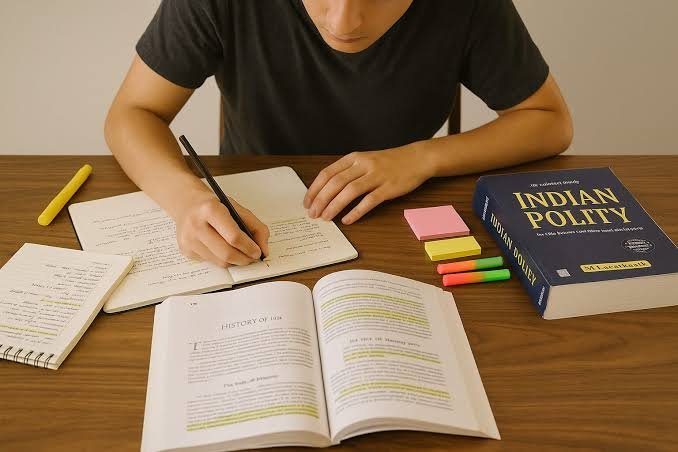
- Indian Polity by M. Laxmikanth
Modern History
- A Brief History of Modern India by Spectrum
Geography
- G.C. Leong
- Oxford School Atlas
Economy
- Basic economic concepts
- Economic Survey and Budget highlights
Environment
- Environment books and government reports
Ethics
- Lexicon for Ethics
Choose limited books and revise them multiple times.
Step 6: Develop a Daily Newspaper Reading Habit
Current affairs play a crucial role in both Prelims and Mains.
Spend 45–60 minutes daily reading newspapers.
Focus on:
- Government policies
- Supreme Court judgments
- Parliament proceedings
- International relations
- Economy
- Environment
- Science and technology
Avoid spending excessive time on political debates and entertainment news.
Step 7: Make Smart Notes
UPSC preparation requires continuous revision. Proper note-making saves time.
Your notes should include:
- Important facts
- Government schemes
- Constitutional articles
- Committee recommendations
- Data and statistics
- Current affairs
Tips for note-making:
- Keep notes concise.
- Use headings and bullet points.
- Revise regularly.
- Prefer digital notes if comfortable.
Step 8: Choose the Right Optional Subject
The optional subject contributes significantly to your final score in the Mains examination.
Choose an optional based on:
- Interest in the subject
- Availability of study material
- Syllabus length
- Previous academic background
- Availability of guidance
Popular optional subjects include:
- Geography
- Political Science
- Sociology
- History
- Anthropology
- Public Administration
- PSIR
- Philosophy
Do not select an optional solely based on trends or others’ recommendations.
Step 9: Create a Realistic Study Plan
A proper timetable is essential.
Sample Daily Schedule
| Time | Activity |
|---|---|
| 7:00–8:00 AM | Newspaper and current affairs |
| 8:00–10:00 AM | Static subject study |
| 10:00–11:00 AM | Revision |
| 11:00–1:00 PM | Optional subject |
| 2:00–4:00 PM | NCERT/Standard books |
| 5:00–6:00 PM | Answer writing |
| 7:00–8:00 PM | Mock tests |
| 9:00–10:00 PM | Revision |
Quality matters more than the number of hours studied.
Step 10: Start Answer Writing Early
Many aspirants postpone answer writing until after completing the syllabus.
This is a mistake.
Practice:
- 150-word answers
- 250-word answers
- Essays
- Case studies
Focus on:
- Structure
- Introduction and conclusion
- Use of examples
- Time management
Step 11: Practice Mock Tests Regularly
Mock tests help improve:
- Accuracy
- Speed
- Time management
- Revision
Take:
- Prelims mock tests
- Mains answer-writing tests
- Essay tests
Analyze mistakes after every test.
Step 13: Maintain Consistency and Discipline
UPSC preparation is a marathon, not a sprint.
To remain consistent:
- Study every day.
- Set weekly goals.
- Revise regularly.
- Avoid comparing yourself with others.
- Track your progress.
Consistency over one to two years often matters more than studying intensely for a few weeks.
Common Mistakes Beginners Should Avoid
- Ignoring the syllabus.
- Buying too many books.
- Neglecting revision.
- Delaying answer writing.
- Following multiple strategies.
- Ignoring current affairs.
- Studying without a timetable.
- Depending entirely on coaching.
How Much Time Is Required to Prepare for UPSC After Graduation?
The preparation time varies from person to person.
Generally:
- Beginners: 12–18 months.
- Candidates with a strong academic background: 8–12 months.
- Working professionals: 18–24 months.
The key is not the number of months but the quality and consistency of preparation.
Final Thoughts
Starting UPSC preparation after graduation can seem challenging, but with proper planning, the right resources, and consistent effort, it becomes manageable. Begin by understanding the exam pattern and syllabus, build strong fundamentals through NCERTs, choose limited resources, and practice answer writing regularly.
Remember that UPSC is not just a test of knowledge—it evaluates discipline, patience, analytical ability, and perseverance. Stay focused, trust the process, and improve step by step.
A well-planned strategy today can bring you closer to your dream of serving the nation as a civil servant.