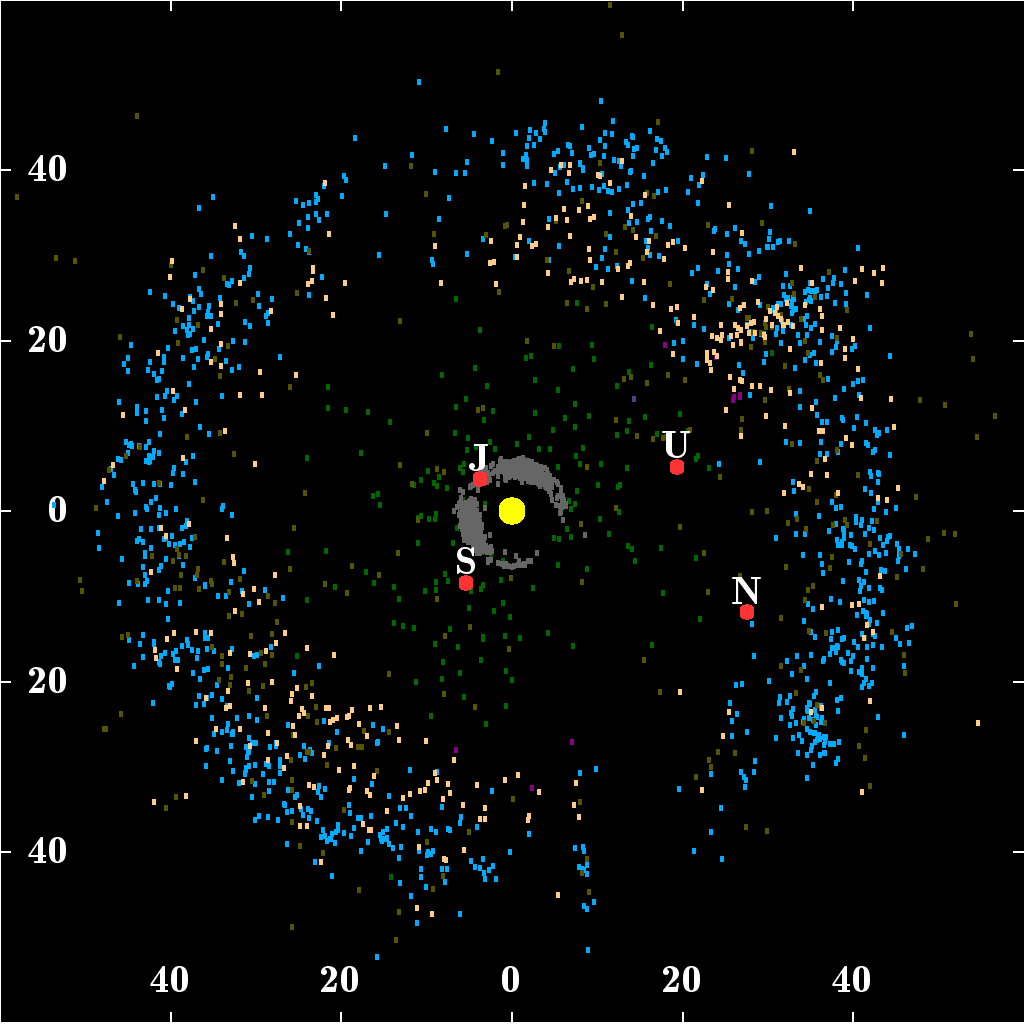
- The Kuiper Belt, also called the Edgeworth–Kuiper Belt, is a broad, flattened region of icy bodies located beyond the orbit of Neptune.
- It is named after astronomer Gerard Kuiper, though the idea of such a distant population of objects was developed by several astronomers.
- It contains millions of Kuiper Belt Objects (KBOs), many of which are also classified as Trans-Neptunian Objects (TNOs).
- The region consists of leftover material from the early formation of the solar system.
- It contains icy bodies, dwarf planets and other small objects, providing clues about the primitive outer solar system.
Comets and the Kuiper Belt
- The Kuiper Belt is an important source region for many short-period comets.
- In particular, many Jupiter-family comets, which generally have orbital periods of about 20 years or less, originate from populations associated with the Kuiper Belt.
- More broadly, short-period comets are defined as those completing an orbit around the Sun in less than 200 years.
- In contrast, many long-period comets originate from the much more distant Oort Cloud.
- Studying these bodies helps scientists understand the formation and evolution of the outer solar system.
Pluto and the Kuiper Belt
- Pluto is one of the best-known Kuiper Belt objects.
- It was once regarded as the ninth planet of the solar system.
- In 2006, the International Astronomical Union (IAU) classified Pluto as a dwarf planet.
- Pluto orbits the Sun and is nearly round, but it has not cleared the neighbourhood around its orbit, preventing its classification as a full planet under the IAU definition.
Kuiper Belt vs Oort Cloud
- Kuiper Belt: A relatively nearby, flattened region beyond Neptune, associated with many short-period comets.
- Oort Cloud: A far more distant, roughly spherical reservoir surrounding the solar system, associated with many long-period comets.
FAQs
Q1. What is the Kuiper Belt?
It is a flattened region of icy objects beyond Neptune.
Q2. What are KBOs?
They are Kuiper Belt Objects located within or associated with the Kuiper Belt.
Q3. Is Pluto a Kuiper Belt object?
Yes. Pluto is a dwarf planet and one of the best-known KBOs.
Q4. Which comets are associated with the Kuiper Belt?
Many short-period, especially Jupiter-family, comets are linked to this region.
Q5. How is the Oort Cloud different from the Kuiper Belt?
The Kuiper Belt is flattened and closer, whereas the Oort Cloud is much more distant and roughly spherical.