Context
Recent observations by the MAVEN mission of the National Aeronautics and Space Administration have revealed the presence of the Zwan-Wolf effect in the atmosphere of Mars, offering fresh insights into how the planet responds to solar wind activity.
About the Zwan-Wolf Effect
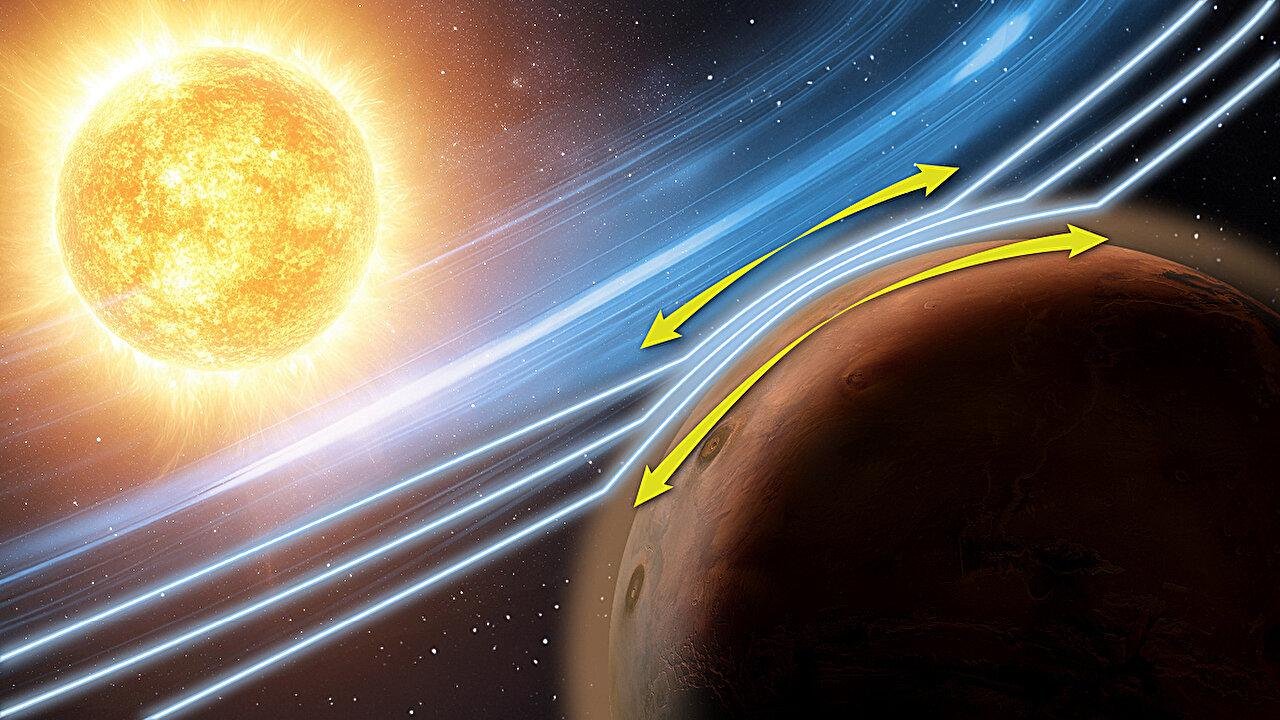
- The Zwan-Wolf effect refers to the compression of charged particles along magnetic field structures known as flux tubes.
- First identified in 1976, it had previously been observed only in planetary magnetospheres.
- The phenomenon occurs when solar wind interacts with a planet’s magnetic environment, creating pressure differences that redistribute charged particles.
- This interaction produces regions with comparatively lower particle density near the solar wind stream.
- On Earth, the process helps deflect solar wind and reduces the impact of harmful charged particles.
Significance of the Discovery on Mars
- The effect was detected in the Martian ionosphere below an altitude of nearly 200 km.
- Unlike Earth, Mars lacks a strong global magnetic field, making its atmosphere more vulnerable to space weather interactions.
- Observations showed redistribution of charged particles within the Martian atmosphere due to solar wind activity.
- The discovery improves understanding of atmospheric loss, space weather processes, and the evolution of the Martian climate.
About MAVEN
- MAVEN is the first mission dedicated to studying the upper atmosphere of Mars and its interaction with space weather.
- It is part of the National Aeronautics and Space Administration Mars Exploration Program and entered Mars orbit in 2014 after its launch in 2013.
- The spacecraft carries instruments to study solar wind interactions, atmospheric composition, and ultraviolet radiation.
- The mission has shown that Mars lost nearly two-thirds of its early atmosphere to space.