Context
A recent peer-reviewed study has reported a significant decline in bird populations in the Gulf of Mannar, with the abundance of shorebirds decreasing by nearly 57% over the past four decades, raising concerns over the health of its coastal ecosystem.
About Gulf of Mannar
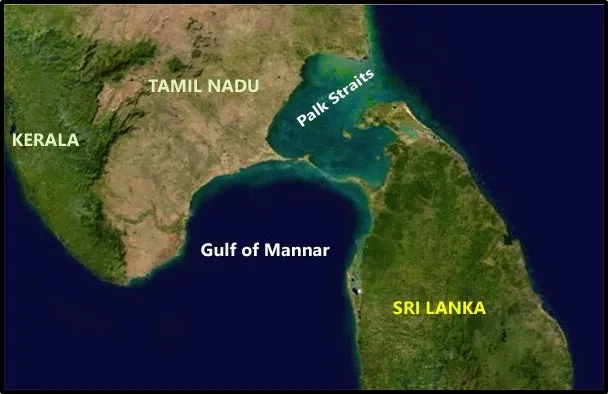
- The Gulf of Mannar is a shallow bay of the Laccadive Sea (Indian Ocean), located between the southeastern coast of India and western Sri Lanka. It extends about 160 km in length and 130–275 km in width.
- It is connected to the Palk Bay through the Palk Strait and is bounded by Rameswaram Island, Adam’s (Rama’s) Bridge, and Mannar Island.
- Freshwater inflow into the gulf is provided by rivers such as the Tambraparni (India) and the Aruvi (Sri Lanka).
- Tuticorin (Thoothukudi), a major port on India’s southeastern coast, lies along the gulf, which is also known for its pearl banks and the sacred chank (Turbinella pyrum), a commercially important marine gastropod.
Ecological Significance
- The gulf comprises three major coastal ecosystems—coral reefs, seagrass beds, and mangroves—and is recognised as one of the world’s richest marine biodiversity hotspots.
- Its rich marine ecosystem supports over 4,223 recorded species of flora and fauna, including dugongs, dolphins, sharks, sea turtles, and 117 species of hard corals.
- The Gulf of Mannar National Park was established in 1986, and the region was designated India’s first Marine Biosphere Reserve in 1989, becoming the first marine biosphere reserve in South Asia.