Context
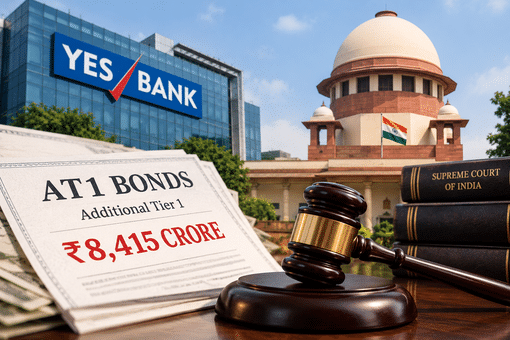
The Supreme Court upheld the Bombay High Court’s ruling against Yes Bank’s ₹8,415 crore AT1 bond write-off, stating that the bank’s administrator lacked the authority to cancel the bonds under the 2020 reconstruction scheme.
About AT1 Bonds
- Meaning: AT1 bonds are perpetual, unsecured and subordinated debt instruments issued by banks under the Basel III framework to meet regulatory capital requirements.
- Additional Tier-1 (AT1) capital is part of a bank’s Tier-1 capital and acts as a loss-absorbing buffer.
- Key Features:
- Perpetual: No fixed maturity date or scheduled principal repayment.
- Higher returns: Investors may receive higher interest because these instruments carry significant risk.
- Discretionary Coupon: Interest payments may be cancelled under applicable regulatory and contractual conditions.
- Non-cumulative Interest: Cancelled interest is not carried forward as arrears for future payment.
- Loss Absorption: Principal may be written down, potentially to zero, or converted into equity under specified conditions.
- Unsecured and Subordinated: No collateral; AT1 holders rank below depositors and senior creditors but generally above equity shareholders during liquidation.
- Debt–equity characteristics: Investors initially provide funds as debt, but the instruments can absorb losses in ways similar to equity.
Yes Bank AT1 Bonds Case
- Issuance: Yes Bank raised ₹3,000 crore in 2016 and ₹5,415 crore in 2017 through AT1 bonds, totalling ₹8,415 crore.
- Background: During Yes Bank’s financial crisis in March 2020, the bank underwent reconstruction.
- Write-off: The bank’s administrator cancelled the bonds, wiping out investors’ principal.
- Legal Challenge: The Bombay High Court ruled that the administrator lacked the authority to write off the bonds. The Supreme Court upheld this ruling.
- Key Issue: The draft reconstruction scheme included the write-off provision, but the final scheme omitted it. The case centred on the administrator’s legal authority and compliance with the prescribed procedure.
Significance of the Verdict
- Rule of Law: Ensures that bank rescues follow legal procedures and contractual terms.
- Regulatory Accountability: Highlights the need for effective RBI oversight during bank reconstruction.
- Investor Protection: Draws attention to the risks faced by retail investors in complex financial instruments.
- Financial Stability: Reinforces that bank rescues must protect the financial system without bypassing legal requirements.
- Market Confidence: Promotes transparency and predictable regulatory decisions to maintain investor trust.
Challenges
- Investor Protection vs Loss Absorption: Protecting investors without weakening the loss-bearing capacity of AT1 bonds remains difficult.
- Mis-selling: Retail investors may invest without fully understanding the risk of losing their entire principal.
- Regulatory Uncertainty: Overlapping or unclear powers of the RBI and bank administrators can complicate bank reconstruction.
- Capital Uncertainty: Reversing the write-off creates uncertainty over Yes Bank’s capital position and financial obligations.
- Lack of Transparency: Differences between draft and final reconstruction schemes raise concerns about disclosure and procedural compliance.
Way Forward
- Clarify Legal Powers: Clearly define the roles of the RBI and bank administrators during bank reconstruction.
- Improve Disclosure: Explain the risks, perpetual nature and loss-absorption conditions of AT1 bonds in simple language.
- Prevent Mis-selling: Strengthen investor awareness and suitability checks for complex financial products.
- Ensure Legal Compliance: Require proper authorisation and documentation before writing off bonds.
- Strengthen Crisis Resolution: Establish clear procedures for resolving banking crises while protecting financial stability and investor rights.
FAQs
Q1. What are AT1 bonds?
Ans. Perpetual bank debt instruments that strengthen regulatory capital and absorb losses through write-downs or conversion into equity.
Q2. Can AT1 bondholders lose their entire investment?
Ans. Yes, their principal can be written down to zero under specified conditions.
Q3. What is the role of the RBI in bank reconstruction?
Ans. The RBI regulates banks, monitors capital requirements and oversees banking distress resolution within the legal framework.