Context
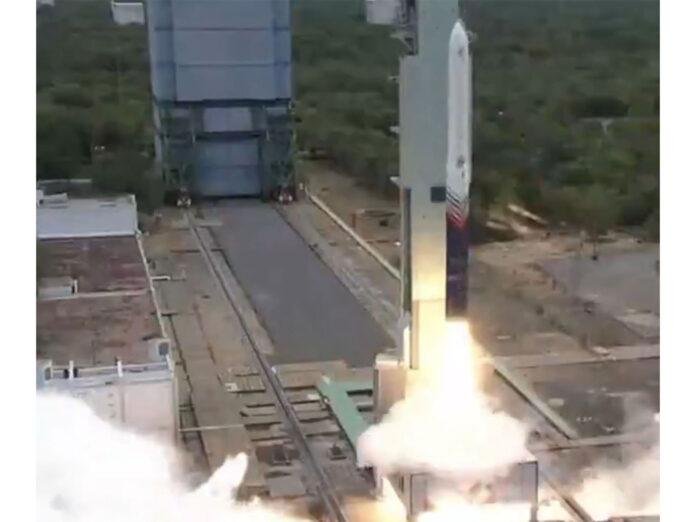
- Skyroot Aerospace’s Vikram-1 became India’s first privately developed orbital launch vehicle to successfully place payloads into Low Earth Orbit (LEO).
- Mission Aagaman makes India the third country, after the United States and China, to demonstrate private-sector orbital launch capability.
- The achievement reflects the growing maturity of India’s commercial space ecosystem following the space-sector reforms introduced in 2020.
Key Features of Vikram-1 Mission
- Historic Achievement
- Vikram-1, a 22-metre, three-stage launch vehicle, was successfully launched from the Satish Dhawan Space Centre, Sriharikota.
- The mission successfully demonstrated the rocket’s capability to achieve a full orbital flight.
- It established India’s private sector as an important contributor to orbital launch services alongside ISRO.
- Technical Features
- Payload Capacity: Up to 350 kg.
- Built using all-carbon composite structures, 3D-printed engines, high-thrust solid-fuel boosters, and indigenous propulsion systems.
- Successfully validated critical systems, including propulsion, stage separation, Guidance, Navigation and Control (GNC), avionics, telemetry, and overall vehicle performance.
- Payloads and Technology Demonstrations
- Carried technology demonstration payloads from Grahaa Space, Cosmoserve, and DCubed.
- Also transported commemorative payloads, including a lab-grown diamond, a miniature gold sculpture, and a micro-art tribute to Vikram Sarabhai, Dr. A.P.J. Abdul Kalam, and C.V. Raman.
- Included messages from well-wishers, including the Prime Minister.
- Equipped with robotic arms designed to support future space-debris removal missions, reflecting India’s growing focus on sustainable space operations.
Evolution of Skyroot Aerospace
- Founded in 2018 following the liberalisation of India’s space sector.
- Became India’s first space-tech unicorn.
- Successfully launched Vikram-S in 2022, demonstrating suborbital launch capability.
- Vikram-1 marks the company’s transition from technology demonstration to operational orbital launch capability.
- The company plans to scale up commercial launch services with a manufacturing capacity of 12 Vikram-1 rockets annually.
Space-Sector Reforms (2020)
- Opened the Indian space sector to private participation.
- Established IN-SPACe to authorise, regulate, and promote private space activities.
- Strengthened commercialisation through NewSpace India Limited (NSIL).
- Enabled private companies to access ISRO’s infrastructure, expertise, and launch facilities.
- Encouraged the growth of startups in launch vehicles, satellite manufacturing, and downstream space applications.
Challenges and Way Forward
| Challenges | Way Forward |
| The global small-satellite launch market is highly competitive, with several private launch providers competing for limited demand. | Demonstrate consistent launch reliability to build customer confidence and strengthen market credibility. |
| Increasing use of rideshare launches has reduced the demand for dedicated small-satellite launch vehicles. | Improve cost competitiveness through technological innovation, operational efficiency, and continuous product development. |
| Competition from ISRO’s Small Satellite Launch Vehicle (SSLV) and the established Polar Satellite Launch Vehicle (PSLV). | Focus on specialised launch services and niche market segments requiring dedicated orbital insertion. |
| Domestic demand for dedicated small-satellite launches remains limited. | Expand the international customer base by securing long-term commercial launch contracts. |
| Launch services are capital-intensive and subject to increasing regulatory and space-debris mitigation requirements. | Expand into satellite manufacturing, downstream applications, and space-based services to diversify revenue sources. |
Conclusion
Vikram-1 marks a significant milestone in India’s commercial space journey. Sustained policy support, technological innovation, and global competitiveness will be crucial for positioning India as a leading space economy.
UPSC FAQs
Q1. Why is the successful launch of Vikram-1 considered a milestone for India’s commercial space sector?
Ans: Vikram-1 established India’s first private orbital launch capability, demonstrating that Indian private companies can independently undertake orbital missions and complement ISRO in commercial launch services.
Q2. What is the significance of Mission Aagaman for India’s space programme?
Ans: Mission Aagaman validated India’s private-sector orbital launch capability, strengthened the commercial space ecosystem, and demonstrated the impact of post-2020 space-sector reforms.
Q3. What are the major commercial challenges facing private launch vehicle companies in India?
Ans: Major challenges include intense global competition, increasing preference for low-cost rideshare launches, limited domestic demand, competition from ISRO’s launch vehicles, and the capital-intensive nature of launch services.
Q4. Why are dedicated small-satellite launch vehicles still relevant despite the growth of rideshare missions?
Ans: Dedicated launch vehicles provide greater flexibility in launch schedules, customised orbital insertion, and mission-specific deployment, making them suitable for customers with specialised mission requirements.
Q5. How have India’s space-sector reforms promoted the growth of private space companies?
Ans: The reforms opened the space sector to private participation, established IN-SPACe as the regulatory and promotional body, strengthened commercialisation through NSIL, and enabled startups to access ISRO’s infrastructure and develop indigenous space technologies.
Q6. Why are private companies becoming increasingly important in India’s space programme?
Ans: Private companies complement ISRO by developing launch vehicles, satellites, and space technologies. Their participation promotes innovation, expands commercial opportunities, enhances manufacturing capabilities, and strengthens India’s competitiveness in the global space sector.
Q7. What role does IN-SPACe play in India’s space ecosystem?
Ans: Indian National Space Promotion and Authorisation Centre (IN-SPACe) is the nodal agency that authorises, regulates, and promotes private participation in the space sector. It facilitates access to ISRO’s infrastructure and supports the growth of India’s commercial space industry.