Context
The Directorate of Revenue Intelligence (DRI) recently intercepted two individuals in Mariani, Assam, and recovered 86 live Tokay Geckos, bringing attention to the illegal collection and trade of the species.
About Tokay Gecko
- Tokay Gecko (Gekko gecko) is a tree-dwelling (arboreal) lizard found mainly in the tropical parts of South and Southeast Asia. It is among the largest geckos.
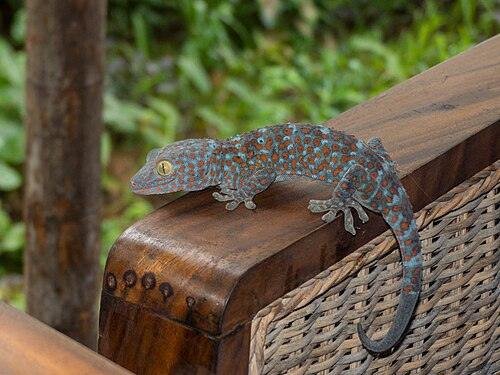
- Its distinctive appearance makes it easily recognisable, with a bluish-grey body covered with contrasting red, orange or yellow spots. Two commonly identified colour forms are red-spotted and black-spotted.
- The species is adaptable in terms of habitat and can occur in rainforests, rocky shelters and human settlements, provided suitable microhabitats are available.
- It is predominantly nocturnal and solitary. Rather than continuously searching for food, it often remains concealed and waits for prey to come within reach.
- Males defend territories, particularly against competing geckos and other intruders. Their loud vocal calls also play a role in territorial behaviour and reproduction.
- The gecko has specialised ways of interacting with its surroundings:
- It collects chemical particles using its tongue and brings them towards the Jacobson’s organ, helping it detect and interpret smells.
- When threatened, it can shed its tail, allowing it to escape from a predator.
- Its diet consists mainly of insects, along with other small vertebrates, making it an important predator of smaller animals in its habitat.
Conservation Status
- IUCN: Least Concern
- CITES: Appendix II
- Wildlife (Protection) Act, 1972: Schedule I
The Tokay Gecko may not currently be classified as threatened globally, but its capture and illegal trade are important conservation concerns, particularly because the species receives high legal protection in India.
FAQs
Q1. What is the scientific name and habitat of the Tokay Gecko?
The scientific name of the Tokay Gecko is Gekko gecko. It is a tree-dwelling (arboreal) lizard found mainly in tropical South and Southeast Asia, in rainforests, rocky shelters and even human settlements.
Q2. How can the Tokay Gecko be identified?
The Tokay Gecko is among the largest geckos. It has a bluish-grey body with red, orange or yellow spots, and is commonly seen in red-spotted and black-spotted forms.
Q3. What are the key adaptations and behaviours of the Tokay Gecko?
The Tokay Gecko is nocturnal and solitary, and waits hidden for prey. It detects smells by carrying chemical particles from its tongue to the Jacobson’s organ, sheds its tail to escape predators, and males defend territories with loud calls.
Q4. What is the conservation status of the Tokay Gecko?
The Tokay Gecko is Least Concern on the IUCN list, listed in CITES Appendix II, and placed in Schedule I of the Wildlife (Protection) Act, 1972. Despite its global status, its capture and trade remain a serious concern in India because of its high legal protection.