Context
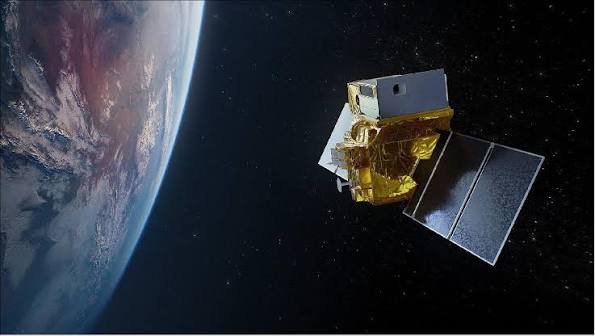
TRISHNA is a joint India–France Earth observation mission being developed by ISRO and CNES. The satellite is scheduled for launch in 2027 to provide high-resolution observations of land-surface temperature, vegetation and water-related processes.
About TRISHNA Mission
- TRISHNA stands for Thermal infraRed Imaging Satellite for High-resolution Natural resource Assessment.
- It is an Earth observation mission, designed to monitor natural resources and environmental processes.
- The satellite will operate in a Sun-synchronous orbit at about 761 km altitude.
- It is designed for a nominal mission life of around 5 years.
- The mission is expected to provide a 3-day revisit at the equator, enabling frequent monitoring of surface changes.
Payloads and Observation Capability
- Thermal Infrared (TIR) payload: Developed by CNES, it will measure surface temperature and emissivity.
- VNIR-SWIR payload: Developed by ISRO, it will observe surface reflectance, vegetation and other biophysical characteristics.
- Combining both instruments will support estimation of surface energy balance, heat fluxes and evapotranspiration.
- TRISHNA is expected to provide about 57–60 m spatial resolution over land and coastal regions, while oceanic and polar observations will be available at a coarser resolution of about 1 km.
- The combination of high spatial resolution and frequent revisit makes the mission suitable for monitoring dynamic environmental processes.
Major Applications
- Agriculture: Monitoring crop water stress and estimating evapotranspiration for irrigation management.
- Drought and ecosystems: Assessing vegetation health, land-surface temperature and ecosystem stress.
- Urban areas: Mapping urban heat islands and supporting urban planning.
- Water resources: Monitoring inland waters, coastal zones and surface-water temperature.
- Cryosphere and hazards: Studying snow cover, snowmelt, geothermal activity and sub-surface fires.
- TRISHNA can therefore support water management, climate studies, agriculture and natural-resource planning.
India–France Space Cooperation
- TRISHNA continues the long-standing cooperation between ISRO and CNES in Earth observation.
- Megha-Tropiques, launched in 2011, studied the tropical water cycle and atmospheric energy exchanges.
- SARAL, launched in 2013, used satellite altimetry to study oceans and sea-surface characteristics.
- Both missions demonstrated sustained Indo-French collaboration in Earth observation.
- TRISHNA is scheduled for launch from India in 2027; earlier mission documentation identified PSLV as the planned launch vehicle.
FAQs
Q1. What is TRISHNA?
It is a joint ISRO–CNES Earth observation satellite mission.
Q2. When is TRISHNA scheduled for launch?
It is currently scheduled for 2027.
Q3. What are its two main payloads?
A CNES thermal-infrared sensor and an ISRO VNIR-SWIR optical sensor.
Q4. What is its spatial resolution?
About 57–60 m over land and coastal regions, with coarser observations over oceans and polar areas.
Q5. What are its major applications?
Agriculture, evapotranspiration, drought, urban heat, water resources, cryosphere and ecosystem monitoring.