Context
Recently, the Defence Ministers of India and South Korea held bilateral discussions in Seoul focusing on strengthening defence cooperation and expanding strategic partnership between the two countries.
About South Korea
Location and Boundaries
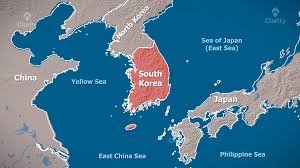
- South Korea is located in East Asia and occupies the southern half of the Korean Peninsula.
- The 38th Parallel North is the historic latitude line that traditionally divided the Korean Peninsula into North Korea and South Korea.
- The country is bounded by the Yellow Sea to the west, the East China Sea to the south and the East Sea (Sea of Japan) to the east.
- The Korea Strait separates South Korea from the Japanese island of Tsushima in the southeast.
- Seoul is the capital and largest city of the country.
Physical Features
- The terrain of South Korea is largely mountainous, with the Taebaek Mountain Range extending along the eastern coast.
- Jeju Island, located in the Korea Strait, is the country’s largest island.
- Mount Halla on Jeju Island is the highest peak of South Korea, rising to about 1,950 metres. It is an extinct volcano.
- Major rivers of the country include the Han River and the Nakdong River.
Climate and Natural Resources
- South Korea experiences a continental climate characterised by hot, rainy summers and cold winters.
- Important mineral resources found in the country include anthracite coal, iron ore, graphite, gold, silver, tungsten, lead and zinc.