Context
- The National Perspective Plan (NPP) identifies 30 river-linking projects—16 Peninsular and 14 Himalayan.
- The Ken–Betwa Link Project (KBLP) is the first NPP project to enter the implementation stage; foundation stone laid in December 2024 and targeted for completion by 2030.
What is River Interlinking?
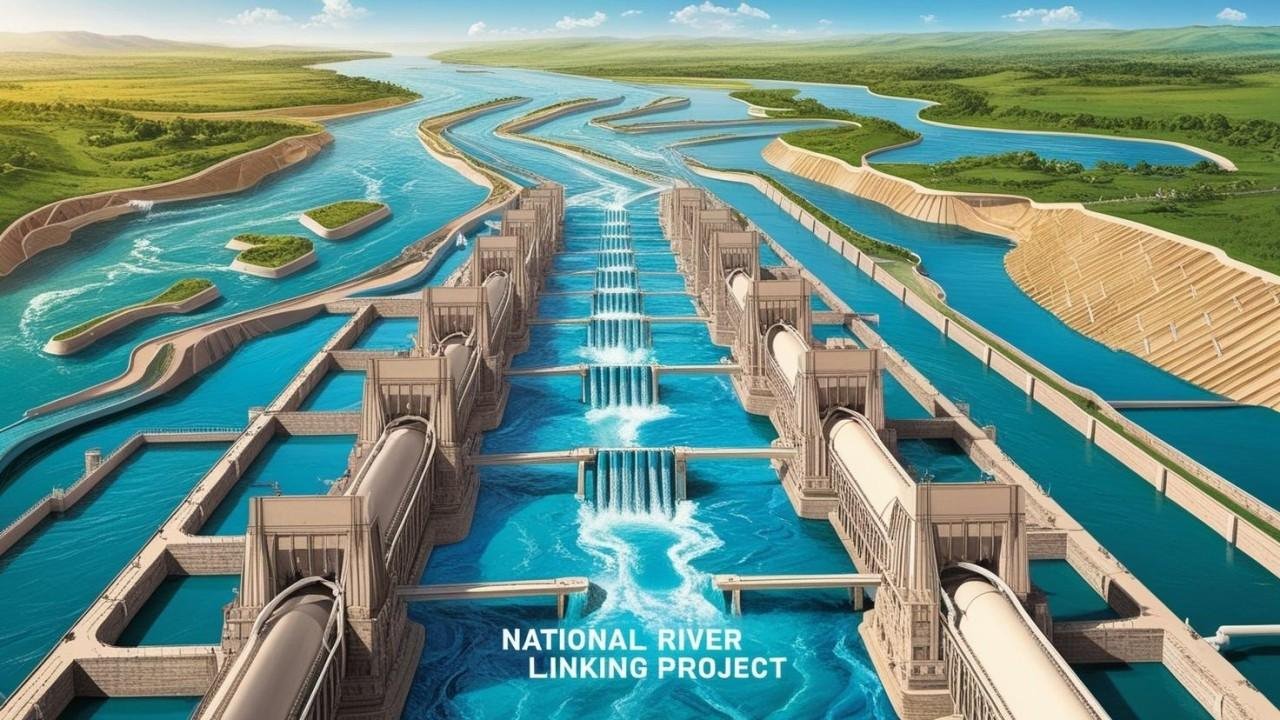
- River interlinking involves transferring water from one river basin to another through canals, dams, reservoirs, tunnels or pipelines.
- It aims to manage India’s uneven water availability by addressing regional shortages and seasonal floods caused by unequal rainfall and monsoon dependence.
- The National Water Development Agency (NWDA) conducts surveys, prepares Feasibility Reports (FRs) and Detailed Project Reports (DPRs) for projects under the National Perspective Plan (NPP).
Why is River Interlinking Considered?
- Irrigation security: Provides more reliable water to drought-prone areas and reduces dependence on monsoons.
- Flood moderation: Surplus water can be stored or transferred to water-deficient regions, subject to basin conditions.
- Water supply: Inter-basin transfers can supplement drinking and industrial water in water-stressed areas.
- Hydropower: Dams and related infrastructure can increase power-generation capacity.
- Regional development: Better access to water, irrigation and energy can support agricultural and economic development and reduce regional disparities.
Ken–Betwa Link Project: Key Features
- Location: Madhya Pradesh and Uttar Pradesh, covering the Bundelkhand region.
- Water transfer: From the Ken basin to the Betwa basin.
- Key structures: 96.7-metre Daudhan Dam on the Ken River in Panna and Chhatarpur districts of Madhya Pradesh and a 216.5-km link canal connecting the two river systems near Barua Sagar, Jhansi.
- Cost: Estimated at ₹44,605 crore.
- Expected benefits: Irrigation for 10.62 lakh hectares, drinking water for nearly 62 lakh people, and 103 MW hydropower + 27 MW solar power.
- Other components: Lower Orr Project, Kotha Barrage and Bina Complex Multipurpose Project.
Major Concerns
- Uncertain Water Availability:
- “Surplus” and “deficit” status can change with rainfall, river flows and groundwater levels.
- Climate change makes water availability more unpredictable, raising doubts about long-term surplus estimates.
- Ecological Impact:
- Rivers carry sediments, nutrients and aquatic life; altering their flows can disrupt wetlands, fisheries, groundwater recharge and river ecosystems.
- Dams and canals may also cause forest loss, habitat fragmentation and biodiversity loss.
- Ken–Betwa and Panna Concerns:
- The KBLP has environmental implications for the Panna landscape, including its wildlife habitats.
- Though mitigation measures such as compensatory afforestation and wildlife conservation are being undertaken, ecological impacts remain a major concern.
- Displacement and Rehabilitation:
- Large projects can involve land acquisition, forest diversion and displacement, affecting livelihoods and forest-dependent communities.
- Rehabilitation, resettlement and protection of tribal rights remain key concerns under the KBLP.
- Federalism and Water Conflicts:
- Water is a State subject, while inter-State rivers involve constitutional roles for the Centre.
- States may oppose transfers due to competing claims and uncertainty over future water needs, creating federal tensions.
- High Financial and Energy Costs:
- River linking requires large investments in dams, canals, tunnels and pumping systems.
- Long-distance water transfer can involve significant energy, maintenance and operational costs.
Way Forward
- Basin-level planning: Plan water use by considering surface water, groundwater, ecology and future demand together.
- Improve water-use efficiency: Expand drip/sprinkler irrigation, “More Crop Per Drop” and suitable cropping patterns. E.g. Pradhan Mantri Krishi Sinchayee Yojana (PMKSY).
- Strengthen groundwater management: Control over-extraction and promote aquifer recharge.
- Selective river linking: Undertake projects only after hydrological, environmental, economic and social assessment.
- Cooperative federalism: Involve States, local bodies, farmers and affected communities in water planning and sharing.
- Ensure fair rehabilitation: Provide timely compensation, livelihood support and community participation.
Conclusion
River interlinking can strengthen India’s water and food security, but cannot alone solve the water crisis. A resilient strategy should combine selective inter-basin transfers, efficient water use, groundwater conservation and cooperative river-basin governance.
FAQs
Q1. What is the National Perspective Plan for river interlinking?
Ans. The NPP, formulated in 1980, provides a framework for transferring water between relatively surplus and deficit river basins. It identifies 30 links—16 Peninsular and 14 Himalayan.
Q2. Q5. What is the main purpose of the Ken–Betwa Link Project?
Ans. To transfer water to water-deficient areas of Bundelkhand for irrigation, drinking water and power generation.
Q3. How does river interlinking involve federalism?
Ans. Water is primarily under the State List, while Parliament has powers concerning inter-State rivers. Therefore, interlinking requires Centre–State coordination and agreement on water sharing.
Q4. Why cannot river interlinking alone solve India’s water crisis?
Ans. Water stress also results from groundwater depletion, inefficient irrigation, water-intensive crops, pollution, urbanisation and climate change. Hence, it must be combined with water conservation and demand management.