Context
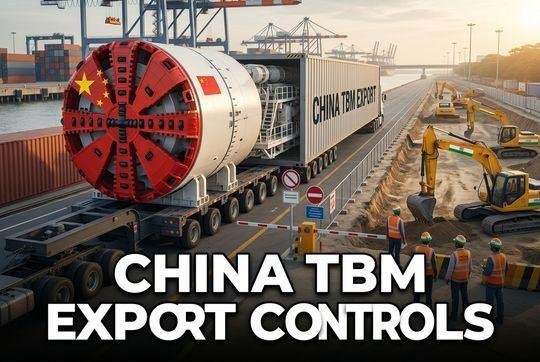
China’s export controls on Tunnel Boring Machines (TBMs), effective 18 November 2026, could affect India’s infrastructure projects, particularly the Mumbai–Ahmedabad High-Speed Rail Corridor, which has faced TBM supply delays.
About Tunnel Boring Machines (TBMs)
- Core Function: Specialized heavy machinery that excavates tunnel cross-sections through varied rock and soil strata while simultaneously installing precast tunnel linings.
- Key Applications: Critical infrastructure projects including urban metro rail networks, high-speed rail corridors, expressways, and subsea/underwater tunneling.
- Infrastructure Significance: Enables controlled sub-surface excavation, minimizing ground settlement and surface disruption compared to conventional drill-and-blast methods—making it ideal for dense urban areas and fragile Himalayan geology.
Key Features of China’s Export Controls
- Coverage: Specified TBMs, including earth-pressure-balance, slurry-shield and rock-boring machines, along with critical components and related technologies.
- Licensing and Certification: Exports to designated sensitive destinations require a licence, while other destinations are subject to registration and export-certificate requirements, as applicable.
- Objective: China cites national security and non-proliferation concerns, as TBMs and related technologies may have both civilian and strategic uses (dual-use).
- Implications for India: The measures do not constitute a blanket export ban or explicitly target India. Their impact depends on the applicable requirements and Chinese authorities’ decisions.
Implications for India
- Infrastructure Delays: Supply disruptions could delay the 508-km Mumbai–Ahmedabad High-Speed Rail Corridor, which includes a 7-km undersea tunnel, and increase project costs.
- Import Dependence: In 2024, India raised concerns over delays in receiving China-manufactured TBMs from Herrenknecht, a German tunnel-boring machine manufacturer. Shipments resumed in March 2026.
- Trade Imbalance: India’s trade deficit with China reached $69 billion in the first half of 2026–27, up 27% year-on-year.
- Supply-Chain Risks: TBM export controls and earlier restrictions on rare earth magnets highlight India’s dependence on foreign suppliers for critical technologies.
Challenges
- Supplier Dependence: Limited alternatives for specialised TBMs make it difficult to replace disrupted Chinese supplies quickly.
- Project Delays and Cost Overruns: Export licensing and compliance requirements may delay equipment deliveries and increase infrastructure costs.
- Escalating Trade Tensions: India’s trade imbalance with China and rising use of anti-dumping and anti-subsidy investigations may complicate bilateral trade relations. India initiated 18 such investigations in July–September 2026.
Way Forward
- Diversify Imports: Secure alternative suppliers to reduce dependence on China.
- Indigenous Manufacturing: Develop domestic TBM production, critical components and related technologies.
- Supply-Chain Resilience: Identify critical dependencies and maintain contingency plans for major infrastructure projects.
- Trade and Diplomacy: Balance engagement with China with the protection of domestic industries and strategic interests.
FAQs
Q1. What are Tunnel Boring Machines (TBMs)?
Ans. TBMs are specialised machines used to excavate tunnels through soil and rock for railways, highways and underwater infrastructure.
Q2. Do the new restrictions amount to a complete ban on TBM exports to India?
Ans. No, the measures do not impose a blanket ban or explicitly target India; their impact depends on applicable export requirements and licensing decisions.
Q3. What is a dual-use item?
Ans. A dual-use item has both civilian and potential military or strategic applications and may be subject to export controls.
Q4. How can India reduce its dependence on imported TBMs?
Ans. India can diversify suppliers, promote indigenous TBM manufacturing and strengthen domestic component production and supply chains.