Context
Banaras Hindu University (BHU) has begun examining artefacts excavated from Rajghat between 1957 and 1969, uncovering over 10,000 objects that had remained stored for nearly seven decades. The collection includes 3,000-year-old painted black pottery and a human skeleton that is now being studied using modern scientific techniques.
Where is Rajghat and why is it historically important?
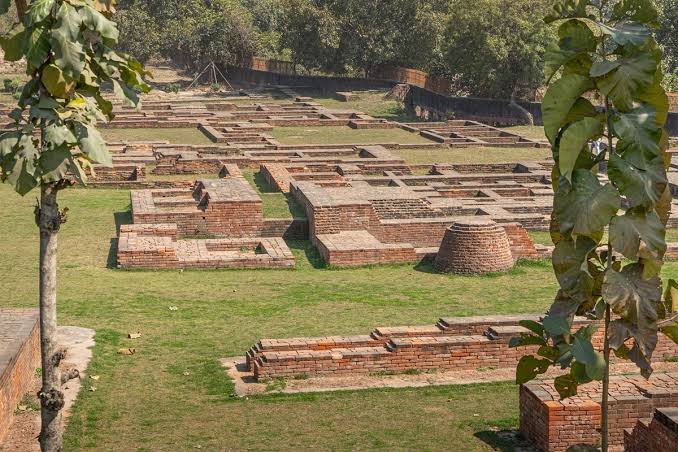
- Rajghat is located on the northeastern outskirts of Varanasi, near the confluence of the Ganga and Varana rivers.
- Archaeologists identify it with the ancient capital of the Kashi Janapada.
- Janapadas were territorial kingdoms that emerged during the later Vedic period, with some developing into Mahajanapadas by the 6th century BCE.
- Ancient Buddhist and Jain texts mention Kashi as one of the 16 Mahajanapadas.
- Archaeological evidence suggests that while Sarnath developed mainly as a religious centre, Rajghat became an important urban centre, with places such as Aktha and Ramnagar functioning more as peripheral settlements.
How were the Rajghat excavations carried out?
- The site came to attention in 1940, when archaeological remains were found during the expansion of Kashi Railway Station.
- A trial excavation was subsequently conducted by the Archaeological Survey of India (ASI).
- Large-scale excavation began in 1957, led by K. Narain and his colleagues from BHU.
- Excavations continued in four phases over 12 years and revealed the settlement’s oldest layers.
- The discovery of pre-Northern Black Polished Ware (pre-NBPW) pottery indicated an early Iron Age phase and initially placed the settlement’s origins around 800 BCE.
- The site was re-excavated in the early 2000s, and later scientific analysis confirmed the 800 BCE dating of its oldest layer.
What have the newly examined artefacts revealed?
The 10,000+ artefacts provide evidence about the region’s social, economic and cultural development.
They include:
- Sculptures and terracotta figurines
- Ancient and punch-marked coins
- Tools and iron objects
- Objects made of copper, ivory and bone
- Stamp seals and sealings
The seals and sealings are particularly important because some contain Greek inscriptions, while others mention administrative units and officials, offering clues about governance, trade and wider cultural contacts.
What is the difference between archaeological evidence and mythology?
- The ancient history of Varanasi needs to be understood through material evidence as well as textual traditions, without automatically treating mythology as archaeological fact.
- Its well-known association with Shiva and the Ganga largely comes from later religious texts and cannot by itself establish the archaeological age of the settlement.
- Archaeological evidence from the wider Varanasi region indicates settlements dating back to around 1800 BCE, while Rajghat’s oldest confirmed layer dates to around 800 BCE.
- Therefore, precise archaeological dating is important when reconstructing Varanasi’s past rather than simply describing sites as “pracheen” (ancient).
Why is BHU documenting the artefacts now?
- The initiative is part of the centenary celebrations of BHU’s Department of Ancient Indian History, Culture and Archaeology.
- Documentation began in January 2026, with around 4,000 artefacts recorded so far.
- Although excavation reports were already available, this is the first systematic effort to comprehensively document the collection.
- The project aims to preserve the department’s research legacy and make the material accessible to future researchers, with a museum also being planned.
How can modern technology provide new insights into Rajghat’s past?
The human skeleton recovered during the earlier excavations is being examined for the first time using modern scientific methods.
- When it was excavated in the 1960s, techniques for analysing ancient human remains were limited.
- Modern methods such as DNA analysis can potentially reveal information about the person’s age, ancestry and lifestyle.
- This demonstrates how old archaeological collections can generate new historical evidence when studied with modern technology.
Conclusion
The renewed study of Rajghat provides an opportunity to reconstruct Varanasi’s ancient urban history through scientific evidence, while keeping it distinct from later mythological traditions. The combination of archaeology, systematic documentation and modern DNA techniques can reveal new dimensions of life in one of India’s historically significant urban centres.
FAQs
Q1. Where is Rajghat located and why is it important?
Rajghat lies on the northeastern outskirts of Varanasi near the Ganga–Varana confluence, identified as the ancient capital of the Kashi Janapada, one of the 16 Mahajanapadas.
Q2. How were the Rajghat excavations carried out?
Excavations began in 1957 by BHU archaeologists, revealing early Iron Age layers with pre‑NBPW pottery dated to ~800 BCE; later re‑excavations confirmed this dating.
Q3. What artefacts have been found at Rajghat?
Over 10,000 objects including pottery, coins, terracotta figurines, tools, copper/ivory/bone items, and seals with Greek inscriptions and administrative references.
Q4. How does archaeology differ from mythology in Varanasi’s history?
Varanasi’s association with Shiva and the Ganga comes from later texts, while archaeological dating shows Rajghat’s oldest confirmed layer around 800 BCE, distinct from mythological claims.
Q5. Why is BHU documenting artefacts now and how can modern technology help?
As part of BHU’s centenary, artefacts are being systematically catalogued and studied; modern DNA analysis of a recovered skeleton may reveal age, ancestry, and lifestyle insights.