Context
The Supreme Court recently stressed that the Union and State Governments must follow cooperative federalism while implementing rules governing purse seine fishing in India’s territorial waters and Exclusive Economic Zone (EEZ).
What is Purse Seine Fishing?
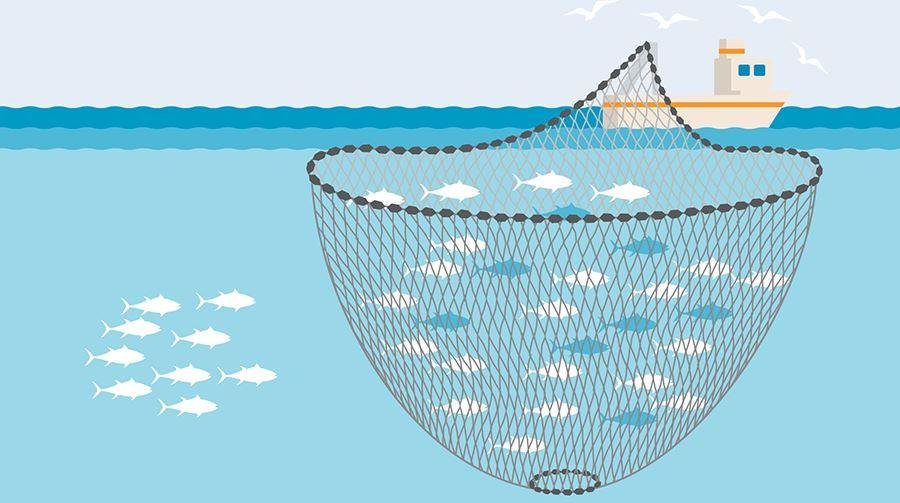
- Purse seine is a large fishing net used mainly to catch pelagic fish—species that live and move in the open-water column, rather than near the seabed.
- The net is spread around a concentrated fish school and its lower edge is then tightened using a purse line, trapping the fish inside.
- Purse line: A strong rope at the bottom of a purse seine net used to tighten and close the net, trapping the fish inside.
- The catch is subsequently brought onto the fishing vessel or alongside it.
- Depending on the vessel and target species, the net can be over 2 km long and around 200 m deep.
Advantages
- High efficiency: Large schools of fish can be caught in a single operation.
- Limited seabed disturbance: The net generally does not drag along the ocean floor.
- Potentially lower bycatch: When properly targeted, it can reduce the accidental capture of non-target species.
- Versatile: It can also be used around Fish Aggregating Devices (FADs), which attract fish and facilitate their capture.
Why is it Controversial in India?
Key Concerns
- Fish-stock depletion: Concerns over declining stocks of small pelagic fish such as sardines, mackerel, anchovies and trevally.
- Livelihood impact: Large-scale fishing may intensify competition for marine resources, affecting traditional and small-scale fishers.
- Bycatch: The method may unintentionally capture non-target or protected species, including turtles.
Current Restrictions
Due to these concerns, purse seine fishing is restricted or prohibited in the territorial waters of Tamil Nadu, Kerala, Puducherry, Odisha, Dadra and Nagar Haveli and Daman and Diu, and the Andaman and Nicobar Islands, up to 12 nautical miles.
Constitutional and Federal Dimension
- Territorial waters: Fisheries are a State subject under the Seventh Schedule, giving States authority over fishing within 12 nautical miles.
- EEZ: Fishing beyond territorial waters in the EEZ comes under the Union’s jurisdiction.
- Cooperative federalism: Regulation therefore requires Union–State coordination to balance conservation, fisher livelihoods and fishing rights.
Way Forward
- Sustainable fishing: Balance marine conservation with the livelihood needs of traditional fishers.
- Scientific regulation: Use fish-stock assessments, sustainable catch limits and effective monitoring to ensure responsible fishing.
- Stakeholder participation: Involve traditional fishing communities in policy-making to address livelihood concerns and reduce conflicts.
- Union–State coordination: Strengthen cooperative federalism for consistent regulation and better enforcement across maritime jurisdictions.
Additional Information:
Exclusive Economic Zone (EEZ)
- Definition: The EEZ is a maritime zone extending up to 200 nautical miles from a country’s baseline.
- Rights of India: India has sovereign rights to explore, exploit, conserve and manage living and non-living resources in its EEZ.
- Not Territorial Sea: Unlike the territorial sea (up to 12 nautical miles), the EEZ is not part of India’s sovereign territory; other States retain freedoms such as navigation and overflight.
- Legal Basis: Governed domestically by the Territorial Waters, Continental Shelf, Exclusive Economic Zone and Other Maritime Zones Act, 1976, while United Nations Convention on the Law of the Sea (UNCLOS) provides the international legal framework.
- India’s EEZ: India has an EEZ of about 2.37 million sq. km, providing significant resources for fisheries, hydrocarbons and other marine activities.
| Maritime Zone | Extent | Key Rights/Jurisdiction |
| Territorial Sea | Up to 12 nautical miles | India exercises sovereignty; coastal States regulate fisheries subject to applicable law. |
| Contiguous Zone | Up to 24 nautical miles | India can enforce laws relating to customs, immigration, sanitation and fiscal matters. |
| EEZ | Up to 200 nautical miles | India has sovereign rights over natural resources, including fisheries, oil and gas. |
| High Seas | Beyond EEZ | Not under any State’s sovereignty; governed by international law and UNCLOS. |
FAQs
Q1. What is purse seine fishing?
Ans: It uses a large net to surround a school of fish and then tightens the lower part of the net to trap the catch.
Q2. What are pelagic fish?
Ans: Pelagic fish live mainly in the open-water column rather than on or near the seabed. They include species such as sardines and mackerel.
Q3. Why is purse seine fishing considered efficient?
Ans: It can capture a large number of schooling fish in one operation and generally causes little direct disturbance to the seabed.
Q4. What is the significance of the 12-nautical-mile limit?
Ans: It broadly marks India’s territorial sea, where States have an important role in regulating fisheries under the constitutional division of powers.
Q5. What is bycatch?
Ans: Bycatch refers to the unintended capture of species that are not the primary target of fishing activity, including potentially protected marine animals.