Context
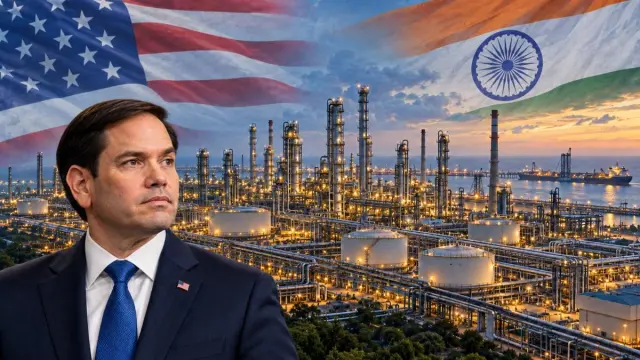
The proposed visit of US Secretary of State Marco Rubio to the Jamnagar refinery (Gujarat) highlights the role of energy cooperation in India–US trade relations, particularly amid efforts to expand US oil exports to India and reduce India’s dependence on Russian crude.
About Jamnagar Refinery
- Location & Ownership: Situated in Jamnagar, Gujarat, and operated by Reliance Industries Limited (RIL).
- World’s Largest Scale: Features a combined capacity of 2 MTPA (~1.4 million barrels per day), making it the world’s largest single-location refining complex.
- Dual Structure: Comprises a Domestic Tariff Area (DTA) refinery (serving local markets) and an export-oriented Special Economic Zone (SEZ)
- Key Capability: Can process heavy, complex crude grades into high-value refined fuels for domestic consumption and export.
Significance of Jamnagar Refinery
- Energy Security: Supplies critical domestic fuel from imported crude, mitigating energy risks as India’s crude import reliance reaches 7% (2025–26).
- Export Earnings: Enhances imported crude value into high-grade refined products (diesel, jet fuel), generating substantial foreign exchange.
- Supply-Chain Flexibility: Adapts to process varied crude oil grades (heavy, high-sulfur), allowing India to leverage price discounts and source diversification.
- Strategic Geo-Economics: Positions India as a key global refining hub and “swing refiner,” boosting trade leverage in energy markets.
- Private-Sector Role: Demonstrates how private energy infrastructure (Reliance Industries) drives national industrial capacity and export growth.
Strategic Drivers of US Interest
- Expand US Energy Exports: Boost exports of American crude oil and energy products to the Indian market.
- Process Venezuelan Heavy Crude: Leverage Jamnagar’s specialized capability to refine heavy and extra-heavy Venezuelan crude.
- Reduce Russian Oil Reliance: Encourage India to reduce dependence on Russian crude by diversifying its supplier base.
- Commercial Energy Ties: Promote technology exchange, energy investments, and joint ventures like Reliance’s proposed Texas refinery project.
- Bilateral Strategic Relations: Strengthen broader India–US trade and diplomatic ties through energy cooperation amidst tariff negotiations.
Challenges in India’s Refining & Energy Strategy
- Import Dependence: High reliance on imported crude (~88–89%) leaves India vulnerable to global price volatility and supply chain disruptions.
- Geopolitical Pressure: Navigating US and Western sanctions regarding discounted Russian oil imports risks straining ties with key diplomatic and energy partners.
- Commercial Viability: Refining profitability is directly tied to fluctuating Gross Refining Margins (GRMs), crude oil prices, shipping freight costs, and global demand shifts.
- Strategic Autonomy: India faces a delicate balancing act to maintain strategic autonomy, ensuring energy affordability while diversifying suppliers and maintaining global partnerships.
- Global Uncertainty: Ongoing geopolitical conflicts and maritime trade bottlenecks (e.g., Red Sea shipping disruptions) drive up energy costs and threaten supply security.
Way Forward for India’s Energy Strategy
- Diversify Crude Imports: Maintain a well-balanced portfolio of multiple suppliers to reduce vulnerability to single-country import dependence.
- Protect Commercial Interests: Prioritize competitive pricing, supply reliability, and overall national energy security in crude procurement.
- Strengthen Refining Capacity: Upgrade technology, infrastructure, and operational efficiency to expand high-value refined product exports.
- Expand Bilateral Cooperation: Deepen India–US energy partnerships spanning conventional oil trade, clean energy transition, and advanced technology.
- Maintain Strategic Autonomy: Strengthen strategic ties with global partners while preserving an independent foreign policy to safeguard national interests.
FAQs
Q1. Where is the Jamnagar refinery located?
Ans. It is located in Jamnagar, Gujarat.
Q2. What is the difference between the DTA and SEZ refineries?
Ans. The Domestic Tariff Area (DTA) refinery serves the domestic market, while the Special Economic Zone (SEZ) refinery is primarily export-oriented.
Q3. Why is the Jamnagar refinery strategically important for India?
Ans. Its large capacity and ability to process diverse crude grades support energy security, petroleum exports and supplier flexibility.
Q4. How does petroleum refining contribute to India’s economy?
Ans. It adds value to imported crude by producing refined fuels for domestic use and export, generating foreign-exchange earnings.