Context
The World Bank’s October 2026 Poverty and Equity Brief says India’s extreme poverty rate fell from 27.1% in 2011 to 2.6% in 2023. This is described as one of the fastest declines in the world, yet the same report points to uneven wages, concentration of poverty in some regions and weak job quality. The story is therefore one of strong progress along with unfinished work.
Understanding Poverty
Poverty is not only about low income, because it also means limited access to health, education, clean water and good jobs, and these together decide whether a person can live with dignity.
Two Ways of Measuring It
- Monetary Poverty: This checks whether a person or household earns or spends enough to cross a fixed income line, such as a certain number of dollars per day.
- Multidimensional Poverty: This checks deprivation in areas such as health, education and living standards, so it shows what money figures alone can miss.
World Bank Poverty Lines (2021 PPP)
- Extreme Poverty: $3.00 per person per day.
- Lower-Middle-Income Line: $4.20 per person per day, which suits countries like India.
- Upper-Middle-Income Line: $8.30 per person per day.
India’s Progress
Monetary Poverty
- Extreme Poverty: The share of Indians in extreme poverty fell from 27.1% in 2011 to 2.6% in 2023, which means the rate was cut to about a tenth in twelve years.
- Lower-Middle-Income Line: The share of people below $4.20 per day fell from 57.7% to 16.1% in this period.
- People Lifted Up: About 496 million people are estimated to have moved above the $4.20 line.
Multidimensional Poverty
- OPHI Measure: India’s MPI fell from 53.8% in 2005-06 to 16.4% in 2019-21, which shows large gains in health, education and living conditions.
- World Bank Measure: The World Bank’s own MPI figure for India was 15.5% in 2022-23.
Major reasons for the decline in poverty
- Economic growth and employment generation
- Economic growth has expanded opportunities in manufacturing, services, construction and other sectors.
- Growth in sectors such as IT, infrastructure, retail and tourism has created employment and increased household incomes.
- Expansion of small businesses and entrepreneurship has supported self-employment.
- Direct Benefit Transfer (DBT)
- The JAM Trinity (Jan Dhan, Aadhaar and Mobile) has enabled direct transfer of welfare benefits into beneficiaries’ bank accounts.
- It has reduced dependence on intermediaries, delays and leakages in welfare delivery.
- Example: PM-KISAN provides income support to eligible farmer families.
- Improvement in basic infrastructure
- Access to electricity, drinking water, sanitation, LPG connections and housing has improved living conditions.
- Examples:
- Swachh Bharat Mission – household toilets.
- Jal Jeevan Mission – tap water connections.
- Saubhagya – household electricity connections.
- PM Ujjwala Yojana – LPG connections.
- PMAY – affordable housing.
- Financial inclusion
- Pradhan Mantri Jan Dhan Yojana has expanded access to formal banking.
- Access to bank accounts, insurance, pensions and institutional credit improves the financial security of vulnerable households.
- Formal financial inclusion also facilitates savings and productive investment.
- Food security and nutritional support
- The National Food Security Act and Pradhan Mantri Garib Kalyan Anna Yojana have strengthened food security.
- The Public Distribution System provides subsidised foodgrains to eligible households.
- PM POSHAN and Anganwadi services support nutrition among children and mothers.
- Rural development and agricultural support
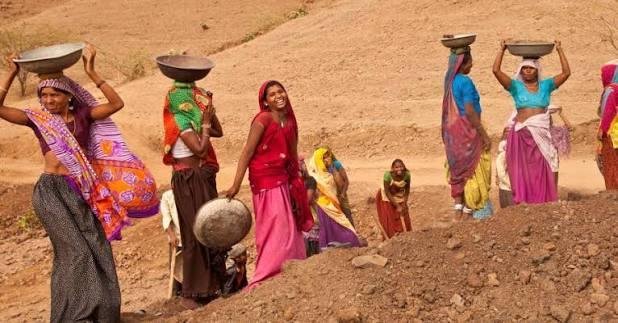
- MGNREGA provides a source of wage employment to rural households.
- PM-KISAN provides income support to eligible farmers.
- Rural roads, irrigation, storage facilities and market connectivity improve agricultural productivity and rural incomes.
- Education and healthcare
- Expansion of schools, scholarships and skill-development programmes improves human capital.
- Ayushman Bharat provides health insurance coverage to eligible beneficiaries.
- Better access to healthcare reduces the financial burden of illness on poor households.
Challenges in complete poverty alleviation
- Wide Pay Gap: In 2023, the median earnings of the top 10% of workers were about 13 times those of the bottom 10%.
- Inequality Data: The consumption-based Gini index fell from 28.8 in 2011-12 to 23.0 in 2023, but the World Bank cautions that household surveys may miss the spending of richer households, so inequality could be understated.
- The Poverty Belt: About 57% of India’s poor live in a continuous belt from Uttar Pradesh to West Bengal.
- Rising Youth Unemployment: The rate rose from 14.6% to 15.9% between the first quarters of FY2025-26 and FY2026-27, with a sharper rise among rural young women.
- Agrarian distress and climate vulnerability: Small landholdings, crop failure, floods and droughts threaten rural incomes. Example: Farmer indebtedness.
- Gender inequality and social exclusion: Discrimination, unequal wages and limited opportunities restrict economic mobility. Example: Unpaid care work and barriers faced by vulnerable communities.
Way Forward
- Boost Productive Jobs: Support manufacturing, labour-intensive services and small businesses so that new jobs pay better and last longer.
- Focus on Poorer Regions: Invest in infrastructure, industry and skills in the states of the poverty belt, so that growth reaches where poverty is deepest.
- Skills and Education: Improve vocational training and match skills with market needs, especially for young people and rural women.
- Support Women’s Work: Provide childcare, safe transport and fair pay, so that more women can join and stay in the workforce.
- Targeted Social Protection: Keep food and income support for the vulnerable, and use data to improve targeting and reduce leakages.
- Better Data: Update surveys regularly and use consistent methods, so that poverty and inequality can be tracked correctly.
Conclusion
India’s fall in poverty over the last decade shows that growth, job creation and welfare support can together change lives on a very large scale. The next phase will be harder, because the remaining challenge lies in uneven regional development, low-quality jobs, wide wage gaps and youth unemployment. Success will depend on moving from simply reducing poverty to building secure, well-paid livelihoods, so that people who have crossed the line do not slip back and every citizen gets a fair chance to prosper.
FAQs
Q1. What is poverty?
Ans: Poverty is a condition in which individuals lack sufficient income and access to basic necessities such as food, shelter, healthcare, education and a decent standard of living.
Q2. What is the difference between monetary and multidimensional poverty?
Ans: Monetary poverty measures deprivation based on income or consumption, whereas multidimensional poverty measures deprivation in health, education and living standards.
Q3. What is the Multidimensional Poverty Index (MPI)?
Ans: MPI measures overlapping deprivations in three dimensions: health, education and standard of living. It helps identify poverty beyond income levels.
Q4. Which organisation releases India’s National Multidimensional Poverty Index?
Ans: NITI Aayog releases India’s National MPI, based on the methodology developed by the Oxford Poverty and Human Development Initiative (OPHI) and UNDP.
Q5. What is the role of the JAM Trinity in poverty reduction?
Ans: JAM (Jan Dhan, Aadhaar and Mobile) facilitates financial inclusion and direct benefit transfers, reducing intermediaries and improving welfare delivery.