Context
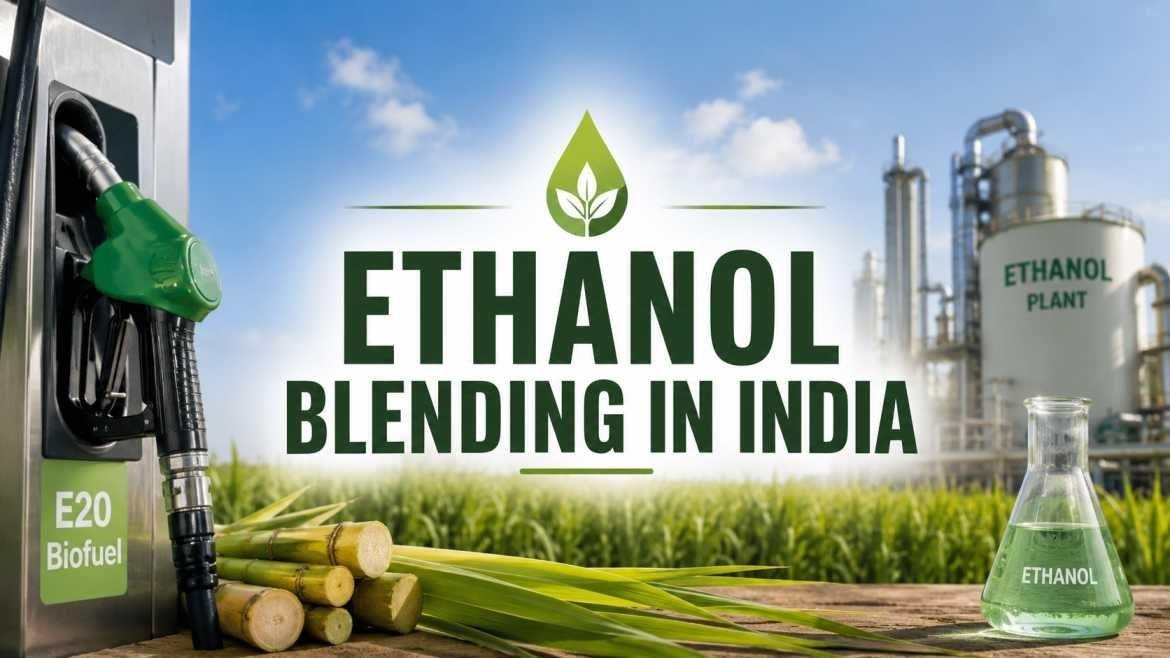
- India has achieved its nationwide E20 ethanol blending target ahead of the original 2030 deadline, marking a significant step towards reducing dependence on imported crude oil.
- However, ethanol blending alone cannot ensure long-term energy security. Excessive dependence on a limited number of agricultural feedstocks can create concerns relating to food security, water availability, agricultural sustainability and vehicle compatibility.
- A broader biofuel strategy involving biodiesel, used cooking oil, non-edible feedstocks and advanced biofuel technologies is therefore necessary.
Understanding Ethanol and Ethanol Blending
- What is ethanol?
- Ethanol is a transparent, volatile and flammable liquid with the chemical formula C₂H₅OH.
- It can be produced through two methods:
- Fermentation: Conversion of sugars obtained from agricultural materials into ethanol using microorganisms.
- Synthetic production: Production using petroleum-based feedstocks.
- Understanding E20 blending
- E20 refers to petrol containing 20% ethanol and 80% conventional petrol.
- India originally aimed to achieve 20% ethanol blending by 2030 but has achieved nationwide E20 distribution ahead of the deadline.
- Comparison with other countries
| Country | Standard ethanol blending level |
| India | E20 – 20% |
| USA | E10 – 10% |
| Brazil | E27 – 27% |
Key Properties of Ethanol as a Fuel
Ethanol offers certain advantages over conventional petrol, but also has limitations.
- Lower energy content: Ethanol contains approximately 33% less energy per litre than petrol. Consequently, vehicles using ethanol-blended petrol may experience a reduction in fuel economy.
- Higher octane rating: The octane number indicates a fuel’s resistance to premature ignition or engine knocking. A higher octane rating helps the engine operate more smoothly by reducing unwanted early ignition. Ethanol has a high octane rating and can improve the anti-knocking properties of petrol blends.
- Variation in fuel economy: Mileage and fuel efficiency depend on vehicle design, engine calibration and driving conditions. Therefore, the impact of ethanol blending is not uniform across all vehicles.
Generations of Bioethanol: Sources and Production Technologies
Bioethanol production has evolved through four generations. The major differences relate to the feedstocks used, their impact on food security and the level of technological intervention.
- First-Generation (1G) Bioethanol: Produced from edible agricultural crops grown on cultivable land. Major feedstocks include sugarcane, wheat, maize, cassava and other carbohydrate-rich crops. These materials undergo fermentation to produce ethanol.
- Major concern: Diverting food crops towards fuel production can create competition between food and fuel requirements, potentially increasing food prices.
- Second-Generation (2G) Bioethanol: Produced from non-edible plant materials and agricultural or organic waste. Feedstocks include wood, crop residues and other materials rich in lignocellulosic content. These materials can be processed to obtain sugars, which are then converted into ethanol.
- Lignocellulose is a major structural component of plant cell walls.
- Major advantage: It reduces direct competition with food crops and allows agricultural waste and non-edible biomass to be used for fuel production.
- Third-Generation (3G) Bioethanol: Primarily produced using algae and other suitable non-vascular biological sources. Algae can grow using sunlight and, depending on the species, can also utilise brackish water or wastewater. They do not require conventional agricultural land and can multiply rapidly, making them a promising biomass source.
- Major advantage: It reduces pressure on cultivable land and offers the possibility of producing biofuel using alternative water resources.
- Fourth-Generation (4G) Bioethanol: Involves advanced biotechnology and genetic engineering to develop organisms with improved fuel-production capabilities. Genetically modified organisms can be designed to absorb greater quantities of carbon dioxide and support its utilisation in biofuel production. This generation involves significant research and development and is still an advanced technological pathway.
Benefits of Ethanol Blending for India
- Strengthening Energy Security: Reduces dependence on imported crude oil, as India imports nearly 88% of its oil requirements. It has replaced nearly 245 lakh metric tonnes of crude oil and saved over ₹1.44 lakh crore in foreign exchange.
- Supporting Farmers and Rural Economy: It creates an additional market for sugarcane, surplus grains and agricultural residues. It generated over ₹1 lakh crore in direct payments to farmers since 2014–15, supporting rural incomes.
- Promoting Environmental Sustainability: It reduces fossil fuel consumption and associated carbon emissions. It has helped avoid nearly 736 lakh metric tonnes of CO₂ emissions. It also supports India’s climate targets, including 500 GW non-fossil energy capacity by 2030 and Net Zero by 2070.
- Promoting Circular Economy and Waste Management: It helps to convert agricultural waste and industrial by-products into useful fuel. Example: Molasses, a by-product of the sugar industry, is used for ethanol production. It promotes the Waste-to-Wealth approach and supports SDG 7 (Clean Energy) and SDG 13 (Climate Action).
Government Initiatives to Promote Ethanol and Alternative Biofuels
- E20 Fuel Quality Standards: Prescribes a minimum Research Octane Number (RON) of 95 for E20 petrol to ensure resistance to engine knocking and smoother operation.
- Scientific Studies on Vehicle Compatibility: Studies assess the long-term impact of ethanol-blended fuels on vehicle engines and components. Ethanol absorbs moisture (hygroscopic nature), which may cause corrosion in certain fuel-system components.
- Pradhan Mantri JI-VAN Yojana: Promotes 2G ethanol production from agricultural residues and non-edible biomass. Provides financial support to establish 2G ethanol plants, reducing food-versus-fuel competition.
- GOBARdhan Initiative: Converts cattle dung and organic waste into biogas and other useful resources. Promotes waste-to-wealth and reduces methane emissions from unmanaged organic waste.
- Repurpose Used Cooking Oil (RUCO) Initiative: Launched by FSSAI to collect used cooking oil and convert it into biodiesel. Prevents repeated-use cooking oil from re-entering the food chain and promotes waste management.
Challenges Associated with Ethanol Blending and Way Forward
| Challenges | Way Forward |
| 1. Food vs Fuel Competition: Use of food crops for ethanol can affect food availability. | Promote 2G ethanol from agricultural residues and non-edible biomass to reduce food-fuel competition. |
| 2. High Water Consumption: Production of 1 litre of ethanol may require ~ 3,000 litres of water. Sugarcane- based production also increases groundwater pressure. | Promote water-efficient technologies and less water-intensive feedstocks; encourage crop diversification. |
| 3. Agricultural & Environmental Concerns: Monoculture and excessive use of fertilisers, pesticides and irrigation can cause soil degradation and loss of crop diversity. | Encourage sustainable farming, crop diversification and environmentally suitable feedstocks. |
| 4. Vehicle Compatibility & Mileage: E20 can reduce fuel efficiency by around 6–7%. Older vehicles may face engine-component compatibility & maintenance issues. | Invest in engine optimisation, vehicle compatibility testing and consumer awareness. |
| 5. Feedstock and Supply-chain Constraints: Dependence on agricultural crops makes it vulnerable to poor harvests, extreme weather & monsoon fluctuations. | Adopt a multi-feedstock approach and strengthen the collection, transportation and storage of agricultural residues. |
| 6. Storage Issues: Ethanol’s moisture- absorbing nature also creates storage & corrosion concerns. | Improve fuel-storage infrastructure, moisture control, fuel-quality monitoring and vehicle compatibility standards. |
| 7. Limited Alternative Biofuel Diversification: Excessive dependence on ethanol limits the use of other potential biofuels. | Promote biodiesel from used cooking oil and non-edible oilseeds, supported by suitable tax incentives and investment. |
India needs a diversified biofuel strategy combining ethanol, biodiesel and 2G biofuels, rather than relying excessively on crop-based ethanol alone.
Conclusion
Ethanol blending is an important step towards reducing India’s dependence on imported fossil fuels, but it cannot independently guarantee energy security. India must adopt a diversified biofuel strategy combining ethanol, biodiesel, agricultural waste and advanced technologies while balancing energy needs with food security, water conservation and environmental sustainability.
Frequently Asked Questions (FAQs)
Q1. What is E20 ethanol blending, and what is India’s achievement?
E20 refers to petrol containing 20% ethanol and 80% conventional petrol. India has achieved nationwide E20 distribution ahead of its original 2030 target.
Q2. What are the four generations of bioethanol?
First-generation uses edible crops; second-generation uses agricultural residues and non-edible biomass; third-generation uses algae; and fourth-generation uses advanced biotechnology and genetically engineered organisms.
Q3. How does ethanol blending contribute to India’s energy security?
It reduces crude oil imports, replacing nearly 245 lakh metric tonnes of crude oil and saving over ₹1.44 lakh crore in foreign exchange. It also supports farmers and rural incomes.
Q4. What are the major challenges associated with ethanol blending?
Key challenges include food-versus-fuel competition, high water consumption, agricultural sustainability concerns, reduced vehicle mileage, engine compatibility issues, feedstock constraints and ethanol’s moisture-absorbing nature.
Q5. Which government initiatives promote ethanol and alternative biofuels in India?
Major initiatives include E20 Fuel Quality Standards, Pradhan Mantri JI-VAN Yojana for 2G ethanol, GOBARdhan for organic waste utilisation and FSSAI’s RUCO initiative for converting used cooking oil into biodiesel.