Context
- The debate on India’s governance model calls for a comparison between the 2004–2014 period, often described as a “lost decade”, and the developments since 2014.
- The central concern is whether governance is creating tangible improvements in citizens’ lives and ensuring that opportunities depend on merit, skills and hard work rather than political connections.
- For India’s young electorate, the quality of governance will be reflected in the opportunities available, the accountability of institutions and the country’s ability to achieve sustainable prosperity.
Transforming the Citizen-State Relationship: From Political Patronage to Merit
- Ensuring equal access to economic opportunities
- During 2004–2014, access to contracts, credit and capital was allegedly influenced by political connections, often benefiting influential business groups at the expense of smaller entrepreneurs.
- A 2012 Credit Suisse report pointed towards the concentration of bank borrowing among major business groups, while small entrepreneurs faced difficulties in accessing credit.
- Good governance requires transparent and merit–based allocation of resources so that individuals and businesses can access opportunities without depending on political influence.
- Direct Benefit Transfer (DBT): Reducing intermediaries in welfare delivery
- Earlier, concerns were raised about leakages in welfare expenditure, with only a fraction of the allocated funds reportedly reaching intended beneficiaries.
- The JAM Trinity – Jan Dhan, Aadhaar and Mobile – transformed welfare delivery by enabling direct transfers into beneficiaries’ bank accounts. Since 2014, more than ₹53 lakh crore has reportedly been transferred directly to citizens through DBT.
- DBT is not merely a technological reform; it strengthens transparency, financial inclusion and accountability by reducing the role of intermediaries.
Poverty Reduction and Inclusive Development
- Reduction in multidimensional poverty
- Effective governance must translate economic growth and welfare programmes into improvements in people’s living conditions.
- According to NITI Aayog estimates, nearly 250 million Indians moved out of multidimensional poverty over nine years.
- The multidimensional poverty headcount ratio declined from 29.17% in 2013–14 to 11.28% in 2022–23.
- Direct financial assistance to farmers, amounting to approximately ₹4.47 lakh crore, has also contributed to strengthening rural economic security.
- Significance for inclusive development
- Poverty reduction improves access to basic necessities and strengthens people’s ability to participate in economic activities.
- Financial security and improved living conditions can create a positive cycle of poverty reduction, dignity, economic stability and human development.
Fiscal Discipline: Balancing Welfare Expenditure and Capital Formation
- Welfare programmes are essential for social protection, but financing recurring expenditure through excessive borrowing can weaken long-term economic development.
- High revenue expenditure and debt-servicing obligations may leave governments with fewer resources for infrastructure, industrial development and employment generation.
- Karnataka: State borrowings reportedly increased from ₹90,280 crore to ₹1.04 lakh crore in a year. The rise has been linked to expenditure on guarantee schemes, raising concerns about the crowding out of capital expenditure. Lower capital investment can affect infrastructure creation, industrial capacity and employment opportunities.
- Keralam: A White Paper released in June 2026 reportedly documented debt of ₹5.07 lakh crore accumulated over a decade. The state was reportedly in RBI overdraft for 84 days during 2025. Capital expenditure stood at around 1.3% of GSDP, substantially below the national average. High public debt and relatively low capital investment can restrict the state’s ability to create productive assets and support future growth.
- Broader significance: Fiscal discipline does not mean reducing essential welfare expenditure. It requires balancing immediate social protection with long-term investments that generate economic opportunities and strengthen productive capacity.
Political Disruption versus Democratic Accountability
- Protecting the right to dissent: Peaceful protest and criticism of the government are essential features of democracy. Citizens must retain the right to question those in power. However, democratic dissent must be distinguished from deliberate disruption of governance for political gains.
- Forms of political disruption: Repeated disruption of Parliament, preventing legislative proceedings from functioning effectively. Blocking highways as a pressure tactic, affecting public movement and essential activities. Creating an artificial appearance of political crisis without presenting credible alternative policies. Such practices can replace meaningful debate with political confrontation and weaken the functioning of democratic institutions.
- Impact on young citizens and democratic values: Repeated political disruption can create cynicism and discourage meaningful public participation. It may also create the misconception that generating disorder is equivalent to demonstrating the ability to govern.
- When political confrontation dominates public debate, attention shifts away from measurable governance outcomes and institutional accountability.
- Given India’s large youth population, developing informed political values and encouraging constructive democratic participation are important for the future of democracy.
Governance and State-Level Development
- The performance of state governments can be assessed through outcomes such as economic growth, investment, infrastructure creation, employment and fiscal sustainability.
- Different state experiences illustrate how governance and financial management influence development.
- Examples:
- Uttar Pradesh: Its transformation from a BIMARU state into a ₹36 lakh crore economy, accompanied by a revenue surplus and improved investor confidence, illustrates the importance of economic and administrative performance.
- Maharashtra: The state reportedly received more than half of India’s FDI inflows in a single quarter, reflecting its position as a major investment destination.
- Karnataka: Rising borrowings and welfare expenditure have raised concerns about the resources available for capital investment.
- Keralam: High public debt, fiscal stress and low capital expenditure pose challenges to future investment and development.
Governance, Technology and Institutional Accountability
- Technology and governance systems must be designed around citizens’ needs rather than the convenience of those administering them.
- The objective should be to build institutions that empower citizens and reduce their dependence on political intermediaries.
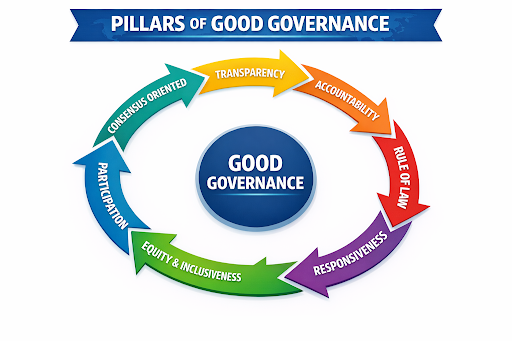
- Key requirements of effective governance:
- Transparency: Ensure openness in public expenditure and government decision-making.
- Accountability: Make institutions and public officials answerable for the use of public resources.
- Efficient service delivery: Ensure that welfare benefits and public services reach citizens without unnecessary delays or intermediaries.
- Merit-based opportunities: Promote fair access to economic resources and opportunities.
- Fiscal sustainability: Maintain financial discipline while investing in infrastructure and other productive assets.
- Such an approach can make governance more citizen-centric, transparent and outcome-oriented.
Conclusion
The true measure of good governance lies in expanding citizens’ opportunities, ensuring institutional accountability and creating sustainable prosperity. India’s future depends on building transparent, merit-based institutions that enable the next generation to succeed through its abilities rather than political connections.
Frequently Asked Questions (FAQs)
Q1. What are the key principles of good governance?
Good governance is based on transparency, accountability, efficient service delivery, merit-based opportunities and fiscal sustainability. It aims to create citizen-centric institutions that ensure fair access to resources and improve people’s living conditions.
Q2. How does Direct Benefit Transfer (DBT) improve governance in India?
DBT uses the JAM Trinity—Jan Dhan, Aadhaar and Mobile—to transfer welfare benefits directly into beneficiaries’ bank accounts. It reduces intermediaries and leakages while strengthening transparency, financial inclusion and accountability.
Q3. What is multidimensional poverty, and how has India performed in reducing it?
Multidimensional poverty measures deprivation across multiple aspects of life rather than income alone. According to NITI Aayog estimates, nearly 250 million Indians moved out of multidimensional poverty between 2013–14 and 2022–23.
Q4. Why is fiscal discipline important for sustainable development?
Fiscal discipline balances welfare expenditure with long-term investments. Excessive borrowing and high revenue expenditure can reduce resources for infrastructure, industrial development, employment generation and other productive assets.