Context
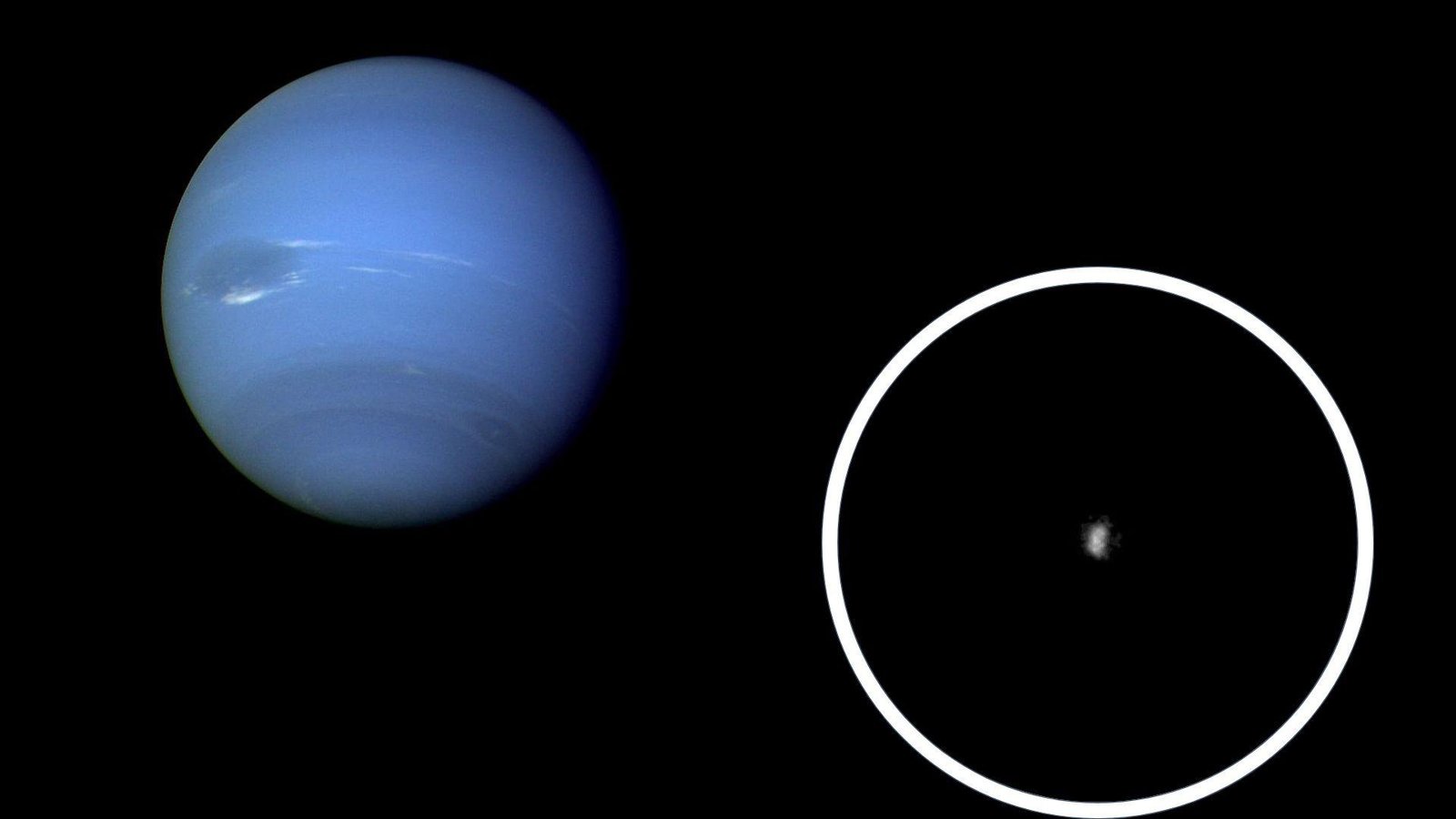
Recent observations from the James Webb Space Telescope have indicated that the crystalline water ice and spectral properties of Neptune’s moon Nereid differ from those of known Kuiper Belt objects, raising doubts about its origin in the Kuiper Belt.
About Nereid
- Nereid is the third-largest moon of Neptune and is about 170 km across.
- It was discovered on 1st May 1949 by Dutch astronomer Gerard Kuiper and was named after the sea nymphs of Greek mythology.
- The moon is notable for having one of the most eccentric orbits among moons in the Solar System.
- Nereid takes nearly 360 Earth days to complete one orbit around Neptune.
- Scientists earlier believed that it may have originated from the Kuiper Belt and was later captured by Neptune’s gravity.
- Observations made using the James Webb Space Telescope showed that its crystalline water ice composition differs from known Kuiper Belt Objects (KBOs).
- The findings suggest that Nereid may have formed as part of Neptune’s original satellite system.
Kuiper Belt
- The Kuiper Belt is a cold, disk-shaped region located beyond the orbit of Neptune.
- It contains icy bodies and remnants from the formation of the Solar System around 4.6 billion years ago.
- The region is significantly larger and more massive than the asteroid belt located between Mars and Jupiter.
- Objects present in this region are known as Kuiper Belt Objects (KBOs), of which Pluto is the best-known example.
- KBOs mainly consist of rock, water ice and frozen compounds such as methane and ammonia.