Context
Scientists have recently improved understanding of how Naegleria amoebae move from the nasal cavity towards the brain, using the non-pathogenic relative Naegleria gruberi as a laboratory proxy for Naegleria fowleri.
The research is significant because direct study of N. fowleri is difficult, while N. gruberi offers a safer model for examining related biological mechanisms.
About Naegleria fowleri
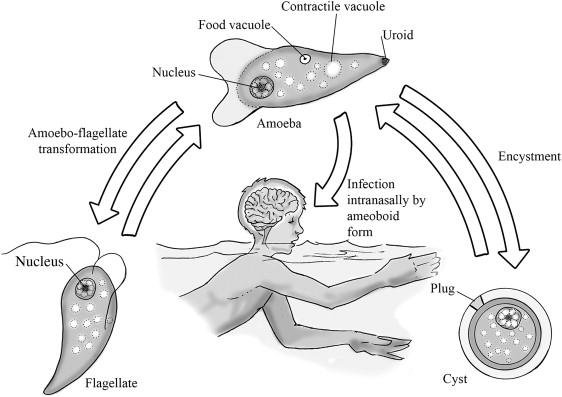
- Naegleria fowleri is a free-living, single-celled amoeba, commonly called the “brain-eating amoeba.”
- It is found mainly in warm freshwater and soil.
- Common habitats include:
- lakes;
- ponds;
- rivers;
- hot springs;
- inadequately disinfected recreational water.
- Among known Naegleria species, N. fowleri** is the species known to cause human infection**.
- Its growth is favoured by warm water, making infections more associated with hotter months.
How Does It Reach the Brain?
Infection occurs when contaminated water enters the nose.
The amoeba then follows the olfactory route towards the central nervous system.
The pathway can be understood as:
Contaminated water enters nose → Nasal tissue → Olfactory nerve pathway → Brain → Severe inflammation
This explains why nasal exposure is critical in infection.
Why Is the New Research Important?
Safer Disease Modelling
- gruberi is non-pathogenic but biologically related to N. fowleri.
Using it as a proxy allows researchers to study movement, cellular behaviour and related mechanisms without working directly with the highly dangerous pathogen.
Understanding Neuroinvasion
The research may help identify:
- how amoebae move through nasal tissue;
- how they interact with olfactory pathways;
- which stages of migration may be biologically vulnerable.
This improves understanding of how neuroinvasion occurs, which is essential for future therapeutic research.
Better Target Identification
Understanding the infection mechanism may help researchers identify specific molecular or cellular targets that could eventually be used to block progression before the amoeba reaches the brain.
What Is Primary Amoebic Meningoencephalitis?
Primary Amoebic Meningoencephalitis (PAM) is a rare but rapidly progressing infection of the brain caused by N. fowleri.
The infection produces severe inflammation and destruction of brain tissue.
Symptoms
Early symptoms may include:
- headache;
- fever;
- nausea;
- vomiting.
Later symptoms may include:
- stiff neck;
- confusion;
- seizures;
- hallucinations;
- coma.
PAM progresses rapidly and has a very high fatality rate.
Treatment
PAM is extremely difficult to treat because:
- the disease progresses rapidly;
- diagnosis is often delayed;
- effective therapy is limited.
Current treatment may involve combinations of drugs such as:
- amphotericin B;
- azithromycin;
- fluconazole;
- rifampin;
- miltefosine;
- dexamethasone.
These regimens are based on limited clinical experience and rare survivor cases, so outcomes remain poor.
Prevention and Public-Health Significance
Because PAM is rare but highly lethal, prevention is especially important.
Useful precautions include:
- using nose clips while diving or swimming in warm freshwater;
- avoiding forceful water entry into the nose;
- avoiding disturbance of sediment in warm shallow water;
- using distilled, sterile, or boiled-and-cooled water for nasal rinsing;
- ensuring proper chlorination of pools.
The broader public-health lesson is:
Rare disease + Very high fatality + Limited treatment → Prevention and early recognition are critical
FAQs
Q1. What is Naegleria fowleri?
A free-living single-celled amoeba that can cause Primary Amoebic Meningoencephalitis.
Q2. Where is it commonly found?
Mainly in warm freshwater, soil, hot springs and inadequately disinfected recreational water.
Q3. Can infection occur by drinking contaminated water?
No. Infection typically occurs when contaminated water enters the nose.
Q4. Does Naegleria fowleri spread from person to person?
No. PAM is non-communicable.
Q5. Why is Naegleria gruberi used in research?
Because it is a closely related but non-pathogenic proxy, allowing safer study of Naegleria biology and infection-related mechanisms.