Context
Kozhikode district, Kerala, has reported 161 confirmed measles cases and one death in 2026, prompting stronger surveillance and vaccination efforts. Many cases were reported among unvaccinated individuals, highlighting gaps in immunisation coverage.
About Measles
- Measles is a highly contagious airborne viral disease that can cause serious complications and death.
- It is caused by the measles virus, belonging to the genus Morbillivirus of the Paramyxoviridae family.
- The virus initially infects the respiratory tract and then spreads throughout the body.
- Severe disease is more likely among children below five years, malnourished children, pregnant women and immunocompromised people.
Transmission and Symptoms
- It spreads through coughing, sneezing and infected respiratory secretions, as well as contaminated air.
- The virus can remain infectious in the air or on surfaces for up to two hours.
- An infected person can transmit measles from about four days before to four days after the rash appears.
- Symptoms usually begin 7–14 days after exposure and include high fever, cough, runny nose, red watery eyes and Koplik spots inside the cheeks.
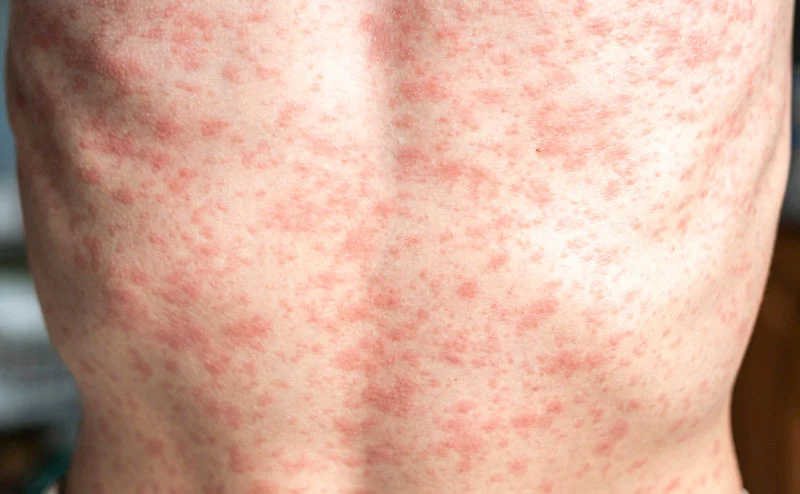
- The characteristic rash begins on the face and upper neck and then spreads downward.
Complications
- Measles can cause pneumonia, encephalitis, severe diarrhoea and dehydration, ear infections and blindness.
- Complications are particularly serious among young children, malnourished people and those with weakened immunity.
Treatment and Prevention
- There is no specific antiviral treatment routinely used for measles; management is mainly supportive.
- WHO recommends vitamin A for children under five with suspected measles, under medical supervision, to reduce complications.
- Vaccination is the most effective preventive measure.
- Under India’s Universal Immunization Programme (UIP), the Measles-Rubella (MR) vaccine is routinely given in two doses:
- MR-1: 9–11 months
- MR-2: 16–23 months
- Two-dose vaccination provides strong protection and helps prevent outbreaks.
FAQs
Q1. What causes measles?
It is caused by the measles virus, a member of the Paramyxoviridae family.
Q2. How does measles spread?
It spreads mainly through airborne respiratory droplets and secretions.
Q3. What are Koplik spots?
They are small white spots inside the cheeks, characteristic of measles.
Q4. Is there a specific antiviral cure for measles?
No. Treatment is mainly supportive.
Q5. What is the MR vaccine schedule under India’s UIP?
It is routinely given at 9–11 months and 16–23 months.