Context
Linguistic reorganisation has recently returned to public debate as discussions around India’s linguistic diversity and the historical reorganisation of States have gained attention.
Background
- At Independence, India inherited territorial units from the British provinces and princely States. Their boundaries did not always match linguistic, cultural or administrative identities.
- The challenge was to accommodate regional aspirations while maintaining administrative efficiency, economic viability and national unity.
Evolution of State Reorganisation
- Dhar Commission, 1948: Headed by S.K. Dhar, it examined linguistic provinces but did not support immediate reorganisation solely on linguistic grounds. It emphasised administrative convenience, economic viability, geographical contiguity, financial self-sufficiency and national unity.
- JVP Committee, 1948–49: Comprising Jawaharlal Nehru, Vallabhbhai Patel and Pattabhi Sitaramayya, it initially opposed immediate linguistic States but recognised that regional aspirations could not be ignored indefinitely.
- The demand for a separate Telugu-speaking State became a turning point. After Potti Sriramulu died in 1952 following a prolonged fast, the Andhra State Act, 1953 created Andhra State on 1 October 1953. This encouraged similar linguistic demands elsewhere.
- The Government subsequently established the States Reorganisation Commission (SRC) in 1953 under Justice Fazl Ali, with H.N. Kunzru and K.M. Panikkar as members. It submitted its report in 1955.
- The SRC accepted linguistic and cultural identity as important but also considered administration, economic viability, geography, development, national unity and security.
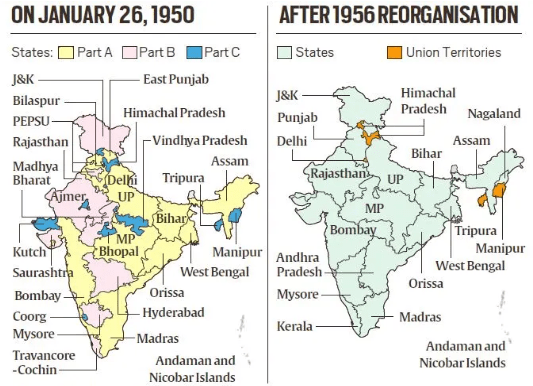
- The States Reorganisation Act, 1956, along with the Seventh Constitutional Amendment Act, 1956, abolished the earlier Part A, Part B and Part C classification and created 14 States and 6 Union Territories.
Major Reorganisation After 1956
- 1960: The bilingual Bombay State was divided into Maharashtra and Gujarat under the Bombay Reorganisation Act, 1960.
- 1966: Punjab was reorganised; Haryana was created, Chandigarh became a Union Territory and certain hill areas were transferred to Himachal Pradesh.
- In the Northeast, State formation reflected tribal and ethnic aspirations, geographical isolation, security concerns and administrative requirements. States such as Nagaland, Meghalaya, Manipur, Tripura, Mizoram and Arunachal Pradesh emerged through successive constitutional and statutory changes.
- 1987: Goa became a State, while Daman and Diu continued as a Union Territory.
- 2000: Chhattisgarh, Uttarakhand and Jharkhand were created from Madhya Pradesh, Uttar Pradesh and Bihar, respectively. Regional development, administrative convenience and geographical identity were important considerations.
- 2014: Telangana was created from Andhra Pradesh through the Andhra Pradesh Reorganisation Act, 2014. The movement was driven by concerns involving regional identity, political representation, development and resource distribution.
Constitutional Framework
- Article 2: Parliament can admit or establish new States on terms and conditions it considers appropriate.
- Article 3: Parliament can create a new State or alter the area, boundaries or name of an existing State. A Bill requires the President’s recommendation. Where a proposal affects the area, boundaries or name of a State, its Legislature is consulted, but its views are not binding on Parliament.
- Article 4: Laws under Articles 2 and 3 may make consequential changes to the First and Fourth Schedules and parliamentary representation. Such laws are not treated as constitutional amendments under Article 368.
Significance
- Linguistic reorganisation provided a democratic outlet for regional aspirations and helped reduce prolonged political tensions.
- It also created greater space for the preservation of language, literature and cultural traditions.
- By accommodating regional identities within the constitutional framework, it contributed to national integration and “unity in diversity.”
- Reorganisation made Indian federalism more politically responsive and showed that internal boundaries could change while preserving India’s territorial integrity.
- Zonal Councils, created under the States Reorganisation Act, 1956, provided an institutional mechanism for promoting inter-State cooperation.
Continuing Challenges
- Linguistic and regional identities can encourage regionalism and identity-based politics.
- Inter-State disputes continue over boundaries, river waters, natural resources, electricity and territorial assets.
- Creation of States has not ended demands for smaller States arising from regional inequality, developmental neglect and geographical isolation.
- Linguistic minorities within States require protection of their cultural and educational rights.
- Smaller States may face concerns regarding revenue generation, fiscal dependence, administrative capacity and infrastructure.
Way Forward
- Demands for new States should be assessed through multiple criteria, including administrative viability, economic sustainability, geographical contiguity, developmental needs, cultural identity and national security.
- Strengthen the Inter-State Council and Zonal Councils for greater cooperation.
- Protect the rights of linguistic and cultural minorities.
- Resolve boundary and resource disputes through negotiation, institutional mechanisms and constitutional processes.
- Address regional aspirations through democratic and constitutional means.
FAQs
Q1. Was language the only basis for State reorganisation?
Ans: No. Language became an important factor, but administrative, economic, geographical, developmental, cultural and security considerations also influenced the formation of States.
Q2. Why was the Andhra movement important?
Ans: The movement led to the creation of Andhra State in 1953, establishing an important precedent for linguistic reorganisation after Independence.
Q3. What is the key feature of Article 3?
Ans: Article 3 empowers Parliament to create States and alter their area, boundaries or names. The concerned State Legislature is consulted, but its views are not binding.
Q4. Why did demands for new States continue after linguistic reorganisation?
Ans: Later movements increasingly focused on regional development, geographical isolation, administrative needs and political aspirations, rather than language alone.
Q5. How did linguistic reorganisation support national integration?
Ans: It gave regional identities constitutional and democratic space within the Union, helping accommodate diversity without weakening national unity.
Q6. What is the role of Zonal Councils?
Ans: Created under the States Reorganisation Act, 1956, they provide a forum for inter-State cooperation.