Context
A magnitude 7.0 earthquake recently struck Russia’s Kamchatka Peninsula, highlighting the intense seismic activity of this highly tectonic and volcanic region.
Location and Physical Geography
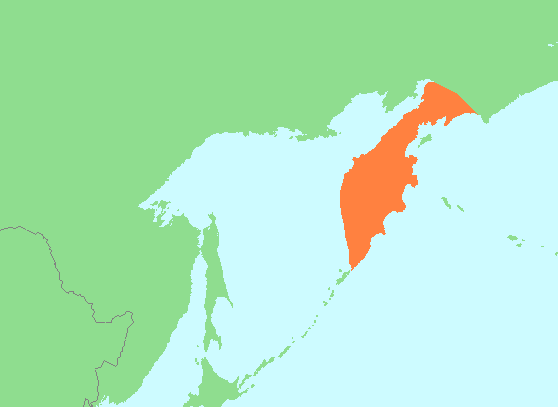
- Kamchatka Peninsula lies in the Russian Far East and forms part of Kamchatka Krai.
- It projects southward between the Sea of Okhotsk on the west and the Pacific Ocean and Bering Sea on the east.
- The peninsula is about 1,200 km long and is one of the largest peninsulas in the world.
- Its relief is dominated by the Sredinny (Central) Range and the Eastern Range, separated by the Central Kamchatka Depression.
- Klyuchevskaya Sopka, about 4,800 m high, is the highest point of the peninsula and the highest active volcano in Eurasia.
- The Kamchatka River is the principal river and flows through the central lowland before entering the Pacific.
- The Kuril Islands extend southwestward from the peninsula toward Hokkaido, Japan.
Tectonic and Volcanic Setting
- Kamchatka forms part of the Pacific Ring of Fire and lies along the Kuril–Kamchatka volcanic arc.
- Along the Kuril–Kamchatka subduction zone, the Pacific Plate descends beneath the Okhotsk microplate, generating frequent earthquakes, volcanic eruptions and geothermal activity.
- This subduction system is associated with the deep offshore Kuril–Kamchatka Trench.
- The UNESCO World Heritage Site “Volcanoes of Kamchatka” is a serial property comprising six protected components.
- The region contains stratovolcanoes, calderas, lava fields, glaciers, geysers, hot springs and geothermal systems.
Ecological and Scientific Significance
- Tectonic value: Natural laboratory for studying subduction, volcanism and earthquakes.
- Geomorphic value: Volcanism and glaciation together create distinctive landforms.
- Biodiversity value: Supports brown bears, sea otters, Steller’s sea eagles and rich salmon populations.
- Geothermal value: Hot springs and geothermal fields reflect intense subsurface heat.
- Hazard relevance: Important for earthquake, tsunami and volcanic-hazard research.
FAQs
Q1. Where is the Kamchatka Peninsula located?
It lies in the Russian Far East, between the Sea of Okhotsk and the Pacific Ocean–Bering Sea region.
Q2. Which mountain ranges dominate Kamchatka?
The Sredinny Range and Eastern Range.
Q3. What is the highest point of Kamchatka?
Klyuchevskaya Sopka, about 4,800 m high.
Q4. Why is Kamchatka highly earthquake-prone?
It lies along the Kuril–Kamchatka subduction zone, where the Pacific Plate descends beneath the Okhotsk microplate.
Q5. What is the UNESCO World Heritage Site in the region called?
The Volcanoes of Kamchatka.