Context
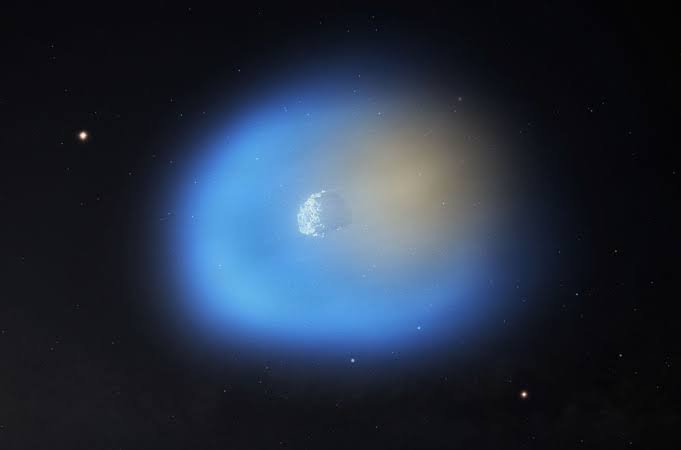
NASA’s Hubble Space Telescope observed 3I/ATLAS, the third confirmed interstellar object detected passing through our solar system. Hubble imagery revealed a teardrop-shaped cocoon of dust around its icy nucleus, allowing scientists to study a rare visitor from beyond the solar system.
3I/ATLAS: An Interstellar Visitor
- 3I/ATLAS was discovered on July 1, 2025 by the NASA-funded ATLAS survey telescope in Chile.
- The letter “I” denotes interstellar, while “3” signifies that it is the third confirmed interstellar object detected in our solar system.
- It follows a hyperbolic trajectory, showing that it is not gravitationally bound to the Sun and originated outside the solar system.
- Hubble observations estimated its nucleus diameter to be between roughly 440 metres and 5.6 kilometres.
- Studying 3I/ATLAS provides a rare opportunity to examine material formed outside our solar system and infer conditions in its parent stellar environment.
What Are Comets?
- Comets are small celestial bodies composed mainly of volatile ices, dust, rock and organic material.
- Solar-system comets are remnants of material left from its formation around 4.6 billion years ago.
- Many short-period comets originate in the Kuiper Belt and complete their orbits in less than 200 years.
- Many long-period comets originate in the distant Oort Cloud and may take thousands or even millions of years to orbit the Sun.
- As a comet approaches the Sun, heat causes its frozen material to sublimate directly from solid to gas, releasing gas and dust.
Main Parts of a Comet
- Nucleus: Solid central body containing frozen volatile substances mixed with dust and rocky material.
- Coma: Cloud of gas and dust surrounding the nucleus after solar heating causes sublimation.
- Dust tail: Formed when solar radiation pressure pushes dust particles away from the comet; it is generally curved.
- Ion tail: Produced when gases in the coma are ionised by solar ultraviolet radiation and carried away by the solar wind.
- The ion tail points almost directly away from the Sun, irrespective of the comet’s direction of motion.
Why 3I/ATLAS Is Scientifically Important
- Extrasolar material: It provides direct access to matter originating outside our solar system.
- Formation conditions: Its composition can reveal the physical and chemical environment in which it formed.
- Comparative astronomy: Scientists can compare it with Kuiper Belt and Oort Cloud comets from our solar system.
- Chemical clues: Observations have identified unusual carbon- and deuterium-related signatures compared with many solar-system comets.
- Interstellar objects therefore act as natural messengers from distant stellar environments, improving understanding of planetary-system formation and evolution.
FAQs
Q1. What is 3I/ATLAS?
It is the third confirmed interstellar object detected passing through our solar system.
Q2. What are comets mainly made of?
They consist primarily of ice, dust, rock and organic material.
Q3. Where do many short-period comets originate?
In the Kuiper Belt.
Q4. What causes a comet’s ion tail?
Ionised gases are carried away from the Sun by the solar wind.
Q5. Why is 3I/ATLAS important?
It helps scientists study material originating outside our solar system.