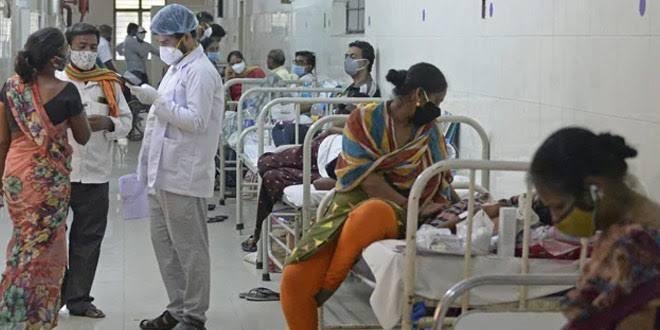
Context
- 176th Parliamentary Report: ~40 crore “missing middle” Indians lack adequate health coverage and cannot easily afford private care.
- Amravati hospital fire (2026): Highlights gaps in neonatal safety and healthcare quality.
The “Missing Middle” in healthcare
- Missing middle: People above the poverty line who lack adequate public health coverage but cannot afford costly private care.
- Private-sector dependence: ~60% of inpatient and 70% of outpatient care is provided privately.
- Financial burden: Out-of-pocket expenditure (OOPE) was 43.4% in 2022–23; medicines alone account for ~30% of health spending.
- This makes the saying “An Indian family is just a hospital bill away from poverty” relevant to India’s problem of medical impoverishment.
Why the Healthcare Gap is Widening
- Rising Non-Communicable Diseases (NCD) Burden
- Diseases like diabetes, hypertension, cancer, CVD, COPD and stroke require long-term treatment, increasing recurring healthcare costs.
- Kerala: ~41% of digitally screened people were found at risk of lifestyle diseases.
- Weak Public Healthcare
- Shortages of doctors, medicines, diagnostics and beds, especially in rural and smaller urban areas, increase dependence on private care.
- Public health expenditure remains below the 2.5% of GDP target under National Health Policy, 2017; it was ~1.43%.
- Insurance Gaps
- Insurance often has limited coverage for OPD care, medicines, diagnostics and pre/post-hospitalisation expenses.
- Exclusions, waiting periods and co-payments reduce effective financial protection.
The Neonatal Healthcare Challenge
- Overburdened neonatal facilities: Rising sick-newborn admissions (11.3 lakh to 14.45 lakh; 2021–22 to 2023–24) and referrals of premature, low-birth-weight and critically ill babies’ strain SNCUs, staff and equipment.
- Safety and infrastructure gaps: Dependence on uninterrupted oxygen, electricity and life-support systems, along with incidents at Gorakhpur, Bhandara, Bhopal, Jhansi and Amravati, highlight weaknesses in fire, electrical and emergency preparedness.
- Infection and staffing risks: Overcrowding, inadequate nurse-to-baby ratios and weak infection control can reduce the quality of neonatal care.
- The concern is therefore not only access to hospitals: “Newborns are increasingly dying inside health facilities meant to protect them.”
The “Hospital Plus Home” Approach
- Home-based care: Stable newborns can receive essential care at home, reducing pressure on hospitals.
- Gadchiroli model: Trained community workers provide breastfeeding, warmth, infection detection and timely referral; its approach is now used through ASHAs (~8 lakh trained).
- Hospital care: Babies with severe prematurity, respiratory distress, shock, severe sepsis or birth asphyxia need immediate specialised treatment.
- Thus, home care should complement, not replace, facility-based neonatal care.
Government Measures
- National Health Policy, 2017: Targets public health spending of 2.5% of GDP.
- Ayushman Bharat–Pradhan Mantri Jan Arogya Yojana (AB-PMJAY): Provides publicly funded health insurance for eligible families, mainly for hospitalisation.
- Ayushman Arogya Mandirs: ~1.5 lakh centres provide primary and preventive healthcare.
- Pradhan Mantri Bhartiya Janaushadhi Pariyojana (PMBJP): Makes generic medicines available at affordable prices.
- Pradhan Mantri Matru Vandana Yojana (PMMVY): Provides maternity benefit support to eligible pregnant and lactating women, promoting maternal health and nutrition.
- Clinical Establishments (Registration and Regulation) Act, 2010: Provides a framework to regulate clinical establishments.
- Home-Based Newborn Care (HBNC): Uses ASHAs to deliver essential newborn care at home.
Way Forward
1. Strengthen public healthcare: Raise public health spending towards 2.5% of GDP and improve primary care, SNCUs, staffing, infrastructure and safety.
2. Expand financial protection: Develop a tiered healthcare system covering universal primary care, government-funded hospitalisation and affordable contributory/private insurance for the missing middle.
3. Reduce out-of-pocket costs: Ensure access to affordable essential medicines, diagnostics and treatment.
4. Strengthen regulation: Enforce quality, safety, fair pricing and accountability through effective implementation of the Clinical Establishments Act.
5. Simplify insurance: Standardise and simplify health insurance rules, coverage and claims to improve consumer protection.
6. Promote hospital-plus-home care: Strengthen HBNC and community-based care for stable newborns while ensuring timely referral for critical cases.
Conclusion
India must move from mere healthcare access to quality, affordability and safety, especially for the missing middle and vulnerable newborns. A “hospital plus home” continuum can combine strong primary care, financial protection and specialised services to achieve Universal Health Coverage (UHC).
FAQs
Q1. Who are the “missing middle” in India’s healthcare system?
Ans. People who are above the poverty line but lack adequate public health coverage and cannot easily afford private healthcare.
Q2. Why is the missing middle vulnerable to healthcare-related impoverishment?
Ans. High private healthcare costs, medicines, diagnostics and OOPE can consume household savings.
Q3. What are the major challenges in neonatal healthcare?
Ans. Overcrowded SNCUs, staff shortages, infection risks and infrastructure-safety gaps strain neonatal care.
Q4. What is the “Hospital Plus Home” approach?
Ans. It combines home-based care for stable newborns with specialised hospital treatment for critical cases, using ASHAs and timely referral.
Q5. How can India achieve better healthcare outcomes?
Ans. By strengthening public healthcare, financial protection, affordable medicines, neonatal safety and health insurance regulation to achieve Universal Health Coverage (UHC).