Context
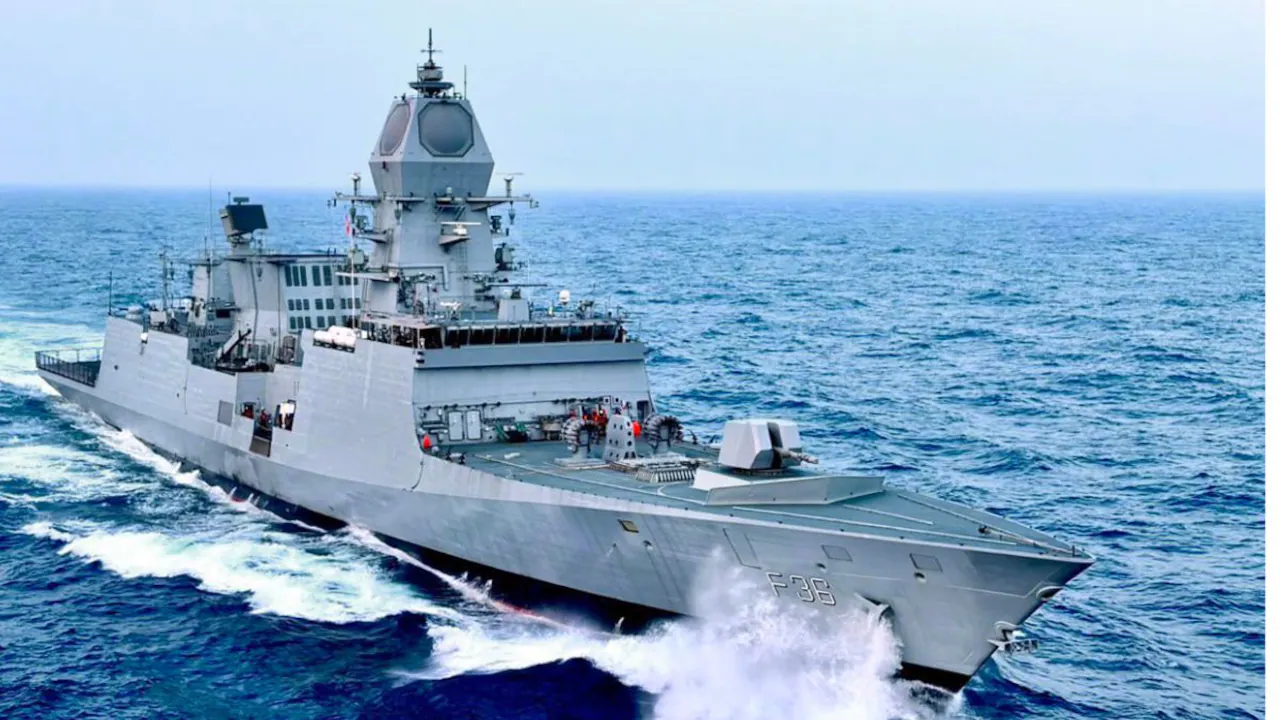
The Indian Navy recently commissioned three indigenously built vessels—INS Dunagiri, INS Sanshodhak, and INS Agray—at Kolkata. The induction strengthens India’s combat readiness, maritime awareness, and coastal security while advancing the objectives of Aatmanirbhar Bharat in defence manufacturing.
INS Dunagiri
- INS Dunagiri is a stealth guided-missile frigate developed under Project 17A.
- It is equipped with BrahMos missiles, MRSAM systems, advanced radar, sonar, electronic warfare suites, and anti-submarine warfare capabilities.
- Designed for blue-water operations, it enhances the Navy’s multi-dimensional combat capability across surface, air, and underwater domains.
- It forms part of the next generation of frigates being inducted to strengthen India’s long-range maritime power.
INS Sanshodhak
- INS Sanshodhak is a Survey Vessel Large (SVL) designed for hydrographic and oceanographic surveys.
- It conducts hydrographic and oceanographic surveys by mapping seabed features, water depths, navigational channels, and ocean conditions.
- The vessel is equipped with Autonomous Underwater Vehicles (AUVs), Remotely Operated Vehicles (ROVs), and multi-beam echo sounders.
- It supports safe navigation, submarine route planning, coastal development, and disaster-response operations.
INS Agray
- INS Agray is an Arnala-class Anti-Submarine Warfare Shallow Water Craft (ASW-SWC).
- It is equipped with lightweight torpedoes, indigenous anti-submarine rocket launchers, and advanced sonar systems.
- The vessel is designed to detect and neutralise submarines operating in shallow coastal waters.
- It enhances the security of ports, naval bases, and critical coastal approaches.
Strategic Significance
- Multi-Layered Naval Capability
The three vessels strengthen distinct dimensions of naval capability:
- INS Dunagiri – Blue-water combat and power projection.
- INS Sanshodhak – Maritime domain awareness and hydrographic support.
- INS Agray – Coastal defence and anti-submarine warfare.
Together, they contribute to a comprehensive and layered maritime security architecture.
- Strengthening India’s Maritime Posture
- The induction enhances India’s ability to safeguard its interests across the Indian Ocean Region (IOR) and the wider Indo-Pacific.
- It improves preparedness against conventional and emerging maritime security challenges.
- The expanded capabilities strengthen India’s ability to secure critical sea lanes of communication and safeguard its maritime interests.
- Advancing Aatmanirbhar Bharat
- All three vessels were constructed by Garden Reach Shipbuilders & Engineers (GRSE), Kolkata.
- Their commissioning reflects the growing maturity of India’s indigenous naval shipbuilding ecosystem.
- The participation of numerous domestic industries and MSMEs highlights the strengthening of the country’s defence manufacturing base.
Conclusion
The commissioning of INS Dunagiri, INS Sanshodhak, and INS Agray marks an important milestone in India’s naval modernisation. By strengthening blue-water operations, maritime domain awareness, and coastal defence, the three vessels significantly enhance India’s maritime preparedness while reinforcing self-reliance in defence production.