| Important questions for UPSC Pre/ Mains/ Interview:
1. Why was the Modi–Merz meeting significant? 2. What were the key agreements and outcomes of the visit? 3. How does defence cooperation feature in India–Germany relations? 4. What were the outcomes in education and skill development? 5. Why is the India–EU Free Trade Agreement important in this context? 6. What areas of cooperation were highlighted in emerging technologies? 7. How does the Indo-Pacific figure in the partnership? |
Context
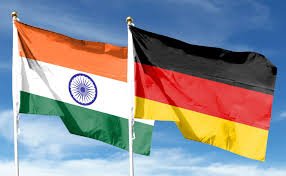
In January, Prime Minister Narendra Modi and German Chancellor Friedrich Merz held bilateral talks in Gandhinagar. The visit came ahead of the India–EU Summit and reaffirmed India–Germany ties at a time of global geopolitical shifts, with both leaders backing early conclusion of the India–EU Free Trade Agreement (FTA).
Q1. Why was the Modi–Merz meeting significant?
- The visit coincided with:
- 25 years of the India–Germany Strategic Partnership.
- 75 years of diplomatic relations between the two countries.
- It was Chancellor Merz’s first visit to India and Asia after assuming office.
- The meeting took place ahead of the India–EU Leaders’ Summit on January 27, giving it broader regional and economic significance.
Q2. What were the key agreements and outcomes of the visit?
- India and Germany signed 19 agreements and joint declarations, covering multiple sectors.
- Key outcomes included:
- Roadmap for defence industrial cooperation.
- Roadmap for cooperation in higher education.
- Joint declaration on critical minerals and semiconductor ecosystems.
- Establishment of an Indo-Pacific bilateral dialogue mechanism.
- A visa-free transit regime was announced for Indian passport holders transiting through German airports for onward travel.
Q3. How does defence cooperation feature in India–Germany relations?
- Defence and security cooperation was highlighted as a symbol of mutual trust.
- Both sides agreed to develop a roadmap for:
- Co-development and co-production in defence.
- Stronger defence industry collaboration.
- Ongoing cooperation areas include:
- Obstacle avoidance systems for helicopters.
- Counter-unmanned aerial systems.
- Joint military exercises, port visits, and consultations were reaffirmed to support security in the Indo-Pacific.
- Germany emphasised that deeper defence cooperation would help India reduce dependence on legacy suppliers, including Russia.
Q4. What were the outcomes in education and skill development?
- A roadmap on higher education cooperation was announced.
- India invited German universities to establish campuses in India.
- Both sides agreed to set up an Indo-German Centre of Excellence for Skilling in Renewable Energy.
- Germany committed to expanding the teaching of the German language in:
- Secondary schools.
- Vocational education and training centres.
- These steps aim to strengthen people-to-people ties and skilled workforce mobility.
Q5. Why is the India–EU Free Trade Agreement important in this context?
- Modi and Merz jointly supported the early conclusion of the India–EU Free Trade Agreement.
- The FTA is expected to:
- Boost trade and investment flows.
- Enhance market access.
- Strengthen supply chain resilience.
- Germany, as the largest economy in the European Union, plays a key role in shaping EU consensus.
- The FTA is projected as a major outcome of the upcoming India–EU Summit.
Q6. What areas of cooperation were highlighted in emerging technologies?
- Both leaders welcomed progress in cooperation on:
- Critical minerals.
- Digitalisation and telecommunications.
- Health and bioeconomy.
- These sectors are central to future economic competitiveness and strategic autonomy.
Q7. How does the Indo-Pacific figure in the partnership?
- India and Germany reaffirmed commitment to a free and open Indo-Pacific.
- Both sides emphasised:
- Respect for international law, including United Nations Convention on the Law of the Sea.
- A new Indo-Pacific consultation mechanism was announced.
- India welcomed Germany’s growing engagement in the region as part of a broader European strategic outlook.
Conclusion
The Modi–Merz meeting reinforced India–Germany ties across defence, education, technology, and geopolitics. Support for the India–EU FTA and closer Indo-Pacific cooperation signal a deepening strategic partnership aligned with shared democratic values and long-term global interests.