Context
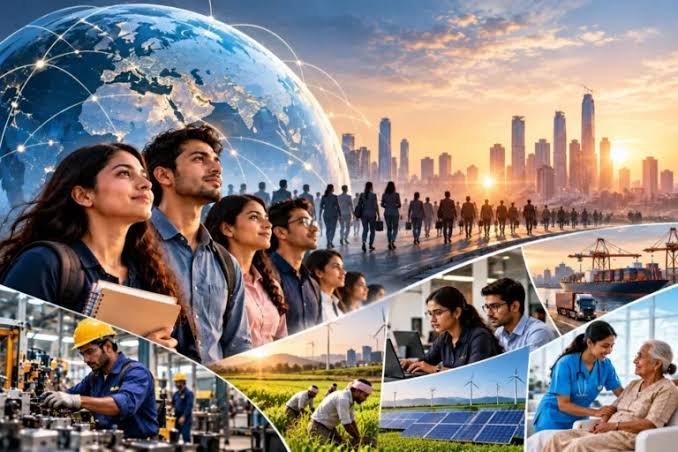
The Global South may add around 2 billion young people to the working-age population over the next decade, but only about 400 million jobs may be created, leaving a potential 800-million-job gap. This poses a major employment challenge, particularly for India, given its large and growing workforce.
Global Employment Challenge
- Insufficient Job Creation: A rising working-age population is not generating enough productive employment, limiting the potential demographic dividend.
- Changing Industrial Model: Automation, robotics and advanced technologies are reducing manufacturing’s capacity to employ large numbers of workers.
- Premature Deindustrialisation: Many developing economies are shifting away from manufacturing before achieving high industrial employment, unlike earlier industrialising economies.
- Skill Deficit: Industries increasingly require digital and technical skills, while many young workers lack relevant training.
- Limited Investment: High borrowing costs, regulatory uncertainty and weak institutions can discourage private investment and job creation.
- Social Consequences: Persistent unemployment can increase underemployment, distress migration and social tensions, affecting global stability.
India’s Employment Challenge
- Demographic Pressure: With a median age below 30, India needs sufficient productive employment for its expanding workforce.
- Low Agricultural Productivity: A large share of workers remains in agriculture despite its relatively lower contribution to output, indicating underemployment and low labour productivity.
- Low Female Participation: Limited female labour-force participation reduces India’s overall employment potential.
- Employment Quality: The challenge is not only creating jobs but also shifting workers from low-productivity and informal activities towards more productive employment.
Way Forward
- Labour-Intensive Sectors: Expand food processing, tourism, healthcare, care services and labour-intensive manufacturing to create large-scale jobs.
- Modernise Agriculture: Promote agri-tech, commercial farming, cold chains and modern storage to raise rural productivity and create better jobs.
- Green Manufacturing: Develop renewable-energy equipment, electric vehicles and energy-efficient products as emerging sources of industrial employment.
- Align Skills with Industry: Expand vocational education, apprenticeships and digital training based on actual industry requirements.
- Strengthen Infrastructure: Invest in transport, electricity, ports, logistics and digital connectivity to create jobs and lower business costs.
- Investment Environment: Simplify regulations, strengthen institutions and improve access to finance to encourage private investment and entrepreneurship.
- Women’s Employment: Expand care infrastructure, workplace safety and suitable employment opportunities to increase female participation.
- Leverage Global Value Chains: Deepen India’s integration into global value chains to expand manufacturing and service-sector employment.
FAQs
Q1. What is a demographic dividend?
Ans. It is the economic growth potential that arises when the working-age population forms a larger share of the population, provided there are adequate jobs, skills and opportunities
Q2. Why is manufacturing creating fewer jobs?
Ans. Automation, robotics and advanced technologies have reduced manufacturing’s labour absorption capacity
Q3. What is premature deindustrialisation?
Ans. It is the slowdown or decline of manufacturing before an economy achieves high levels of industrial employment.