Context
The government has laid the foundation stone for India’s first port-based e-methanol plant at Kandla, with an investment of ₹2,300 crore.
About E-Methanol
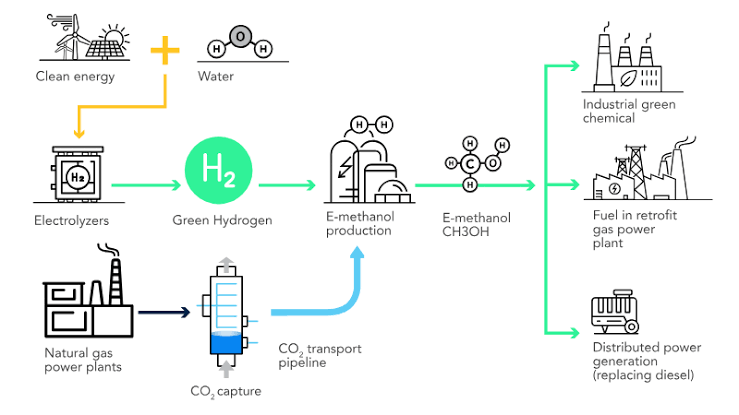
- E-methanol is a low-carbon fuel made using renewable electricity, green hydrogen and captured CO₂.
- It is an e-fuel, produced using electricity from renewable sources such as solar and wind.
- Production involves three main steps:
- Green hydrogen: Electricity is used to split water (electrolysis) into hydrogen and oxygen.
- CO₂ capture: CO₂ is captured from industrial emissions or directly from the air.
- Methanol synthesis: Hydrogen and CO₂ are combined in a catalytic process to produce methanol.
- Applications: Used in shipping, heavy industry and chemical manufacturing.
Key Benefits
- Lower emissions: Can reduce lifecycle greenhouse gas emissions when made with renewable energy and captured CO₂.
- Cleaner fuel: Produces low sulfur emissions and can reduce particulate matter.
- Energy transition: Provides a lower-carbon fuel option for hard-to-decarbonise sectors such as shipping and heavy industry.
- Easy Storage: Unlike volatile pure hydrogen gas, e-methanol is a stable liquid at room temperature and ambient pressure.
Additional Information:
- Methanol
- Methanol (CH₃OH) is a flammable liquid used in fuels, chemicals, plastics and fuel cells.
- It is traditionally produced from natural gas and coal. E-methanol offers a lower-carbon production pathway using renewable energy and captured CO₂.
- India’s Methanol Economy Programme
- Launched by NITI Aayog to reduce oil import dependence and greenhouse gas emissions by promoting methanol production from coal, biomass and municipal waste.
- Targets a 10% reduction in crude oil imports by 2030 through methanol-based fuel substitution.
- Supported by the Methanol Economy Research Programme (MERP) of the Department of Science and Technology (DST).
- M15 (15% methanol blending in gasoline) has been notified, while methanol and DME (dimethyl ether) are recognised as alternative fuels under the National Policy on Biofuels, 2018.
FAQs
Q1. What is e-methanol?
Ans: E-methanol is a low-carbon fuel produced using renewable electricity, green hydrogen and captured CO₂.
Q2. Why is e-methanol called an e-fuel?
Ans: It is produced using electricity, particularly renewable electricity, as a key energy input.
Q3. What are the major uses of e-methanol?
Ans: It can be used in shipping, heavy industry and chemical manufacturing.
Q4. How is e-methanol produced?
Ans: It involves green hydrogen production, CO₂ capture and catalytic synthesis of methanol from hydrogen and CO₂.