Context – Why in the News?
- On 29 September 2026, the Ministry of Power notified the third phase of the Corporate Average Fuel Economy (CAFE-III) norms.
Background – Developments Before the Introduction of CAFE Norms
- Growing dependence on road transport: Economic growth, urbanisation and rising incomes increased passenger vehicle ownership, petrol and diesel consumption, and dependence on imported crude oil.
- Environmental concerns: Fuel combustion in vehicles releases CO₂, contributing to climate change, along with pollutants such as nitrogen oxides, particulate matter and carbon monoxide that harm human health and air quality. Improving vehicle efficiency is therefore important for reducing both fuel demand and emissions from road transport.
- Existing vehicle regulations: India introduced Bharat Stage (BS) emission standards to control harmful tailpipe pollutants and fuel-efficiency standards to reduce fuel consumption and associated CO₂ emissions.
- This highlighted the need for CAFE norms to improve overall fleet fuel efficiency & reduce emissions.
Need for CAFE Norms
The introduction of CAFE norms was necessary for the following reasons:
- Reducing fuel consumption: Improve vehicle mileage and reduce overall petrol and diesel consumption.
- Controlling CO₂ emissions: Reduce greenhouse gas emissions by lowering fuel combustion in vehicles.
- Strengthening energy security: Reduce crude oil import dependence and vulnerability to global price fluctuations.
- Promoting technological advancement: Encourage efficient engines, hybrid systems, electric vehicles and fuel-saving technologies.
- Reducing consumer costs: Lower vehicle running expenses through improved fuel efficiency.
- Establishing measurable targets: Set common fleet-level fuel-efficiency standards to assess automobile manufacturers’ performance.
What Are CAFE Norms?
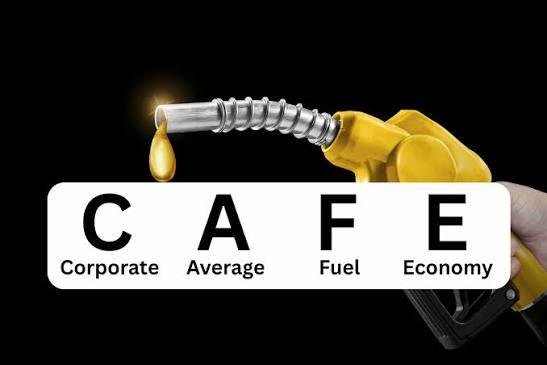
- Corporate Average Fuel Economy (CAFE) norms are regulatory standards that limit the average fuel consumption and associated CO₂ emissions of a manufacturer’s eligible passenger vehicle fleet.
- How do they work?
- Fleet-level assessment: CAFE norms assess average fuel efficiency of all eligible vehicles sold by a manufacturer, rather than requiring every car model to meet same standards.
- Meeting the target: The manufacturer’s overall average is compared with the prescribed target. Selling more fuel-efficient vehicles, such as hybrids and eligible electric vehicles, can help improve its fleet performance, as per the applicable rules.
- Legal and institutional framework
- Introduced in 2017 under the Energy Conservation Act, 2001.
- Ministry of Power formulates regulatory framework, while Bureau of Energy Efficiency (BEE) plays an important role in implementation & compliance-related functions.
- CAFE norms versus Bharat Stage norms
| Basis | CAFE norms | Bharat Stage norms |
| Primary objective | Improve fleet-average fuel efficiency and reduce CO₂ emissions. | Control specified harmful tailpipe pollutants. |
| Main approach | Assess the average performance of a manufacturer’s eligible fleet. | Prescribe pollutant-emission limits for vehicles. |
| Key outcome | Lower fuel consumption and carbon emissions. | Reduced emissions of pollutants such as NOx and particulate matter. |
| Complementary role | Reduces the fuel and carbon intensity of passenger transport. | Reduces harmful local air pollution from vehicles. |
-
- Both frameworks are complementary and are needed to make road transport cleaner.
About CAFE-I and CAFE-II Norms
- CAFE-I Norms
- Implemented from 2017–18, with an average vehicle weight of about 1,037 kg.
- Set a fuel-consumption benchmark of about 5.5 litres/100 km and an average CO₂ emission benchmark of 130 g/km.
- CAFE-II Norms
- Implemented from 2022–23, with an average vehicle weight of about 1,082 kg.
- Tightened the targets to about 4.78 litres/100 km fuel consumption and 113 g/km average CO₂ emissions.
- Achievements of CAFE-I and CAFE-II
- Regulatory framework: Established fuel-efficiency standards for manufacturers’ passenger vehicle fleets.
- Technological progress: Encouraged more efficient engines and the adoption of hybrid and electric vehicle technologies.
- Progressive improvement: Created a foundation for stricter fuel-efficiency targets in subsequent phases.
- Limitations of CAFE-I and CAFE-II
- Larger vehicles: Increasing vehicle size and weight make fuel-efficiency improvements more challenging.
- High transition costs: Developing and adopting electric and hybrid technologies requires substantial investment and research.
- Unequal compliance burden: Differences in manufacturers’ product portfolios and technological capabilities make compliance challenging for some companies.
Need for CAFE-III Norms
- Stricter standards: Further reduce fuel consumption & CO₂ emissions as vehicle ownership increases.
- Changing vehicle sizes: Account for the rising popularity of heavier cars and SUVs through revised target calculations.
- Technological advancement: Encourage electric vehicles, hybrids and other fuel-saving technologies.
- Affordable mobility: Balance stricter environmental standards with the cost of vehicles for consumers.
- Flexible compliance: Give manufacturers options and time to meet targets while managing investment costs.
- Long-term planning: Provide a clear five-year regulatory period for planning new models and technology investments.
About CAFE-III Norms
- Implementation: From 1 April 2027 to 31 March 2032, covering five financial years from 2027–28 to 2031–32.
- It aims to improve the average fuel efficiency of passenger vehicles and reduce CO₂ emissions.
- The framework also provides manufacturers with different technological and regulatory options to achieve the prescribed standards.
- Stricter Fuel-Efficiency Targets
- It seeks to improve fuel efficiency by approximately 16.7% over five years, through gradually tighter annual requirements.
- A manufacturer’s permissible average fuel consumption is determined using the following formula:
Annual average fuel consumption = a × (W − b) + c, where:- W: Weighted average unladen weight of the manufacturer’s eligible vehicles.
- b: Reference vehicle weight, fixed at 1,229 kg.
- a: Factor used to adjust the target according to vehicle weight.
- c: Base fuel-consumption target for the relevant year.
- The reference weight has been raised from 1,082 kg under CAFE-II to 1,229 kg, reflecting changes in the composition of India’s passenger vehicle fleet.
- The base fuel-consumption benchmark will fall from 3.996 litres per 100 km in 2027–28 to 3.3273 litres per 100 km in 2031–32.
- A revised weight-adjustment formula determines targets according to fleet weight, with a less steep adjustment than under the earlier framework.
- Small Cars versus Large Cars
- The treatment of small cars became a major point of disagreement during the formulation.
- In September 2025, the draft rules proposed an additional relaxation of 3 g CO₂/km for petrol cars weighing below 909 kg. Some manufacturers (like Tata Motors and Mahindra & Mahindra) opposed this proposal arguing that it could give Maruti Suzuki an advantage because of its large share of the lightweight-car segment.
- The final framework removed this separate concession but revised the weight-based formula to offer relatively more favourable targets to lighter vehicles.
- Consequently, the target for a small car that would have been 54.1 g CO₂/km under the draft became 63.7 g CO₂/km under the final framework.
- However, cars below 909 kg do not form a separate regulatory category. The applicable target is determined by the manufacturer’s overall fleet characteristics.
- Incentives for Electric Vehicles and Alternative Fuels
- CAFE-III introduces a super-credit system that gives additional weight to eligible cleaner vehicles when calculating fleet performance.
- Battery electric vehicles (BEVs) and range-extended electric vehicles (REEVs) receive a volume derogation factor of 3, while plug-in hybrids and strong hybrids using flex-fuel receive a factor of 2.5. Thus, one eligible BEV or REEV can count as three vehicles for the prescribed fleet calculation.
- The framework also recognises the use of alternative fuels through carbon-neutrality factors (CNFs), including 8% for vehicles using E20 or higher ethanol-blended petrol and 22.3% for flex-fuel ethanol vehicles.
- Electricity consumption is converted into petrol-equivalent consumption using the prescribed factor of 0.1028 for eligible electric vehicles.
- These provisions encourage manufacturers to adopt electric mobility, hybrid technology and fuels with lower carbon intensity.
- Flexible Compliance Mechanism
- A credit-and-debit system allows manufacturers to manage differences between their actual fleet performance and prescribed targets.
- Companies that perform better than the required standard can earn credits, while those that fall short accumulate deficits.
- Subject to the applicable rules, credits can be carried forward within compliance blocks or transferred between manufacturers.
- Manufacturers with remaining deficits can purchase credits from the Bureau of Energy Efficiency (BEE) at prescribed rates.
- The buyout rate begins at ₹2,500 per g CO₂/km in 2027–28 and rises by ₹500 each year, reaching ₹4,500 in 2031–32.
- The 3-year & 2-year compliance blocks allow manufacturers to manage their performance across these periods rather than treating every year as an entirely separate compliance exercise.
- Incentives for Technological Innovation:
- Manufacturers can receive recognition for adopting specified technologies that improve vehicle efficiency, including:
- Engine and transmission improvements: Start-stop systems, efficient transmissions and motor-generators.
- Energy recovery & monitoring: Regenerative braking & tyre-pressure monitoring systems.
- Electrical efficiency: Improved alternators, electric water pumps and LED lighting.
- Reduced energy demand: Advanced glazing and more efficient air-conditioning systems.
- Each qualifying technology may be credited with a reduction of 1 g CO₂/km, subject to a combined maximum benefit of 9 g CO₂/km.
- During the first compliance block, manufacturers can submit self-declared claims. Claims in the second block require validated testing.
- Manufacturers producing or importing fewer than 1,000 eligible vehicles in a reporting period are exempt from specified CAFE targets but must report their actual fleet-average fuel consumption.
- Manufacturers can receive recognition for adopting specified technologies that improve vehicle efficiency, including:
Significance of CAFE-III Norms
- Environmental sustainability: Reduces fuel consumption and CO₂ emissions, supporting climate-change mitigation and cleaner mobility.
- Energy security: Lowers petrol and diesel demand, reducing crude oil import dependence and exposure to global price fluctuations.
- Technological innovation: Encourages investment in electric vehicles, hybrids, efficient engines and alternative fuels through technology incentives.
- Regulatory certainty: The five-year implementation period and compliance blocks help manufacturers plan investments, research and new vehicle models.
- Consumer choice & competitiveness: Offers manufacturers multiple ways to improve efficiency & encourages more fuel-efficient vehicles across market segments, while balancing affordability.
- Sustainable transport transition: Complements emission standards, electric mobility initiatives & alternative-fuel promotion to make India’s transport sector more energy-efficient & less carbon-intensive.
Challenges Associated with CAFE-III Norms and the Way Forward
| Challenges | Way Forward |
| Higher compliance costs: Developing cleaner technologies requires heavy investment. | Promote domestic R&D, technology transfer and affordable manufacturing. |
| Small-car affordability: Compliance costs may increase entry-level vehicle prices. | Encourage cost-effective efficiency improvements while protecting environmental goals. |
| Unequal industry capabilities: Manufacturers differ in financial resources and technological capacity. | Ensure transparent rules, predictable timelines and fair compliance options. |
| Monitoring & verification: Technology credits & laboratory tests may not reflect actual road performance. | Strengthen independent testing, real-world monitoring and transparent audits. |
| Infrastructure and environmental concerns: EVs and alternative fuels require adequate infrastructure and lower lifecycle emissions. | Expand charging networks and promote sustainable fuels based on lifecycle emission assessments. |
Frequently Asked Questions (FAQs)
Q1. What are CAFE norms?
Corporate Average Fuel Economy (CAFE) norms regulate the average fuel consumption and associated CO₂ emissions of a manufacturer’s eligible passenger vehicle fleet.
Q2. When will CAFE-III norms be implemented?
CAFE-III will be implemented from 1 April 2027 to 31 March 2032, with progressively stricter fuel-efficiency targets.
Q3. How are CAFE norms different from Bharat Stage (BS) norms?
CAFE norms focus on fleet-average fuel efficiency and CO₂ emissions, whereas BS norms regulate harmful tailpipe pollutants such as nitrogen oxides and particulate matter.
Q4. How do CAFE-III norms promote electric vehicles?
They provide super credits for eligible electric and hybrid vehicles, allowing them to receive additional weight in fleet-performance calculations under prescribed rules.
Q5. What are the major challenges in implementing CAFE-III norms?
The key challenges include higher manufacturing costs, affordability of small cars, unequal technological capabilities, verification of compliance and inadequate charging infrastructure.