| Important questions for UPSC Pre/ Mains/ Interview:
1. What is the latest development regarding the BSL-4 laboratory? 2. What is a BSL-4 laboratory and why is it important? 3. What are the key features of the Gujarat BSL-4 facility? 4. What is the institutional framework supporting the laboratory? 5. How is the laboratory designed to ensure safety? 6. What role will the lab play in disease control and vaccine research? 7. Why is this facility considered a national asset? 8. What is the current status of high-containment labs in India? 9. How does this fit into India’s broader biosafety ecosystem? |
Context
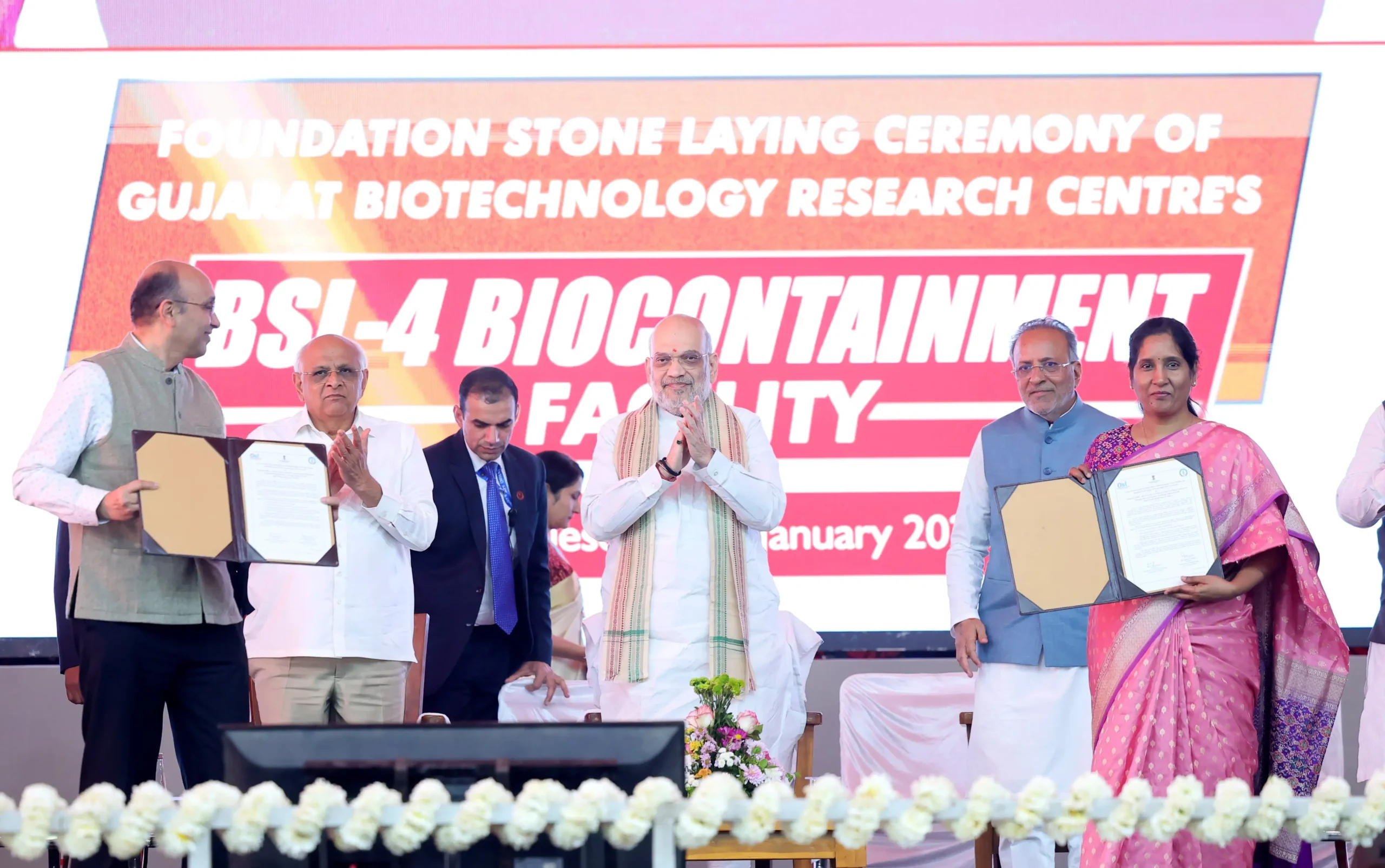
India is strengthening its biosecurity and health preparedness by expanding high-containment laboratory infrastructure. In this context, the foundation stone for India’s first state-funded Bio-Safety Level 4 (BSL-4) laboratory has been laid in Gujarat, marking a significant step in the country’s ability to handle deadly pathogens and future outbreaks.
Q1. What is the latest development regarding the BSL-4 laboratory?
- The foundation stone for a BSL-4 containment facility was laid in Gandhinagar.
- The facility was described as a national “health shield”.
- It marks India’s first fully state-funded and state–controlled BSL-4 laboratory.
- The project signals a new phase in India’s health security and biotechnology capacity.
Q2. What is a BSL-4 laboratory and why is it important?
- A Bio-Safety Level 4 (BSL-4) laboratory is the highest level of biological containment.
- It is designed to handle:
- Highly infectious pathogens
- Diseases with high fatality rates
- Agents without known vaccines or treatments
- Such laboratories operate under strict international safety protocols.
- They enable:
- Research on deadly diseases
- Development of diagnostics, vaccines, and therapeutics
- Rapid outbreak investigation and response
Q3. What are the key features of the Gujarat BSL-4 facility?
- The facility is located in Sector-28, Gandhinagar.
- It will be developed over an area of about 11,000 square metres.
- The project cost is ₹362 crore.
- It is being implemented under the Gujarat State Biotechnology Mission.
- It will be the second civilian BSL-4 research lab in India.
Q4. What is the institutional framework supporting the laboratory?
- The lab will function under the Gujarat Biotechnology Research Centre.
- The centre already houses a BSL-2+ laboratory.
- It played a key role during the COVID-19 pandemic, including genome sequencing of SARS-CoV-2.
- Planning for the BSL-4 facility began in mid-2022.
- The foundation stone was laid on January 13, 2026.
Q5. How is the laboratory designed to ensure safety?
- The complex will include:
- BSL-4, BSL-3, and BSL-2 laboratories
- Animal Bio-Safety Level (ABSL) 4 and ABSL-3 laboratories
- It will have advanced utilities and containment systems.
- Design and operation will follow international biosafety guidelines issued by:
- Centers for Disease Control and Prevention
- National Institutes of Health
- Department of Biotechnology
- Indian Council of Medical Research
Q6. What role will the lab play in disease control and vaccine research?
- The facility will strengthen real-time response to outbreaks of:
- Severe human infectious diseases
- Zoonotic infections
- It will support advanced research on:
- Diagnostics
- Vaccines
- Therapeutics
- The ABSL-4 component will allow animal disease research and vaccine development using animal-derived antibodies.
- This work earlier required sending samples outside the State, causing delays.
Q7. Why is this facility considered a national asset?
- The Department of Biotechnology has signed an MoU to designate it as a national facility.
- Expert guidance from institutions across India will be available.
- The lab will address long-standing bottlenecks due to limited BSL-4 infrastructure.
- It enhances national preparedness for future pandemics and biosecurity threats.
Q8. What is the current status of high-containment labs in India?
- Civilian BSL-4 labs: India currently has one functional civilian BSL-4 lab at the National Institute of Virology, Pune.
- Defence sector: In 2024, Defence Research and Development Organisation set up a BSL-4 lab in Gwalior.
- High-security animal disease labs
- ICAR–NIHSAD, Bhopal (ABSL-3+, proposed upgrade to ABSL-4)
- ICAR–ICFMD, Bhubaneswar (ABSL-3Ag)
Q9. How does this fit into India’s broader biosafety ecosystem?
- Under the Virus Research and Diagnostic Laboratories (VRDL) scheme:
- 165 biosafety laboratories have been approved.
- This includes 154 BSL-2 and 11 BSL-3 labs.
- Indian Council of Medical Research operates:
- 1 BSL-4
- 8 BSL-3
- 12 BSL-2 laboratories.
- Other contributions include:
- Department of Biotechnology: 26 labs
- Indian Council of Agricultural Research: 9 labs
- Council of Scientific and Industrial Research: 11 labs
Conclusion
The state-funded BSL-4 laboratory in Gujarat marks a major upgrade in India’s biosecurity architecture. By enhancing outbreak response, vaccine research, and high-risk pathogen studies, it strengthens national health preparedness and reduces India’s dependence on limited high-containment facilities.