Context
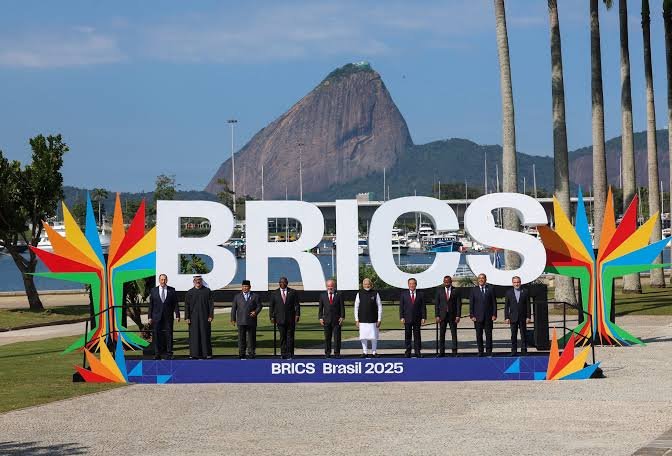
- India will host the 18th BRICS Summit on 12–13 September 2026 at Bharat Mandapam, New Delhi.
- India assumed the BRICS Chairship on 1 January 2026. This is India’s fourth Chairship, following 2012, 2016 and 2021.
- The theme for India’s 2026 Chairship is “Building for Resilience, Innovation, Cooperation and Sustainability”, guided by the principle of “Humanity First.”
About BRICS
- BRICS is an intergovernmental cooperation mechanism comprising emerging and developing countries.
- It originated as BRIC with Brazil, Russia, India and China in 2006. South Africa joined in 2011, giving the grouping its present name.
- BRICS currently has 11 full members:
- Brazil, Russia, India, China and South Africa
- Egypt, Ethiopia, Iran, Saudi Arabia and the United Arab Emirates (UAE)
- Indonesia
- The expansion announced at the 2023 Johannesburg Summit brought Egypt, Ethiopia, Iran, Saudi Arabia and UAE into BRICS from 1st January 2024.
- Indonesia became a full BRICS member in January 2025, taking total full membership to 11.
- BRICS is not a military alliance. It provides a platform for cooperation on political, economic, financial and socio-cultural issues.
Three Pillars of BRICS
- Political and Security Cooperation: Promotes dialogue on international peace, security and global governance.
- Economic and Financial Cooperation: Covers trade, investment, finance and development cooperation.
- People-to-People Exchanges: Promotes cooperation in culture, education, youth and other social areas.
Institutional Framework
- Annual Chairship: The BRICS Chairship rotates among members. The country holding the Chair leads the annual agenda and hosts the summit.
- No permanent headquarters: BRICS does not have a permanent headquarters or a conventional permanent secretariat.
- Consensus-based cooperation: Major decisions are generally taken through consultation and consensus.
- BRICS functions through summits, ministerial meetings, working groups and other institutional mechanisms.
New Development Bank
- The New Development Bank (NDB) was established by the founding BRICS countries and became operational in 2015.
- It finances infrastructure and sustainable development projects.
- Headquarters: Shanghai, China.
- The NDB is associated with BRICS but is a separate multilateral development bank.
- NDB and AIIB are distinct institutions: NDB is headquartered in Shanghai, while the Asian Infrastructure Investment Bank (AIIB) is headquartered in Beijing.
Significance for India
- Global South: Strengthens India’s engagement with major emerging and developing economies.
- Global Governance: Provides a platform to advocate greater representation of developing countries in institutions such as the United Nations, IMF, World Bank and WTO.
- Economic Cooperation: Creates opportunities for greater trade, investment and financial cooperation.
- Strategic Engagement: Enables India to engage with countries having diverse geopolitical interests while preserving its strategic autonomy.
- Development Finance: The NDB provides an additional institutional channel for financing infrastructure and sustainable development.
FAQs
- What is BRICS?
BRICS is an intergovernmental cooperation mechanism of emerging and developing countries. It promotes cooperation in political, economic, financial and socio-cultural areas. - How many full members does BRICS have?
BRICS has 11 full members: Brazil, Russia, India, China, South Africa, Egypt, Ethiopia, Iran, Saudi Arabia, UAE and Indonesia. - What are the three pillars of BRICS?
The three broad pillars are political and security cooperation, economic and financial cooperation, and people-to-people exchanges. - Is BRICS a military alliance?
No. BRICS is an intergovernmental cooperation mechanism, not a military alliance such as NATO. - What is the New Development Bank?
The NDB is a multilateral development bank established by the BRICS founding countries. It supports infrastructure and sustainable development and is headquartered in Shanghai, China. - How many times has India chaired BRICS?
India has held the BRICS Chairship four times—in 2012, 2016, 2021 and 2026. - Why is BRICS important for India?
It strengthens India’s role in the Global South, expands economic and development cooperation, and provides a platform to discuss reforms in global governance institutions.