Context
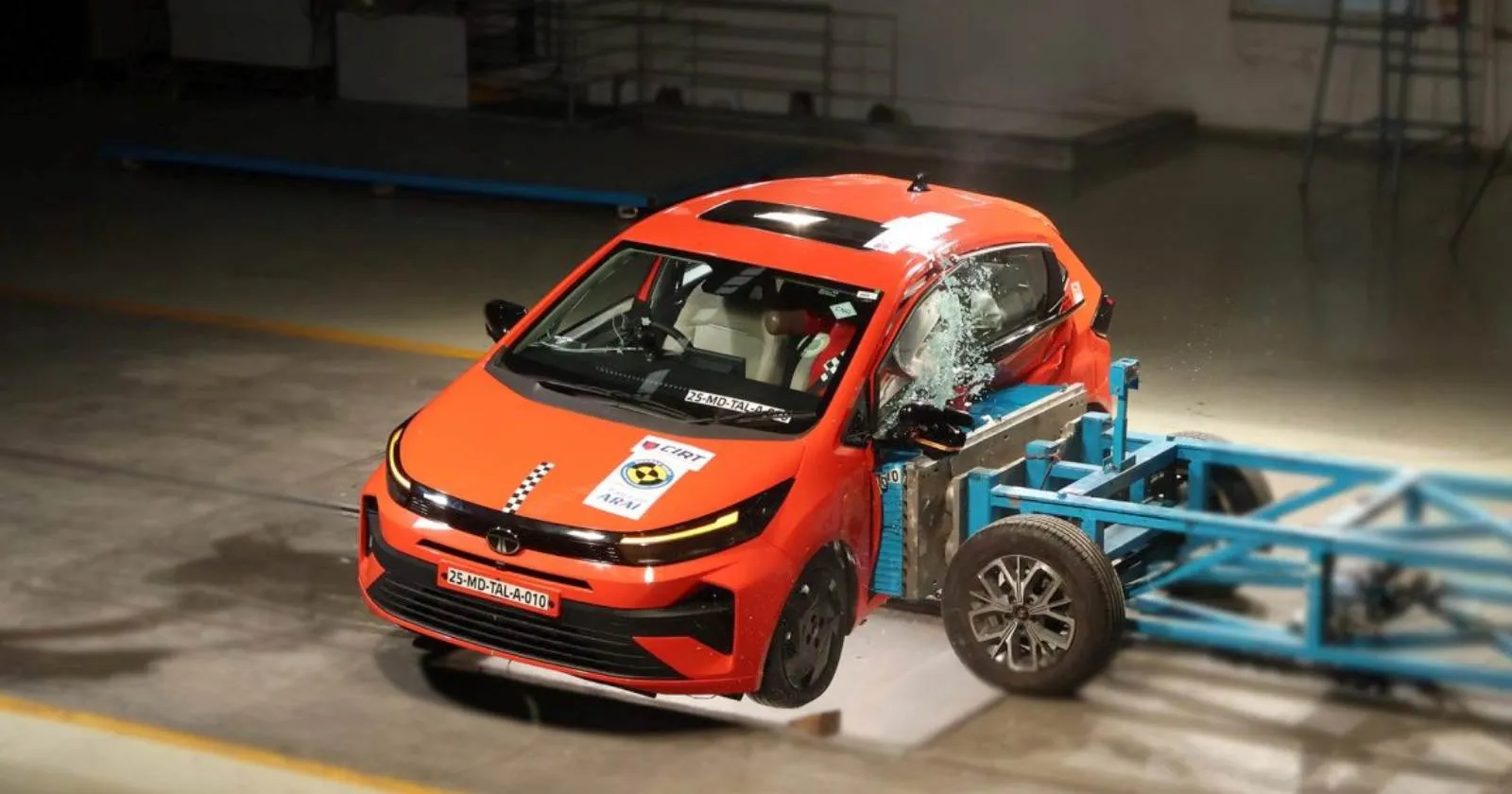
- The Government proposes to introduce Bharat New Car Assessment Programme (Bharat NCAP) 2.0 from October 2027, after the current framework ends on 30 September 2027.
- The proposed framework broadens vehicle assessment from mainly occupant crash protection to a wider safety approach covering crash prevention, vulnerable-road-user protection and post-crash safety.
- It seeks to provide consumers with a more comprehensive safety benchmark while encouraging manufacturers to adopt advanced safety technologies.
What Is Bharat NCAP?
- Bharat NCAP is India’s voluntary safety-rating programme for passenger cars.
- It operates under the Ministry of Road Transport and Highways (MoRTH) through Automotive Industry Standard AIS-197.
- It primarily covers M1 category vehicles with gross vehicle weight up to 3,500 kg.
- M1 category refers to passenger vehicles having not more than eight seats in addition to the driver’s seat.
- Vehicles receive a 1-to-5-star safety rating, with five stars indicating better safety performance.
Why Was Bharat NCAP Introduced?
- Consumer awareness: Helps buyers treat safety as an important purchase criterion alongside price, mileage and features.
- Manufacturer accountability: Public safety ratings create pressure to improve structural protection and standard safety equipment.
- Domestic assessment ecosystem: Builds an Indian testing framework suited to vehicles sold in the domestic market.
- Road-safety objective: Complements safer roads, enforcement and emergency care by strengthening vehicle-level safety.
What Changes Under Bharat NCAP 2.0?
The existing framework mainly assesses Adult Occupant Protection, Child Occupant Protection and Safety Assist Technologies.
The proposed Bharat NCAP 2.0 introduces a broader 100-point assessment framework:
| Safety Vertical | Weightage | Broad Focus |
| Crash Protection | 55 | Protection of adults and children during collisions |
| Vulnerable Road User Protection | 20 | Safety of pedestrians and other exposed road users |
| Safe Driving | 10 | Driver-warning and assistance systems |
| Accident Avoidance | 10 | Technologies that help prevent collisions |
| Post-Crash Safety | 5 | Rescue and safety after an accident |
The key shift is:
Prevent crash → Reduce impact → Protect occupants and vulnerable users → Improve post-crash outcomes
Thus, Bharat NCAP 2.0 moves from mainly measuring crashworthiness to evaluating the entire vehicle-safety cycle
Why Is Bharat NCAP 2.0 Important?
- Preventive safety: Greater emphasis on technologies such as ESC and AEB encourages crash avoidance, not merely crash survival.
- Safe-system approach: Vehicle safety now considers risks to all road users, including pedestrians and other vulnerable users.
- Comprehensive benchmarking: A broader scoring system allows more systematic comparison of overall safety performance.
- Technology diffusion: Competition for higher ratings can push advanced safety features from premium cars towards mass-market models.
- Industry upgrading: Stronger safety benchmarks can improve engineering quality and the competitiveness of Indian automobiles.
Key Challenges
- Affordability: Advanced safety systems may increase vehicle prices, especially in entry-level segments.
- Testing capacity: Wider assessment requires adequate laboratories, specialised equipment and trained personnel.
- Unequal access: Advanced safety technologies may remain concentrated in premium variants.
- Consumer behaviour: Safety ratings can influence manufacturers only when buyers actively value them.
Way Forward
- Standardise essential safety features across mass-market models.
- Localise safety electronics and sensors to reduce costs.
- Expand independent testing capacity and transparent disclosure.
- Integrate vehicle safety with safer roads, enforcement and emergency care.
FAQs
Q1. What is the biggest proposed change under Bharat NCAP 2.0?
It expands assessment from mainly crash protection to pre-crash, crash and post-crash safety.
Q2. Which component carries the highest proposed weightage?
Crash Protection, with 55 out of 100 points.
Q3. Why are vulnerable road users included?
Because vehicle safety must also reduce injuries to pedestrians and other people outside vehicles.
Q4. What is Autonomous Emergency Braking (AEB)?
It detects an imminent collision and can automatically apply brakes when the driver does not respond adequately.
Q5. Is Bharat NCAP the same as mandatory vehicle approval?
No. Bharat NCAP is a voluntary comparative safety-rating programme, while statutory approval checks minimum legal requirements for sale.