Context
The United States and Japan have signed an agreement to establish an AIM-120 AMRAAM production facility in Japan. The facility is expected to strengthen production of this widely used American beyond-visual-range air-to-air missile.
About AIM-120 AMRAAM
- Full Form: Advanced Medium-Range Air-to-Air Missile (AMRAAM).
- Type: It is a supersonic, active radar-guided, medium-range air-to-air missile.
- Category: It is one of the most widely used Beyond-Visual-Range (BVR) air combat missiles.
- Development: Developed by the United States during the late 1970s and 1980s.
- Induction: Became operational with the US Air Force in 1991, replacing older radar-guided missiles.
- Global use: It is used by more than 35 countries, including the US, UK, Japan, Australia and several NATO members.
- Technical Features
- Length – 3.65 metres
- Diameter – 178 mm
- Wingspan – 484 mm
- Speed – More than Mach 4 (Approximate speed – 3,000 miles per hour)
- Range – Over 160 km under optimal launch conditions
- Propulsion – Solid-fuel rocket motor
- Warhead – Blast-fragmentation warhead
- Detonation – Proximity fuse
- Operational capability – Day and night, in all weather conditions
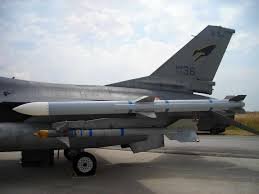
- Physical design – It has four cropped delta wings that provide lift. Four rear control fins help guide the missile towards its target.
Key Terms
|
Purpose and Applications
- Its primary role is to establish air superiority by engaging enemy aircraft from beyond the pilot’s visual range.
- It can target enemy fighter aircraft, bombers and cruise missiles.
- It can be carried by several fighter aircraft, including:
- American aircraft: F-15, F-16 and F-35.
- European aircraft: Eurofighter Typhoon and Gripen.
Guidance System and Working
The missile uses a combination of guidance technologies:
- Mid-course guidance: Inertial guidance helps the missile follow its planned trajectory after launch.
- Mid-course updates: Optional data links allow the launching aircraft to send updated target information and refine the missile’s path.
- Terminal guidance: Active radar homing guides the missile during the final stage towards the target.
Fire-and-forget capability:
- Once the missile is launched, its onboard guidance system can independently guide it towards the target.
- This allows the launching aircraft to move away and engage other threats rather than continuously guiding the missile.
AMRAAM-ER (Extended Range)
- AMRAAM-ER is an extended-range, ground-launched variant of the AMRAAM.
- It offers greater range and altitude capabilities.
- It is designed for use in ground-based air defence systems such as NASAMS (National Advanced Surface-to-Air Missile System).
Frequently Asked Questions (FAQs)
Q1. What is the AIM-120 AMRAAM missile, and what is its primary role?
AIM-120 AMRAAM stands for Advanced Medium-Range Air-to-Air Missile. It is a supersonic, active radar-guided, beyond-visual-range missile designed to engage enemy aircraft and establish air superiority.
Q2. What are the key technical features of the AIM-120 AMRAAM?
It travels at over Mach 4, has a range exceeding 160 km under optimal launch conditions and uses a solid-fuel rocket motor. It carries a blast-fragmentation warhead with a proximity fuse.
Q3. How does the AIM-120 AMRAAM guidance system work?
It uses inertial guidance during the mid-course phase, optional data-link updates from the launching aircraft and active radar homing during the terminal phase to track and engage its target.
Q4. What is the fire-and-forget capability of the AMRAAM missile?
It allows the missile to independently guide itself towards the target after launch using its onboard guidance system. The launching aircraft can then move away or engage other threats.
Q5. What is AMRAAM-ER, and how does it differ from the standard AMRAAM?
AMRAAM-ER is an extended-range, ground-launched variant offering greater range and altitude capabilities. It is designed for ground-based air defence systems such as NASAMS.