Context
The 7th AgriVoltaics World Conference in New Delhi highlighted Agrivoltaics (AgriPV) as a way to combine farming with solar power generation. The release of the Policy Handbook on Agrivoltaics in India and estimates of its solar potential renewed focus on its role in meeting India’s future energy needs.
About Agrivoltaics (AgriPV / Agrisolar)
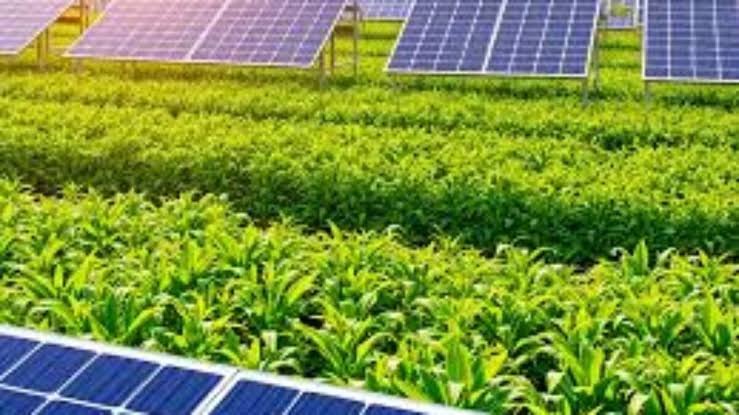
- Definition & Core Concept: Simultaneous dual-use of land for solar PV energy generation and crop cultivation. Panels are mounted on elevated, spaced structures (~2–3m) to allow farming operations below.
- Evolution & Origin: Conceptualized in research during the 1980s; matured globally through pilot commercial projects across Japan, Germany, and France.
- Primary Objective: Solves the “food vs. energy” land-use trade-off by promoting clean energy generation alongside sustainable agricultural production on a single land unit.
- Indian Policy Alignment: Integrates with the PM-KUSUM Scheme (Ministry of New and Renewable Energy)—transforming farmers from Annadata (food providers) to Urjadata (energy producers) by utilizing cropland, fallow land, and feeder solarization for decentralized power.
Key Features and Benefits
- Flexible System Design: Panels can be placed overhead, between crop rows, along field boundaries, or on greenhouses based on crop type and climate.
- Diversified Farm Income: Provides a reliable secondary income from power sales while cutting farm costs by replacing diesel pumps with solar energy.
- Enhanced Water Efficiency: Panel shade reduces soil evapotranspiration and maintains soil moisture, delivering water savings up to 30%.
- Microclimate Optimization & Cooling Synergy: Partial shade protects crops from heat stress, while crop transpiration cools solar panels from below, boosting photovoltaic conversion efficiency.
- Efficient Land Use: Maximizes the Land Equivalent Ratio (LER) by combining food and clean energy generation on a single land parcel.
- Land Equivalent Ratio (LER): A metric measuring dual-use land efficiency, where an LER > 1.0 means combined farming and energy generation yields more overall output than doing both separately.
- Rural Job Creation: Drives local rural employment through system installation, maintenance, and decentralized energy management.
Significance of Agrivoltaics for India
- Farmer Income Resilience: Buffers small and marginal farmers (~86% of holdings) against climate and price shocks through income diversification.
- Clean Energy Transition: Accelerates decentralized solar power adoption without diverting fertile land from food production.
- Climate-Resilient Agriculture: Mitigates crop heat stress and evapotranspiration water loss, improving climate adaptation in vulnerable regions.
- Localized Energy Security: Meets farm-level power demands and generates revenue by feeding surplus electricity to the grid.
- Viksit Bharat @2047 Alignment: Fuses agriculture, renewable power, and rural livelihoods to transform farmers from Annadata into Urjadata.
India’s Initiatives and Emerging Experience
- ICAR– Central Arid Zone Research Institute Model (Jodhpur): Pioneer in dryland farming, integrating crop cultivation, solar power generation, and panel rainwater harvesting.
- National Institutional Framework: ICAR–Indian Agricultural Research Institute (IARI), New Delhi, and NISE (National Institute of Solar Energy) established the joint CoE (Centre of Excellence) for AgriPV to develop national crop suitability matrices and technical guidelines.
- 100-kW AgriPV Pilot: Established at ICAR–IARI in 2025, it uses single-axis solar tracking to study crop–panel combinations, crop growth, energy output and economic viability.
- National Potential Estimate: MNRE (Ministry of New and Renewable Energy) estimates that deploying solar panels on just 1% of India’s agricultural land yields a potential ~630 GWp solar capacity (theoretical estimate, not installed capacity)
Challenges in Agrivoltaic Adoption
- Crop Suitability & Shading Risk: Excessive shade can lower crop yields, requiring careful selection of shade-tolerant crops and optimized panel spacing.
- High Upfront Capital (CapEx): Elevated structural mounting (~2–3m height) and specialized design significantly increase initial investment costs.
- Inter-Ministerial & Policy Friction: Disconnect between agricultural and energy departments creates regulatory hurdles in land classification and subsidy approval.
- Inclusivity & Land Rights Deficit: Benefits tied strictly to land ownership risk excluding tenant farmers and women cultivators.
- Farmer Trust & Contract Risks: Ambiguous power purchase agreements (PPAs) and fear of land degradation lower adoption among smallholders.
- Regional Field Evidence Gap: Limited long-term pilot data on crop yields and economic viability across India’s diverse agro-climatic zones.
Way Forward
- Evidence-Based Planning: Conduct long-term field trials across diverse agro-climatic zones to establish standardized shade-tolerant crop matrices and regional guidelines.
- Affordable & Blended Financing: Expand Priority Sector Lending (PSL) and concessional credit through NABARD to lower upfront capital barriers for smallholders.
- Farmer-Centric Frameworks: Standardize transparent Power Purchase Agreements (PPAs) that safeguard land quality, guarantee clear revenue-sharing, and protect tenant cultivators and women farmers.
- Inter-Institutional Synergy: Institutionalize joint coordination between MNRE, MoA&FW (Ministry of Agriculture and Farmers Welfare), ICAR and state DISCOMs for unified land classification and single-window clearances.
- International Knowledge Exchange: Leverage the ISA (International Solar Alliance) to export AgriPV technical standards and drive capacity-building across Global South nations facing land-water constraints.
FAQs
Q1. What is agrivoltaics?
Ans. Agrivoltaics (AgriPV), also called agrisolar or dual-use solar, combines crop cultivation and solar power generation on the same land.
Q2. How does AgriPV differ from conventional solar farms?
Ans. AgriPV combines farming with solar power generation, while conventional solar farms primarily generate electricity.
Q3. What factors determine the success of AgriPV?
Ans. Crop suitability, panel design, shading, irrigation, climatic conditions and economic viability determine its success.