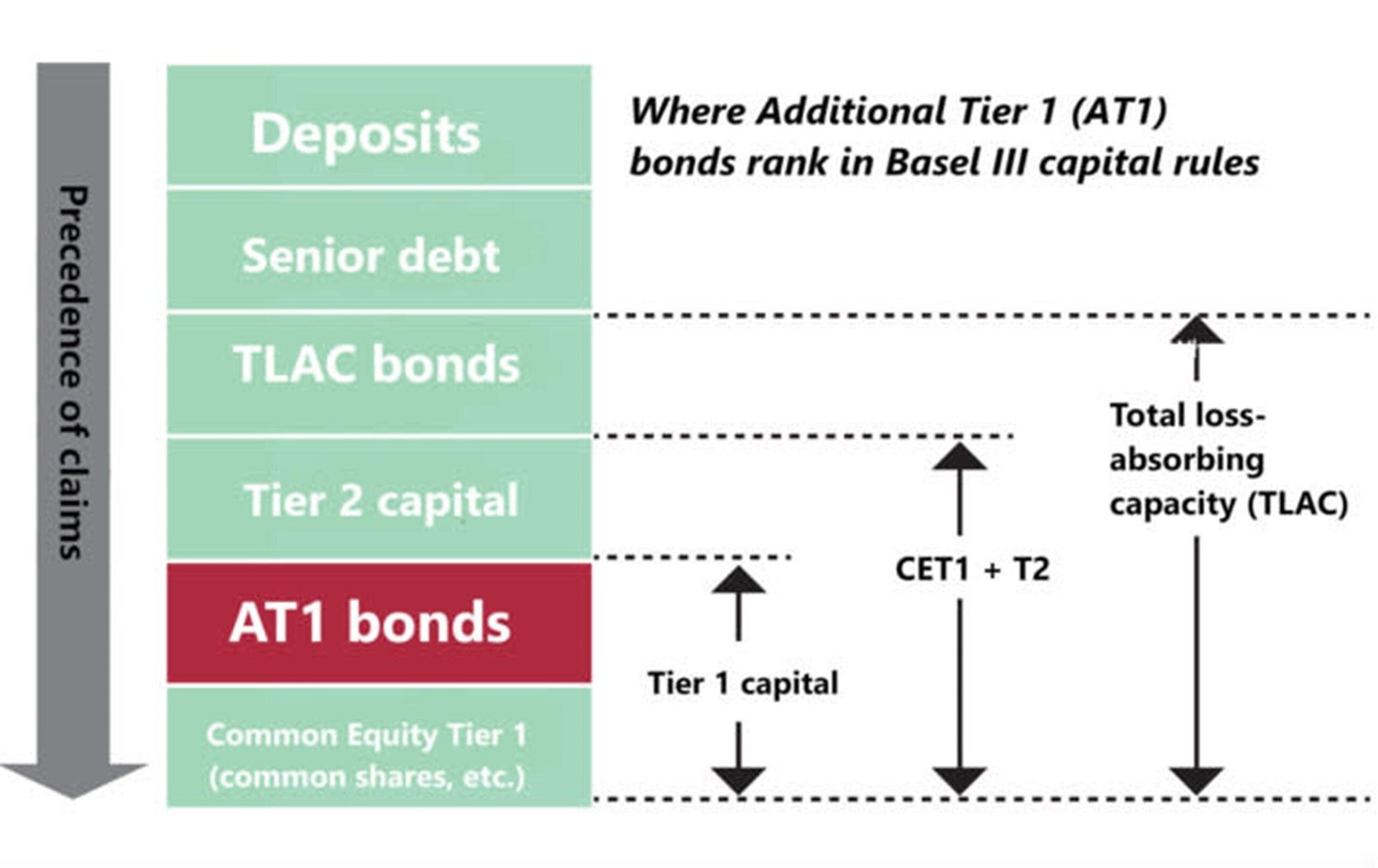
About AT1 Bonds
- Meaning: AT1 bonds are perpetual, unsecured and subordinated debt instruments issued by banks under the Basel III framework to meet regulatory capital requirements.
- Additional Tier-1 (AT1) capital is part of a bank’s Tier-1 capital and acts as a loss-absorbing buffer.
- Tier-1 capital comprises:
-
- Common Equity Tier-1 (CET1): Common equity and retained earnings; the core and highest-quality capital.
- AT1: Qualifying instruments such as perpetual bonds.
Key Features
- Perpetual: No fixed maturity date or scheduled principal repayment.
- Call Option: Banks may redeem bonds, usually after 5 years, subject to RBI approval; redemption is not mandatory.
- Discretionary Coupon: Interest payments may be cancelled under applicable regulatory and contractual conditions.
- Non-cumulative Interest: Cancelled interest is not carried forward as arrears for future payment.
- Unsecured and Subordinated: No collateral; AT1 holders rank below depositors and senior creditors but generally above equity shareholders during liquidation.
- Loss Absorption: Principal may be written down, potentially to zero, or converted into equity if specified capital triggers or Point of Non-Viability (PONV) conditions are met.
- PONV: The stage when a bank cannot remain viable without external support or regulatory intervention.
Significance
- Bank Stability: Strengthens Tier 1 capital and helps banks absorb losses.
- Bail-in Mechanism: Forces investors to share losses, reducing reliance on government-funded bailouts.
- Bail-in: A bank uses its own capital and eligible investors’ funds to absorb losses.
- Bailout: External support, often from the government using public funds, is provided to rescue a distressed bank.
- Protection of Public Funds: Minimizes the potential burden on taxpayers during banking crises.
- Capital Raising: Enables banks to raise regulatory capital without issuing ordinary shares.
- Post-2008 Reforms: Introduced under Basel III norms to enforce stronger capital adequacy and loss-absorption requirements after the global financial crisis.
Challenges
- Investment Risk: Investors may lose their principal, and interest payments may be cancelled.
- Uncertain Repayment: No fixed maturity date; redemption depends on the bank’s call option and RBI approval.
- Complex Terms: Loss-absorption rules and repayment priority can be difficult for retail investors to understand.
Additional Information: Basel III Norms
- Framework: Basel III is a global banking framework developed by the Basel Committee on Banking Supervision (BCBS) after the 2008 global financial crisis.
- Objective: Strengthen banks by improving the quality and quantity of capital, risk coverage and liquidity management.
- Key safeguards: It introduced stronger capital requirements, leverage ratio, countercyclical capital buffer, and liquidity standards such as Liquidity Coverage Ratio (LCR) and Net Stable Funding Ratio (NSFR).
- LCR requires banks to maintain sufficient High-Quality Liquid Assets (HQLA) to meet their 30-day net cash outflows during a liquidity stress scenario.
- India: The RBI implements Basel III requirements for Indian banks through its regulatory framework.
FAQs
Q1. Why are AT1 bonds called perpetual bonds?
Ans. They have no fixed maturity date. Investors cannot demand repayment of the principal on a predetermined date.
Q2. What is the call option in AT1 bonds?
Ans. It allows the issuing bank to redeem the bonds after a specified period, generally five years, subject to RBI approval. The bank is not obliged to exercise this option.
Q3. Which regulatory framework governs AT1 bonds in India?
Ans. They are governed by the RBI’s Basel III Capital Regulations, which prescribe eligibility, capital-trigger and loss-absorption requirements.
Q4. What is the difference between CET1 and AT1 capital?
Ans. CET1 mainly consists of common equity and retained earnings and is the highest-quality bank capital. AT1 includes qualifying perpetual instruments that also provide loss-absorbing capacity.