Context
In October 2026, Prime Minister Narendra Modi and Liechtenstein’s Hereditary Prince Alois reaffirmed cooperation in trade, investment, technology, innovation and reform of multilateral institutions. The engagement also highlighted the India–EFTA Trade and Economic Partnership Agreement (TEPA) as an important framework for bilateral economic cooperation.
Location and Political Geography
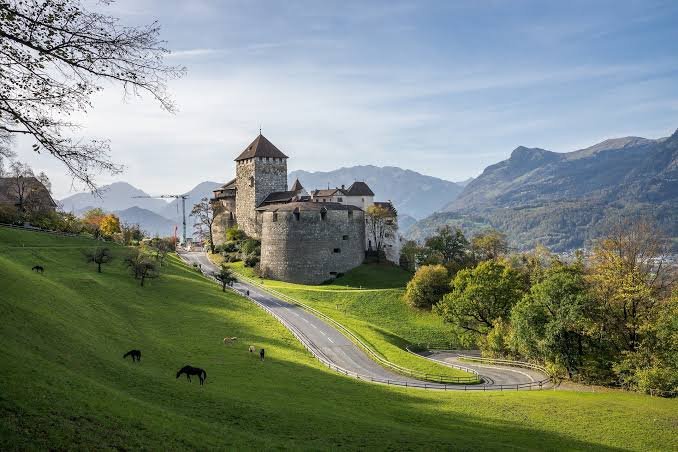
- Central European microstate: Liechtenstein is a small Alpine principality situated between Switzerland to the west and south and Austria to the north and east.
- Doubly landlocked: Both neighbouring countries are themselves landlocked, making Liechtenstein the only doubly landlocked country in Europe.
- Capital and size: Vaduz is the capital, and the country covers about 160 sq km, making it one of Europe’s smallest states.
- Transport implication: With no direct access to the sea, external connectivity depends heavily on road, rail and transport links through neighbouring states.
Physical Geography
- Alpine east: The eastern part is dominated by the Alps, producing steep terrain and limiting extensive settlement.
- Rhine Valley west: The western lowlands along the Rhine Valley contain much of the country’s population, transport infrastructure and economic activity.
- Highest point: Grauspitz (Grauspitze), about 2,599 metres high, is Liechtenstein’s highest point.
- Drainage: The Rhine River forms much of the western boundary with Switzerland, while the Samina drains parts of the mountainous interior.
Economic Profile
- Specialised manufacturing: Liechtenstein has a strong industrial base in machinery, precision instruments, dental equipment and advanced manufacturing, supporting high-value exports despite its small domestic market.
- Financial services: Banking and asset management form another major economic pillar, reinforcing its position as a specialised European financial centre.
- High-productivity economy: Limited land and population have encouraged concentration in technology-intensive, export-oriented and high-value sectors.
India–Liechtenstein Relations
- TEPA linkage: As a member of EFTA, Liechtenstein is covered by the India–EFTA TEPA, providing an institutional framework for deeper trade and investment engagement.
- Economic cooperation: Bilateral engagement can expand opportunities in specialised manufacturing, technology, innovation and financial services.
- Multilateral cooperation: Both sides have reaffirmed support for strengthening and reforming multilateral institutions, including the United Nations.
FAQs
Q1. Why is Liechtenstein called doubly landlocked?
Because it is landlocked and both its neighbours, Switzerland and Austria, are also landlocked.
Q2. What is the capital of Liechtenstein?
Vaduz.
Q3. Which river forms much of Liechtenstein’s western boundary?
The Rhine River.
Q4. What is Liechtenstein’s highest point?
Grauspitz (Grauspitze), about 2,599 metres high.
Q5. Why is Liechtenstein relevant to India?
It is an EFTA member and a partner in trade, investment, technology and multilateral cooperation.